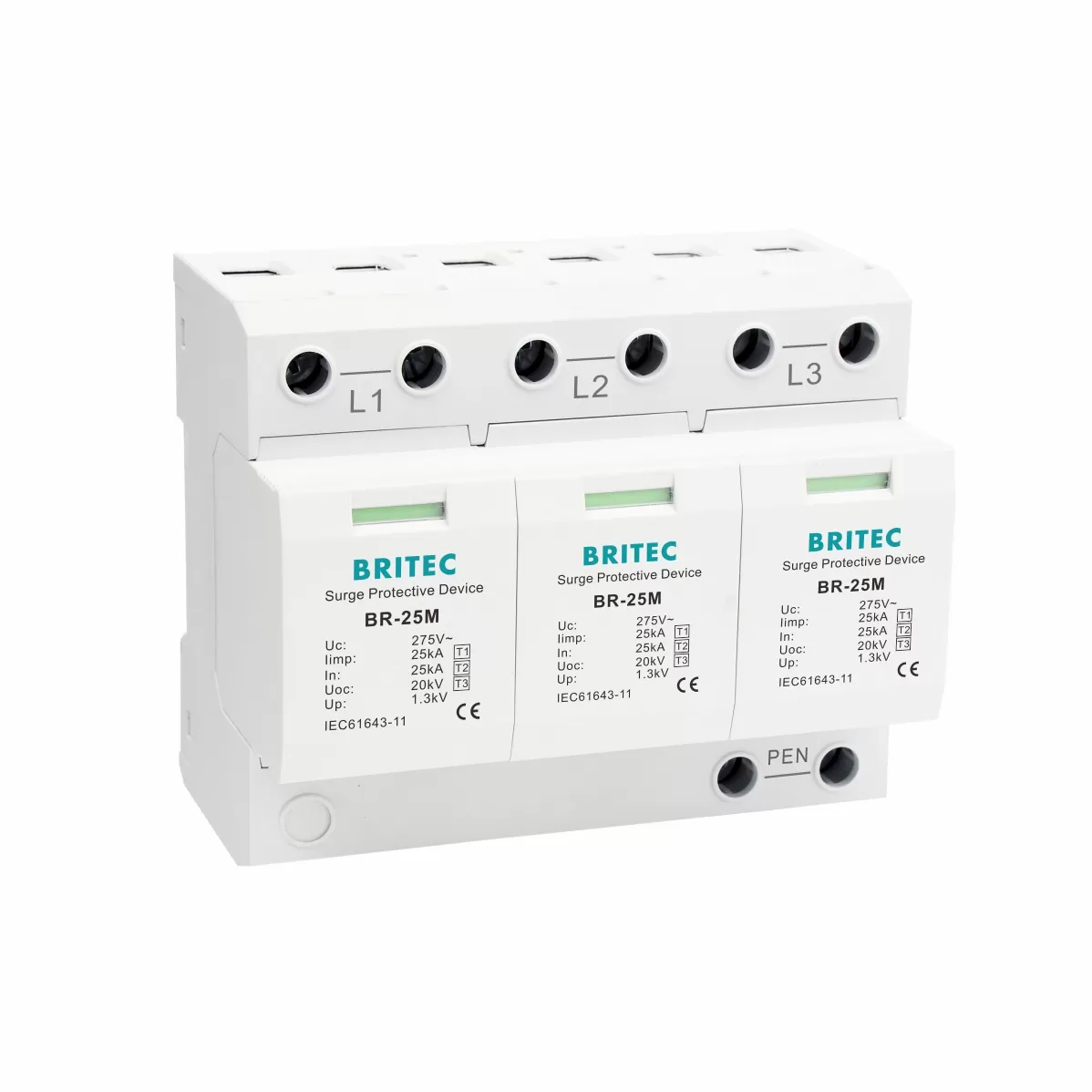

Britec Electric is a Wenzhou-based surge protective device manufacturer founded in 2003. Our products are built under an ISO 9001 quality system and carry TÜV, CE, and Intertek SEMKO approvals. This guide is written by our application engineering team to help panel builders, electrical consultants, and procurement managers specify the right electric SPD for electrical distribution board protection.
An electric SPD (surge protective device) is a component mounted inside or beside an electrical distribution board that clamps dangerous transient overvoltages to a safe level before they reach circuit breakers, energy meters, and connected equipment. In a low-voltage power system, the distribution board is the first place where incoming mains, feeders, and outgoing branch circuits meet — which also makes it the first place a surge tries to enter. Without an electric SPD at the board, a single lightning-induced or switching surge can arc across contacts, trip protection, and destroy the sensitive loads downstream.
Transient overvoltages arrive through two main paths. The first is indirect lightning: a strike several hundred metres away induces a high-energy pulse on the supply or earthing network that propagates into the building. The second is internal and grid switching: capacitor banks, large motors, and transformer tap changes generate fast, repetitive overvoltages on the same busbar your board feeds. Both are brief (microseconds) but can reach kilovolts, far above the insulation rating of modern electronics. In the IEC 62305 lightning-protection-zone model, the board typically sits at the LPZ0–LPZ1 boundary, so coordinated SPDs are the practical line of defence.
The cost of an unprotected distribution board is rarely the board itself. A surge that jumps the busbar can take out the building management system, HVAC controllers, elevator drives, and point-of-sale terminals fed from that board — downtime and replacement that dwarf the price of a certified electric SPD. For commercial and industrial sites, board-level surge protection is now treated as baseline electrical safety rather than an optional extra, and many insurers and auditors now ask for evidence of distribution board surge protection before they will cover equipment losses.
Standards such as IEC/EN 61643-11 divide AC surge protectors into three classes that map to different positions inside a building’s power architecture. A well-protected distribution system usually combines them in a cascade.
Type 1 (Class I) — installed at the service entrance to discharge direct or close lightning currents (10/350 µs). Needed when the building has an external air-termination system or a TT/TN-S earth with a measured lightning risk.
Type 2 (Class II) — the primary electric SPD for the main distribution board. It absorbs the residual surge current from Type 1 devices and the bulk of switching transients, limiting voltage to a level safe for the board and its branch circuits.
Type 3 (Class III) — fine protection placed at sub-distribution boards, socket outlets, or close to sensitive equipment (LPZ2–LPZ3). It handles only low-energy, already-attenuated surges and must always be backed by a Type 2 device.
● Service entrance — Type 1 + Type 2 combination.
● Main distribution board — Type 2 as the principal electric SPD.
● Sub-distribution board and outlets — Type 3 fine protection, cascaded after Type 2.
The three types are not interchangeable, and they must be coordinated rather than stacked at random. A Type 1 or Type 2 device at the incoming side reduces the surge energy; the Type 3 device downstream only has to clean up what remains. Correct coordination is what lets a low-voltage distribution board surge protection scheme survive repeated storms instead of failing on the first event, and it is the reason standards such as EN 62305 describe protection in zones rather than as a single box.
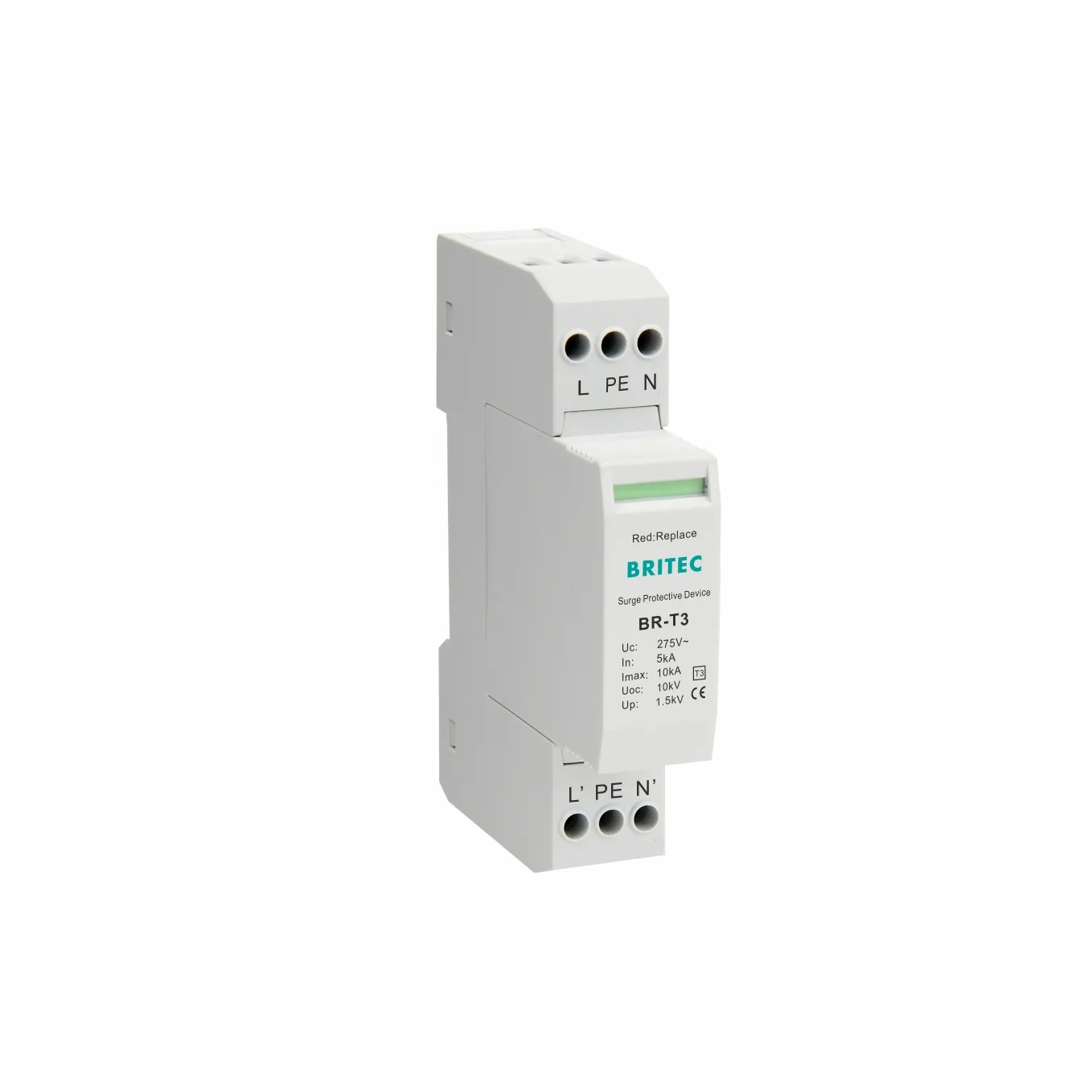
A BR-T3 Type 3 surge protector is a compact, rail-mounted example of the fine-protection stage shown below.
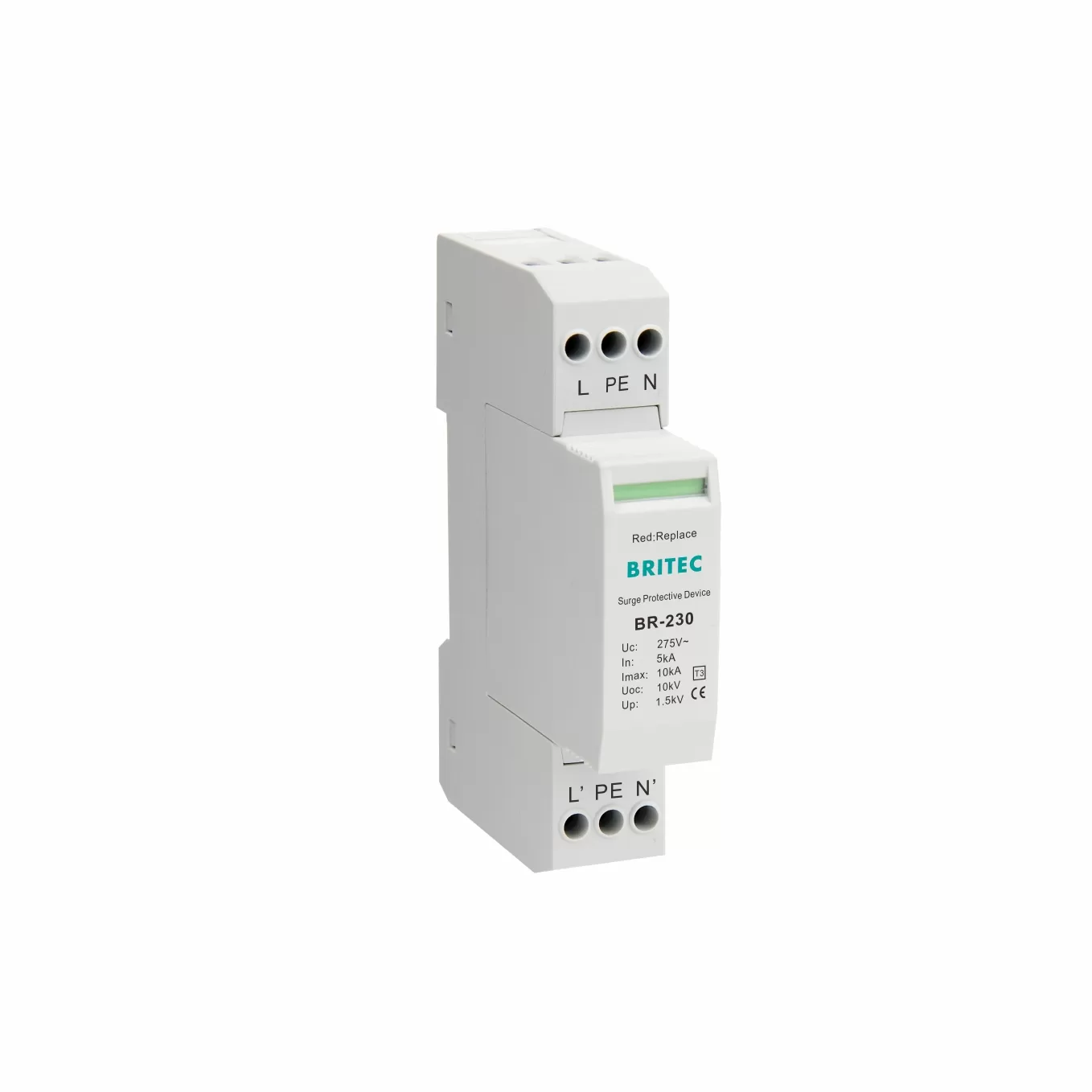
When you size an electric SPD for a board, these parameters decide whether protection is real or cosmetic:
● Maximum continuous operating voltage (Uc) — must exceed the system voltage with margin (for example 275 V or 320 V Uc for a 230/400 V TN-S board).
● Voltage protection level (Up) — the residual clamping voltage; lower is safer. Target ≤1.5 kV for boards feeding drives, PLCs, or servers.
● Nominal discharge current (In) and maximum (Imax) — 20 kA / 40 kA is typical for a Type 2 at the main board; Type 3 devices run 5–10 kA.
● Response time (tA) — nanosecond-level; quality Type 3 devices respond in ≤25 ns.
● Short-circuit withstand (Isccr) — the SPD must survive the board’s prospective fault current; pair it with a coordinated backup fuse or surge protective circuit breaker.
● Status indication and remote signalling — a green/red window plus optional remote alarm tells maintenance when the module is end-of-life.
● Environment — −40 °C to +80 °C operating range, UL94-V0 enclosure, IP20, 35 mm DIN-rail mount.
Protect Your Distribution Board With a Certified Electric SPD
Our engineering team helps you size the right Type 1 / 2 / 3 combination for your board, voltage system, and lightning zone. Get a tailored proposal with datasheets and lead times.
Request a Free SPD Consultation
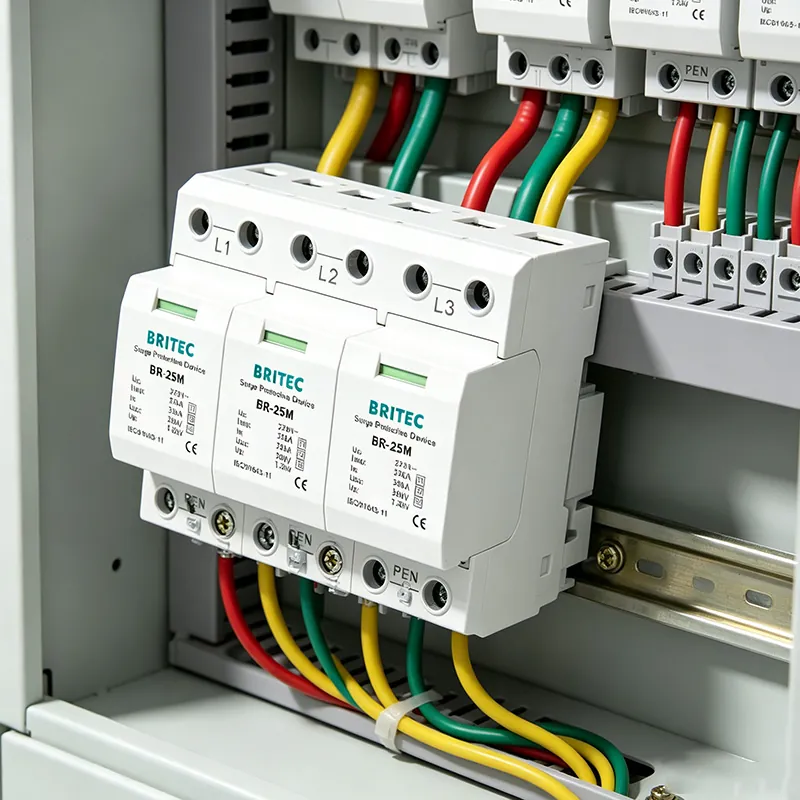
Most board-mounted SPDs use a 35 mm DIN-rail foot and a plug-in module, so they drop into the same rail as the miniature circuit breakers. For effective protection:
● Mount the Type 2 electric SPD as close as possible to the board’s main incomer, upstream of the loads you want to protect.
● Keep the L–N–PE connection leads as short and straight as possible; long leads raise the effective Up.
● Provide a dedicated surge protective earth (SPE) and a coordinated backup device (gG fuse or dedicated SCB).
● Where the board feeds sensitive rooms, add a Type 3 device at the sub-board or outlet level.
Two details decide whether the installation actually works. First, the backup protective device must be coordinated to the SPD’s short-circuit rating — a dedicated surge protective circuit breaker (SCB) is preferred over a generic fuse because it discriminates between a surge and a fault. Second, the surge protective earth must be low-impedance and bonded to the board’s main earth bar; a long or shared protective conductor undermines the whole DIN rail SPD layout and lets the clamped energy return through sensitive equipment instead of the earth.
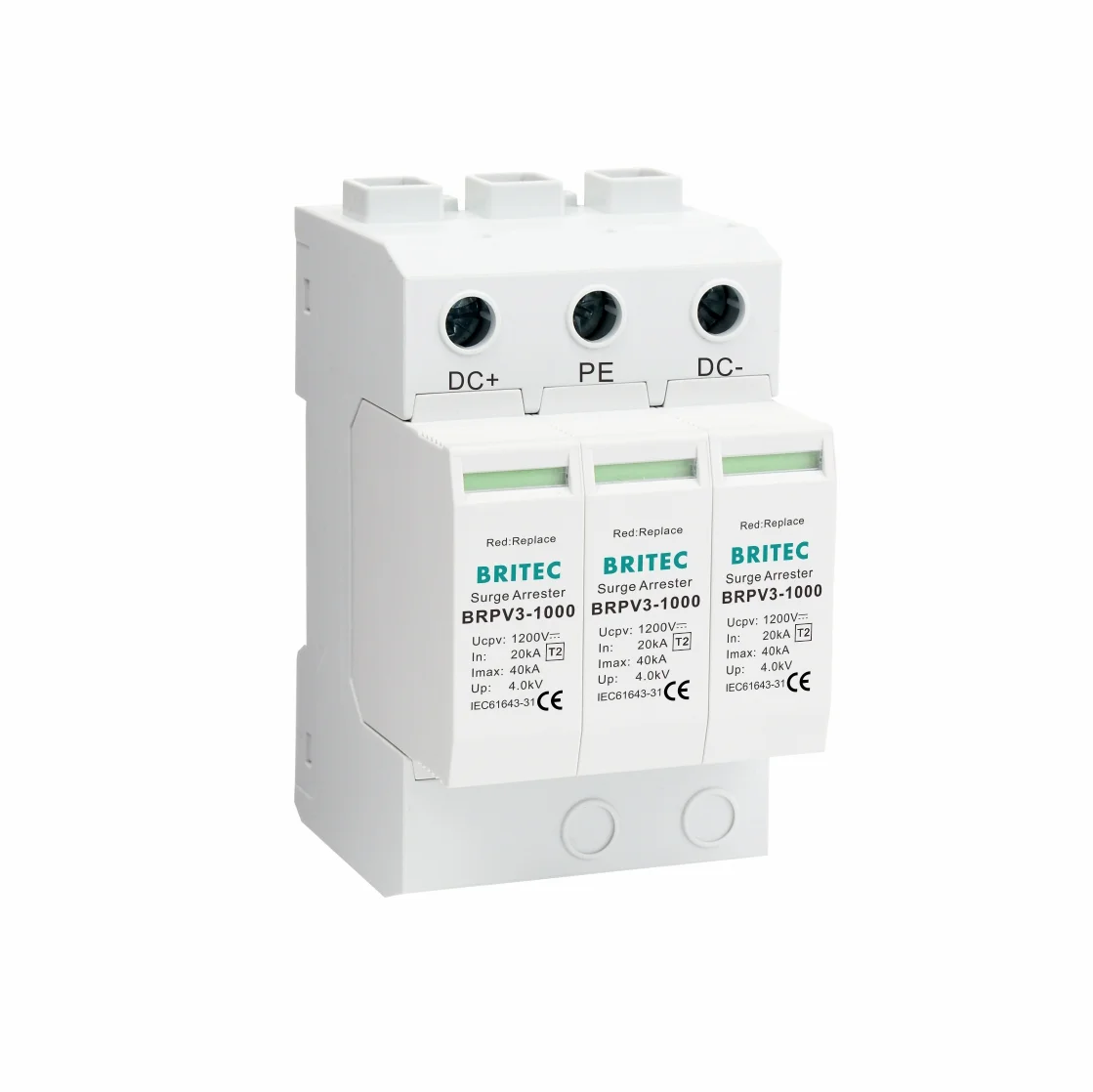
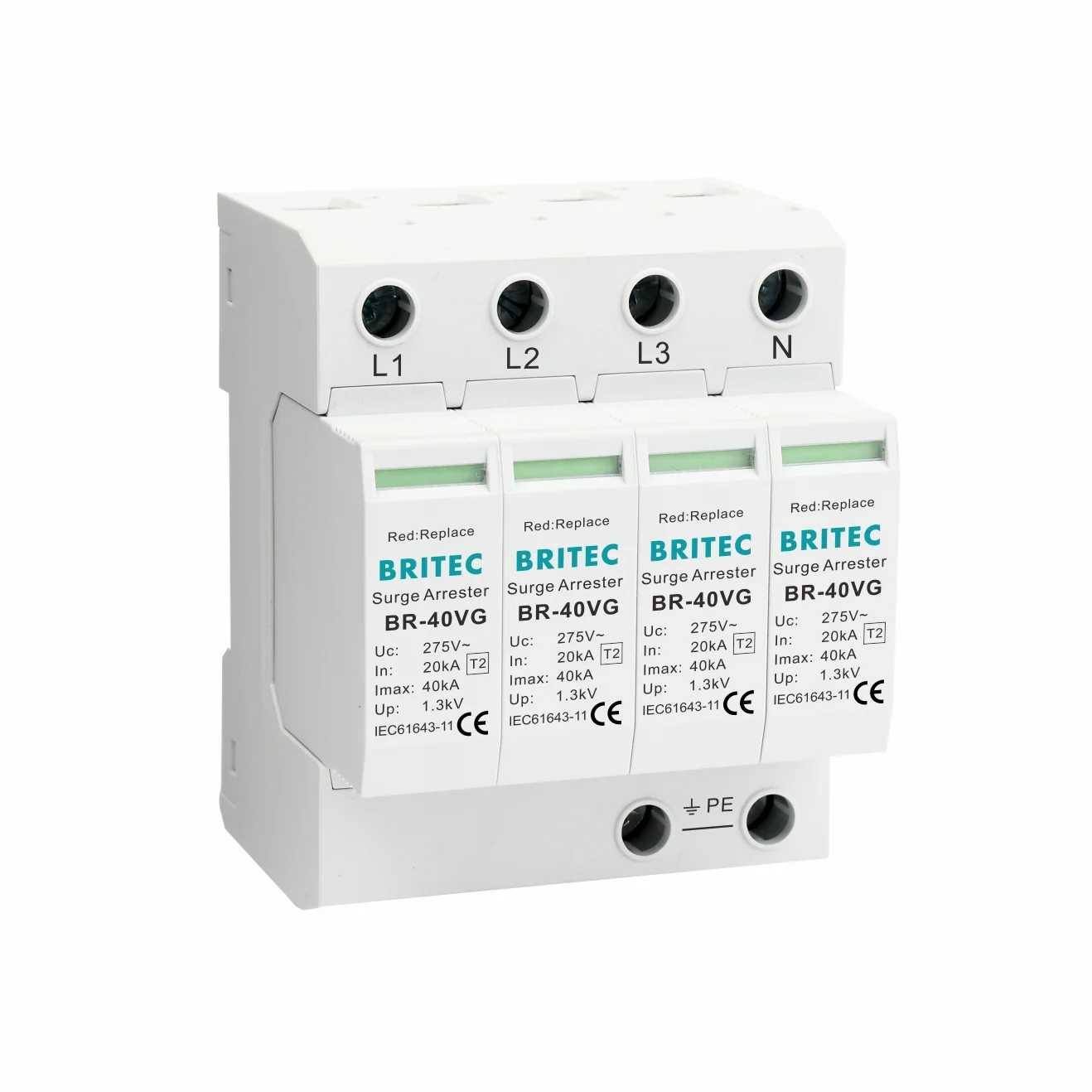
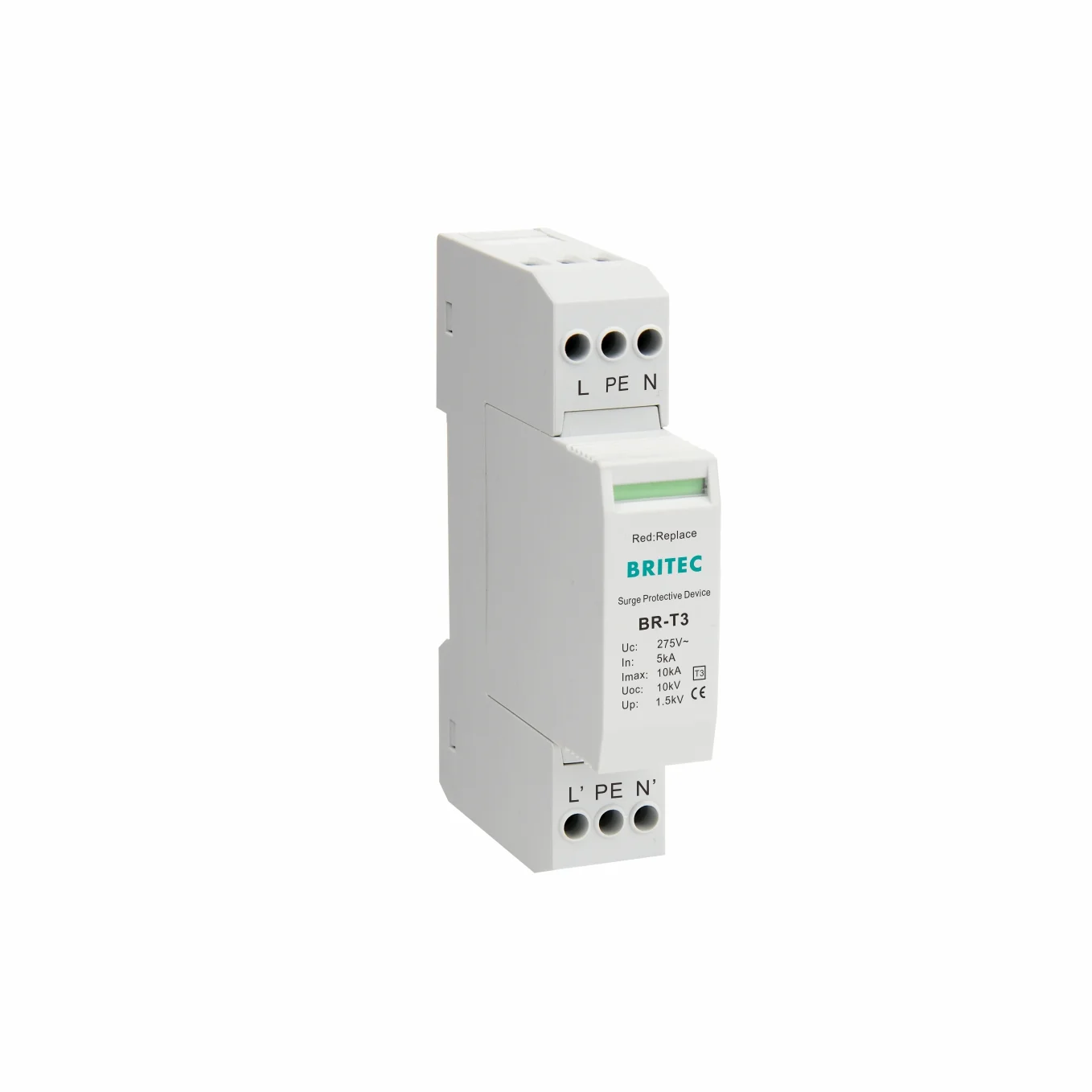
Products such as the BR-40VG Type 2 surge protective device and the BR-T3 Type 3 surge protector are designed for exactly this rail-mounted, cascaded layout.
Match the device to the system and the board’s position in the cascade:
● Single-phase boards (230 V) — 1P+N or 2P Type 2; three-phase boards (400 V) — 3P or 4P Type 2.
● TN-C, TN-S, and TT earthing — confirm pole count and the need for a 1+1 (N-PE) stage in TT/TN-S.
● Main board gets Type 2; sub-boards and socket circuits get Type 3 fine protection behind it.
Also confirm the lightning protection zone (LPZ) of the board. A main board at the LPZ0–LPZ1 boundary sees the largest surges and needs the highest In/Imax, while a sub-board deep inside the building (LPZ2–LPZ3) only needs a modest Type 3 stage. Matching the SPD for electrical panel position to its LPZ is the simplest way to avoid both under- and over-specification, and it keeps the bill of materials lean for large projects with hundreds of boards.
The table below summarises three Britec devices commonly specified for distribution-board duty:
| Product | Type / Class | Uc | In / Imax | Up | Typical use |
|---|---|---|---|---|---|
| BR-40VG 4P | Type 2 / Class II | 150–440 V selectable | 20 kA / 40 kA | ≤1.3–2.0 kV | 3-phase main distribution board |
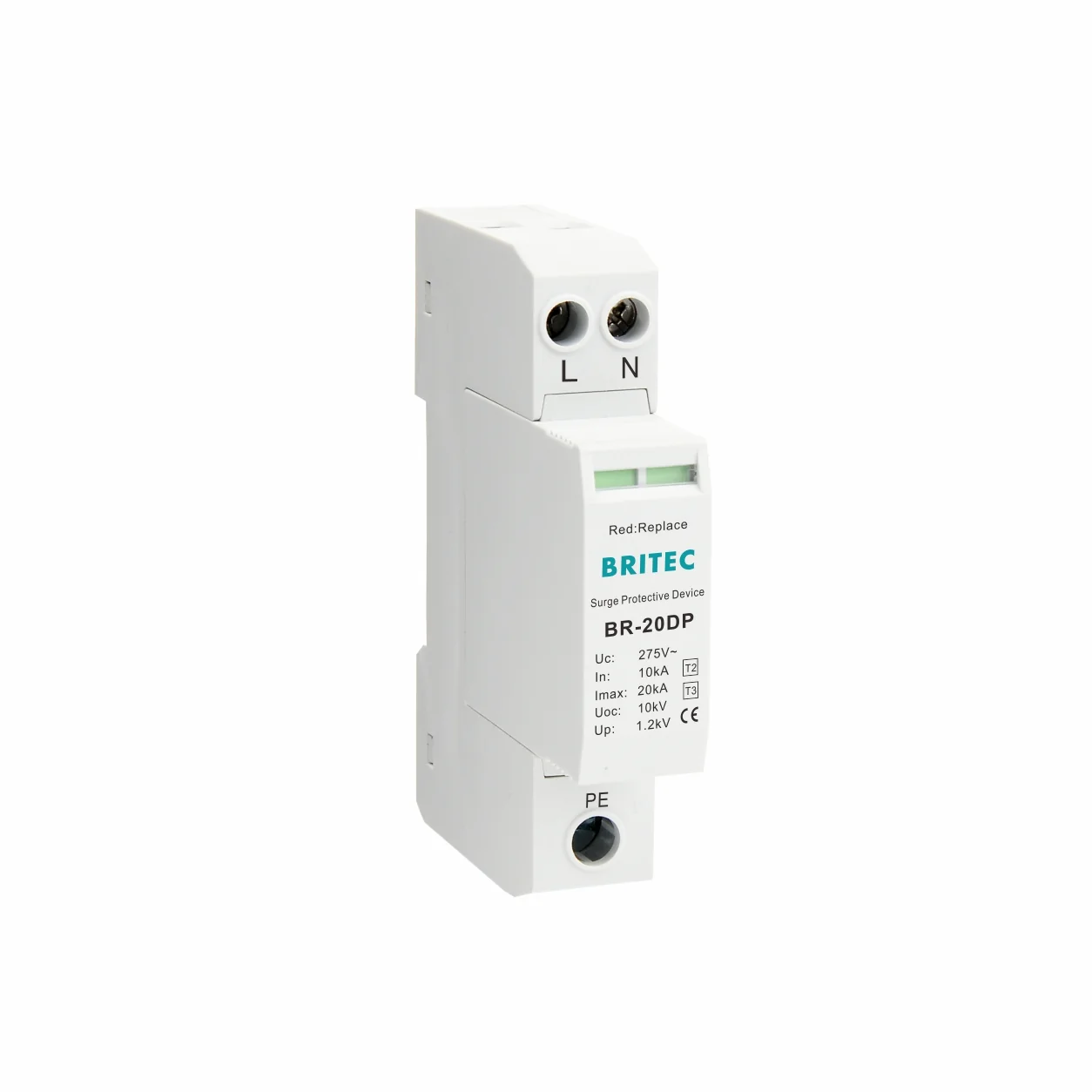
| BR-20DP 2P | Type 3 / Class III | 275 V / 320 V | 10 kA / 20 kA | ≤1200 V | sub-board / outlet fine protection |
| BR-T3 | Type 3 / Class III | 24–230 V | 5 kA | ≤630–1500 V | LPZ2–LPZ3, near equipment |
For panel builders and specifiers, certification is not paperwork — it is proof the electric SPD will perform when a surge hits. Britec devices are tested to IEC/EN 61643-11 for AC systems, supported by EN 62305 lightning-protection coordination, and manufactured under ISO 9001 with TÜV, CE, and Intertek SEMKO marks. Choosing certified, documented SPDs protects your warranty position and simplifies third-party inspection on international projects. For projects destined for North America, our Type 1+2 and Type 2 devices are also evaluated against UL 1449, so the same electric SPD platform can serve both IEC and ANSI/CNS specifications. You can review the full Type 2 surge protective devices range or the Type 3 surge protectors range for complete specifications.
Need a Datasheet and Quotation for Your Board?
Send us your system voltage, earthing type, and board layout. We return a coordinated SPD scheme with IEC 61643-11 declarations and volume pricing.
Request Datasheet & Quote
● Installing only a Type 3 device without an upstream Type 2 — Type 3 cannot survive the energy of a board-level surge.
● Choosing Uc below the system voltage — the SPD ages prematurely or fails.
● Accepting an Up too high for the load — sensitive drives and controllers still get damaged.
● Skipping backup coordination — an SPD without a proper disconnector can become a fault source.
● No status indication — a silently failed module gives a false sense of safety.
What type of electric SPD is required at the main distribution board?
A Type 2 (Class II) device is the standard primary protection for a main distribution board, because it absorbs the bulk of switching and residual lightning energy. If the building has an external lightning-protection system, add a Type 1 device at the service entrance so the Type 2 only sees the attenuated surge.
Can a Type 3 SPD be used alone without a Type 2?
No. A Type 3 device is rated for only the low-energy surges that remain after a Type 2 stage. Used alone at a board that can see full transients, it will be destroyed on the first real surge. Always cascade Type 3 behind Type 2.
How do I choose Uc for a 230/400 V system?
Select a continuous operating voltage above the highest normal phase voltage. For a 230/400 V TN-S or TT system, a 275 V or 320 V Uc is common; three-phase boards with 400 V line-to-line often use 385 V or 440 V Uc modules.
Do electric SPDs need a separate disconnector or backup fuse?
Yes. The SPD must be protected by a backup device coordinated to its short-circuit withstand (Isccr) — typically a gG fuse or a dedicated surge protective circuit breaker (SCB). This prevents the SPD from becoming a persistent fault if its varistor fails short.
How long does a distribution-board SPD last?
Lifespan depends on surge exposure, not just calendar time. A green/red indicator window shows end-of-life, and an optional remote-signalling contact can raise an alarm. In high-lightning regions, modules may need replacement every few years; in benign grids they can last a decade or more.
Can I mount an electric SPD on a standard DIN rail?
Yes. Britec board-mount SPDs use a 35 mm DIN-rail foot with plug-in modules, so they fit directly alongside the circuit breakers in the same enclosure, keeping lead lengths short and Up low.
Are Britec SPDs certified for international projects?
Our AC SPDs are tested to IEC/EN 61643-11 and supported by ISO 9001 manufacturing with TÜV, CE, and Intertek SEMKO marks, which are recognised across Europe, Asia, the Middle East, and many other markets. Declaration of conformity and test reports are available on request.
● Why Every Modern Electrical Panel Needs an Electric SPD
● What Is a Type 2 Surge Protection Device?
● How to Install Type 2 Surge Protector (Step-by-Step Guide with Diagrams)
● Surge Protection Coordination: How To Cascade Type 1, 2, and 3 SPDs
● How To Select Appropriate kA Rating For AC Surge Protection Device
● Overvoltage Protection in Low Voltage Distribution System
Get a Tailored Surge Protection Proposal
Tell us about your distribution board — voltage, earthing system, and load profile — and our engineers will recommend a certified electric SPD scheme with full documentation.
Contact Britec Electric