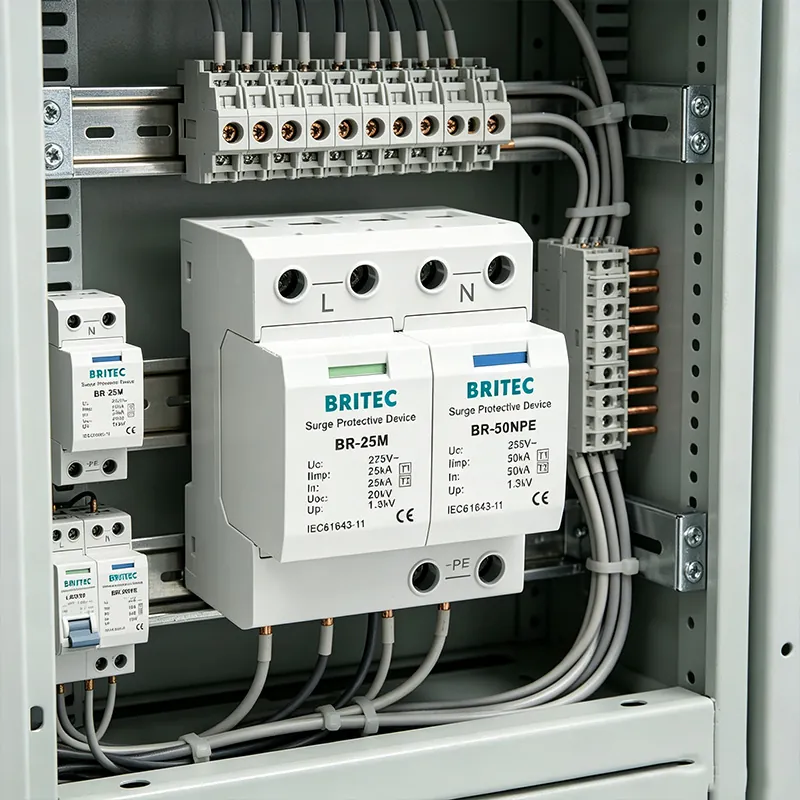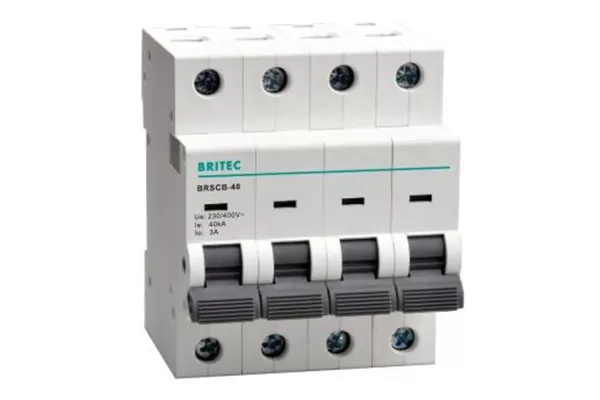

Choosing a surge protective device (SPD) for a solar array starts long before the lightning impulse ratings. The single parameter that decides whether a PV SPD survives its daily duty cycle is the maximum continuous operating voltage — called Uc on the AC side and Ucpv on the DC side. At Britec Electric our engineering team has manufactured IEC / EN 61643-31 compliant PV surge protection devices in Wenzhou, Zhejiang since 2003, with ISO 9001, TÜV, CE and Intertek SEMKO certifications. This guide explains what Uc / Ucpv means for PV SPDs, the IEC 61643-31 sizing rule, the temperature effect that catches most designers out, and how to match Britec products to 600V, 1000V and 1500V systems.
Maximum continuous operating voltage (Uc) is the highest AC rms voltage an SPD can withstand indefinitely without degradation. For DC photovoltaic applications the equivalent rating is Ucpv — the maximum continuous operating DC voltage — defined in IEC 61643-31, the product standard for SPDs connected to photovoltaic installations. The two symbols describe the same design intent: the SPD must stay stable while the protected circuit is energised at its normal, non-surge voltage, day after day, across the full site temperature range.
For an AC SPD, Uc is stated in volts rms (for example 275V or 320V). For a PV surge protection device the figure is a DC value such as 600V, 1200V or 1500V. If the applied voltage ever exceeds Ucpv for a sustained period, the metal-oxide varistor ages prematurely, leakage current climbs, and the protector can enter thermal runaway — exactly the failure mode you install an SPD to avoid.
A PV string does not sit at a fixed voltage. Its open-circuit voltage (Voc) is set by the module count and shifts with temperature: it rises as the array gets colder and falls as it gets hotter. Because the SPD is connected in parallel across the DC bus and energised whenever the sun is up, Ucpv is a true continuous-duty limit, not a one-second impulse rating. Three consequences follow for specifiers:
● A PV SPD sees its maximum voltage at the coldest hour of the year, not at standard test conditions, so the sizing voltage must use the low-temperature Voc.
● Ucpv is independent of the surge current rating (In, Imax) and the clamping level (Up); a high In rating does not compensate for an under-sized Ucpv.
● Undersizing Ucpv to save a few cents typically trades a 20-year service life for a failure inside the first winter on a cold site.
IEC 61643-31, together with the PV array design standard IEC 62548, requires the SPD’s Ucpv to be equal to or greater than the maximum open-circuit voltage the PV source circuit can present at the lowest expected ambient temperature. In formula form, using the module temperature coefficient of Voc (β):
Voc(Tmin) = Voc,STC × [1 + β × (Tmin − 25)]
where Voc,STC is the string open-circuit voltage at 25°C, β is the negative temperature coefficient (commonly around −0.30 %/°C to −0.35 %/°C), and Tmin is the lowest array temperature expected on site. Because β is negative, a lower Tmin makes the bracket larger, so Voc rises in the cold — and that cold-weather peak is the number Ucpv must beat.
For a fast, conservative check many designers apply a 1.2 × margin to the standard-test-condition Voc (Ucpv ≥ 1.2 × Voc,STC). This shortcut rarely under-sizes a string built from mainstream modules, but on very cold sites or with long series strings the temperature-corrected calculation above is the one that keeps the SPD inside its continuous rating.
Take a 1000V-class string with Voc,STC = 720V at 25°C, β = −0.32 %/°C, on a site where the array can reach −20°C. The cold-weather open-circuit voltage is Voc(−20) = 720 × [1 + (−0.0032) × (−45)] = 720 × 1.144 = 824V. The 1.2 × shortcut gives 1.2 × 720 = 864V. Either way the SPD needs Ucpv comfortably above ~824–864V, so a 1000V-class device rated at Ucpv 1200V is the correct choice.
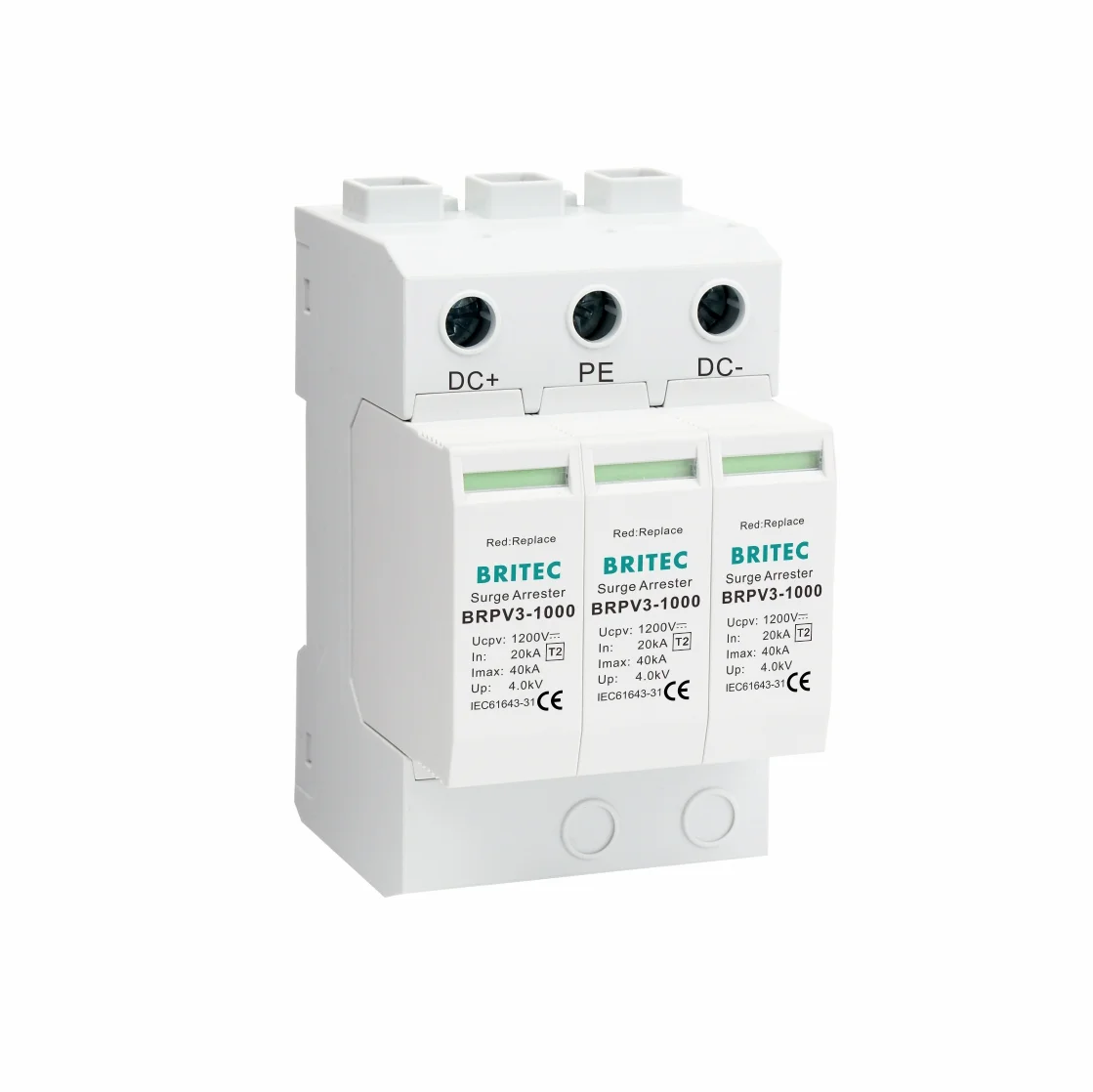
그만큼 BRPV3-1000 Type 2 PV surge arrester is built for exactly this duty: Ucpv 1200V, In 20kA (8/20 µs), Imax 40kA, Up ≤ 4.0kV, response time ≤ 25ns, −40°C to +80°C, 35mm DIN rail, UL94 V-0, IP20, with a green/red status window and plug-in modules for fast field replacement. Full options are listed on the PV Surge Protector Type 2 product pages.
| PV system voltage | Typical string open-circuit (Voc) | Recommended Ucpv | Britec PV SPD |
|---|---|---|---|
| Up to 600V | ≤ 600V | 600V | BRPV2-600 (Type 2) |
| Up to 1000V | ≤ 1000V | 1200V | BRPV3-1000 / BRPV3-1000-20 (Type 2 / T1+T2) |
| Up to 1500V | ≤ 1500V | 1500V | BRPV3-1500-12.5 (T1+T2) |
These pairings follow the IEC 61643-31 rule that Ucpv must exceed the cold-weather string Voc. If you want the full selection method mapped to your inverter, our guide on how to select a solar SPD by inverter specifications walks through the rest of the ratings (In, Imax, Up and type).
● Using an AC Uc rating on a DC array — an AC rms figure is not comparable to a DC Ucpv and will under-protect the bus.
● Sizing from Voc,STC only and ignoring the temperature coefficient, which is the usual cause of winter failures on cold sites.
● Confusing per-module voltage with series string voltage — Ucpv must cover the whole series string, not one panel.
● Choosing Ucpv too close to the operating voltage to cut cost, leaving no margin for tolerance and component aging.
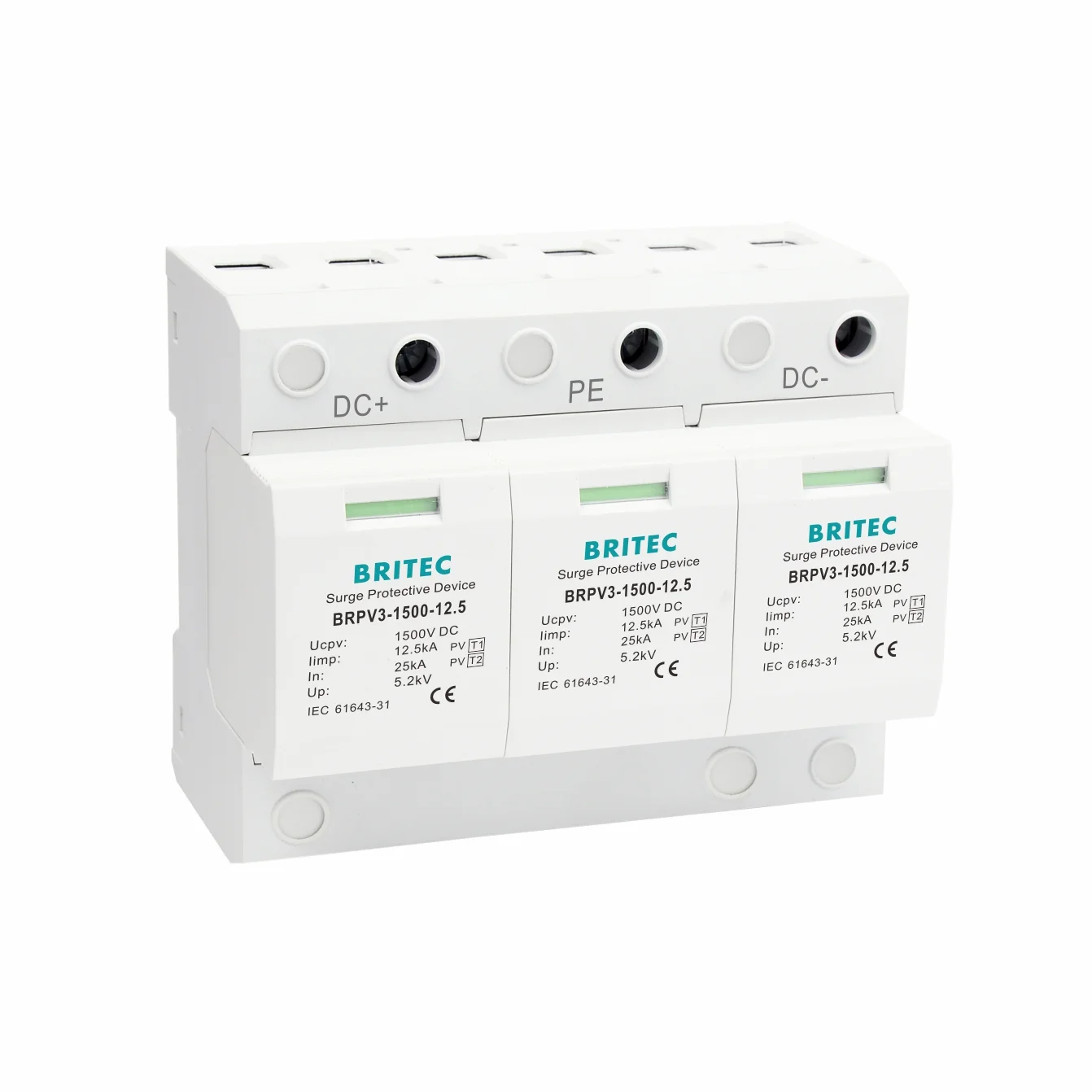
그만큼 BRPV3-1500-12.5 1500V T1+T2 PV surge arrester covers 1500V systems with Ucpv 1500V, 12.5kA nominal discharge, and combined Type 1+2 protection for sites with an external lightning protection system. For 1000V arrays that need combined protection, the BRPV3-1000-20 Type 1+2 PV surge arrester offers Ucpv 1200V and 20kA nominal in a plug-in module. All three families share the same DIN-rail footprint, green/red fault window, and built-in over-current and over-heat open-circuit technology.
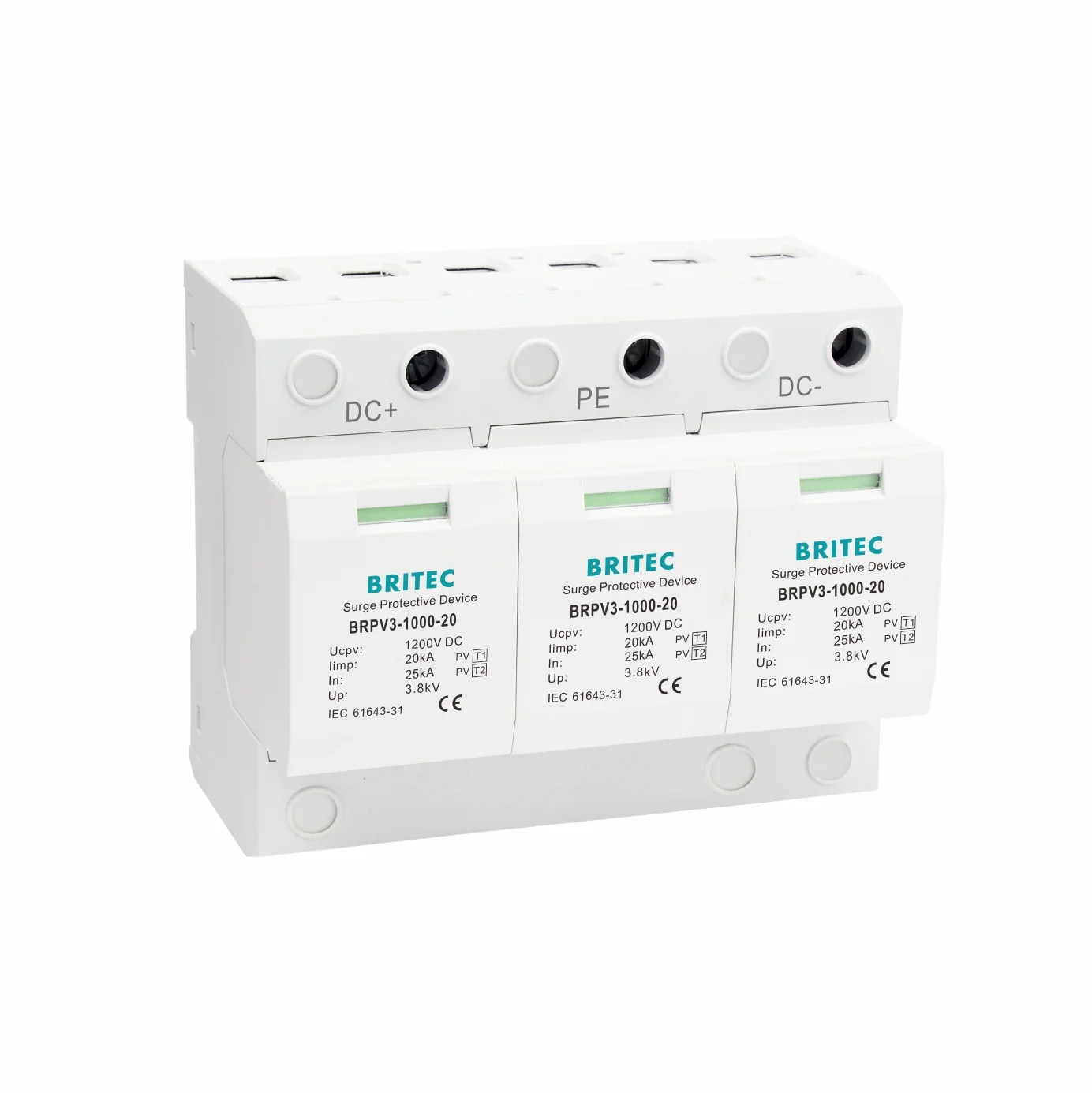
For 600V PV systems the BRPV2-600 Type 2 device provides Ucpv 600V in a compact two-module body. Across the range, Britec PV SPDs are tested in our in-house laboratory (100kA 10/350µs lightning impulse generator, 25kA 10/350µs generator and 120kA 8/20µs generator) so the Ucpv and impulse ratings you specify are the ratings shipped.
What is the difference between Uc and Ucpv for a PV SPD?
Uc is the continuous AC rms voltage rating used for AC SPDs (IEC 61643-11). Ucpv is the equivalent continuous DC voltage rating for photovoltaic SPDs (IEC 61643-31). They express the same idea — the highest voltage the protector can carry continuously — but Ucpv is a DC value sized to the PV string’s cold-weather open-circuit voltage.
How do I calculate the required Uc (Ucpv) for my PV system?
Use Voc(Tmin) = Voc,STC × [1 + β × (Tmin − 25)], then choose Ucpv ≥ that value. As a quick check, Ucpv ≥ 1.2 × Voc,STC is a conservative default, but the temperature-corrected figure is required on cold sites or with long series strings.
Can I use an AC SPD Uc rating on a DC PV array?
No. An AC rms Uc is not equivalent to a DC Ucpv, and an AC-rated protector is not certified to IEC 61643-31 for PV duty. Always select a PV SPD whose Ucpv is stated for DC and matched to your string voltage.
Why does cold weather increase the required Ucpv?
A crystalline PV module’s open-circuit voltage rises as temperature falls (negative β). The lowest site temperature produces the highest Voc, so Ucpv must cover that cold-weather peak, not the 25°C nameplate value.
What Ucpv do I need for a 1500V PV system?
A 1500V-class array needs a PV SPD with Ucpv 1500V, such as the BRPV3-1500-12.5 (T1+T2, 12.5kA). Verify against the cold-weather Voc of your specific string before finalising the order.
Does a higher Ucpv reduce surge protection performance?
No. Ucpv sets only the continuous-voltage withstand; it is largely independent of the clamping voltage Up. A correctly sized higher Ucpv does not weaken protection as long as Up and In / Imax still meet the inverter’s impulse withstand and the site’s lightning level.
● Maximum Continuous Operating Voltage (Uc) of an SPD Explained — the AC-side definition and how Uc differs from Ucpv.
● How To Select Solar SPD According To PV Inverter Specifications — map In, Imax, Up and type to your inverter nameplate.
● Where to Install a Solar SPD in a PV Combiner Box — placement for lowest let-through voltage.
● How Solar SPD Protects Photovoltaic Systems From Lightning Damage — the failure modes SPDs prevent.
● Type 1 vs 1+2 vs 2 vs 3 DC SPD: Which To Choose — pick the right SPD type for your PV site.
● 1500V vs 1000V DC SPD: Should You Upgrade — system-voltage trade-offs for new arrays.