
Reviewed by the Britec Electric engineering team. Britec Electric, based in Wenzhou, Zhejiang, China, has manufactured surge protective devices (SPDs) since 2003. Our products are tested and certified to IEC/EN 61643-11 by TUV, CE and Intertek SEMKO. Drawing on that field experience, this guide explains why a 10kA SPD loses part of its rated performance as its operating temperature climbs — and what specifiers and installers should do about it.
When a manufacturer labels a device a 10kA SPD, the number refers to its nominal discharge current, written In, measured with the 8/20 µs current waveform defined in IEC/EN 61643-11. In is the surge current the SPD can absorb repeatedly — typically a sequence of standardized 8/20 µs strikes — without failing. It is a laboratory rating established at reference test conditions, normally around 25 °C and standard humidity.
Do not confuse In with Imax. On our BR-20DP 2P 20kA Type 3 SPD, In is 10 kA while Imax is 20 kA. Imax is the absolute maximum current for a single event; In is the repeated-duty rating that protects your equipment day after day. Both numbers are valid only at the reference temperature under which they were tested.
For a buyer, the practical question is not whether the datasheet says 10 kA. It is whether that 10 kA survives the real temperature inside your enclosure. The answer, from both component physics and field returns, is that it does not — not fully, and not forever.
Planning a surge protection layout for a hot or enclosed environment? Our engineers will review your panel temperature profile and recommend the right 10kA-class SPD for the job.
Talk to a Britec engineer
Almost every low-voltage SPD is built around a metal-oxide varistor (MOV). An MOV is a voltage-dependent resistor: below its clamping threshold it passes almost no current, and above that threshold it conducts strongly to divert a surge to ground. The critical detail is that the varistor voltage has a negative temperature coefficient.
As the MOV junction temperature rises, its varistor voltage drops. The device therefore begins to conduct at a lower system voltage than it did when cold. Two things follow. First, the leakage (or climbing) current that always flows across the MOV increases. Second, that extra leakage current generates additional self-heating, which drops the varistor voltage further, which increases leakage again. This is a positive feedback loop.
At the extreme, the loop runs away: the MOV heats faster than it can dissipate, its clamping voltage collapses, and a thermal disconnector must trip to remove it from the circuit. Britec Type 3 devices use a built-in thermal disconnection tripping device with a green/red status window for exactly this reason. The red window is the proof that the device sacrificed itself rather than let the fault persist.
Even short of thermal runaway, repeated heat cycling ages the varistor. Each hot day slightly lowers its surge capacity and slightly raises its leakage floor. So high operating temperature derates a 10kA SPD in two ways at once: it reduces the instantaneous surge current the device can still absorb, and it shortens the cumulative service life before end-of-life.
The exact derating curve is specific to each varistor design and is published in the product datasheet. The table below is representative guidance for a 10kA-class MOV SPD rated to an operating range of −40 °C to +80 °C, and it shows the direction and rough magnitude of the effect. Treat it as a planning aid, not a substitute for the datasheet.
| Operating temperature | Relative surge capability (illustrative) | Design note |
|---|---|---|
| −25 °C | ~105% | Cold improves clamping margin |
| 25 °C (reference) | 100% (In = 10 kA) | Datasheet rating applies |
| 40 °C | ~95% | Typical ventilated indoor panel |
| 55 °C | ~85% | Begin ventilation review |
| 70 °C | ~70% | Upsize or actively cool |
| 80 °C (rated max) | ~60% | At limit; avoid sustained operation |
The takeaway is simple: a 10kA SPD installed where it regularly runs hot may behave closer to a 7 kA or 6 kA device in real surge events, and it will reach end-of-life sooner than the same unit in a cool panel.
IEC/EN 61643-11 proves that a device meets its In and Imax at reference conditions. That certification is real and valuable — it is why Britec units carry TUV, CE and Intertek SEMKO marks. But the standard does not de-rate the rating for a 60 °C enclosure or a sealed tropical cabinet. The test simply does not model your site.
That gap is where under-protection hides. A specifier reads 10 kA on the label, assumes 10 kA in the field, and never asks what the enclosure temperature actually is. When the next surge arrives on a hot afternoon, the MOV is already partly derated and the protected equipment pays the difference.
Temperature derating is not a uniform risk. It concentrates in a few installation patterns, and most of them are common in commercial and industrial B2B projects:
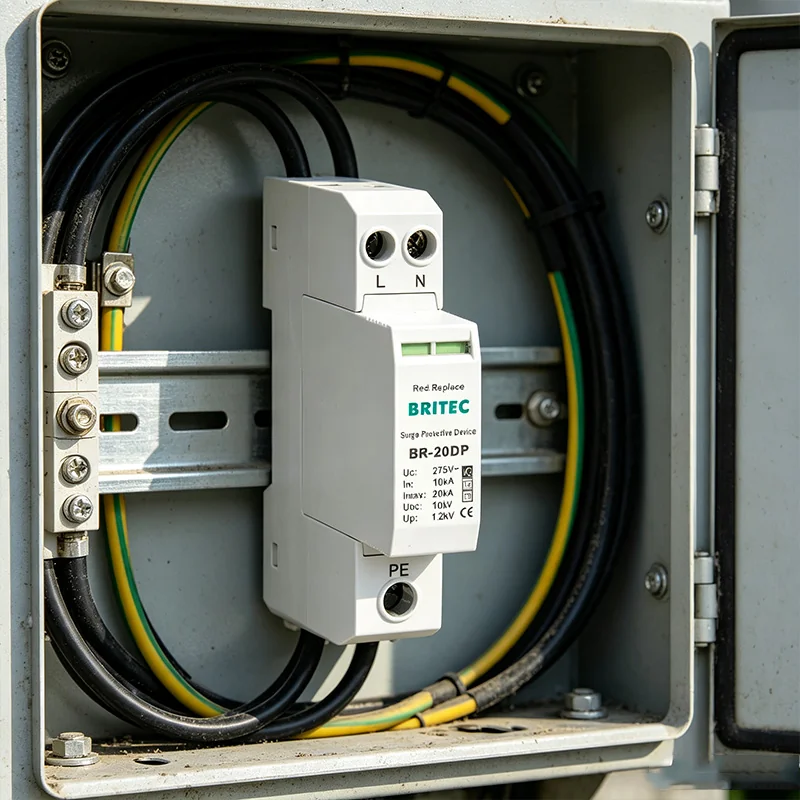
● Sealed distribution enclosures with little or no ventilation, where heat from breakers and the SPD itself accumulates.
● SPDs mounted adjacent to inverters, variable-frequency drives, transformers or motor control centers that radiate heat continuously.
● Tropical, desert or unshaded rooftop sites where ambient air regularly reaches 45 °C to 55 °C.
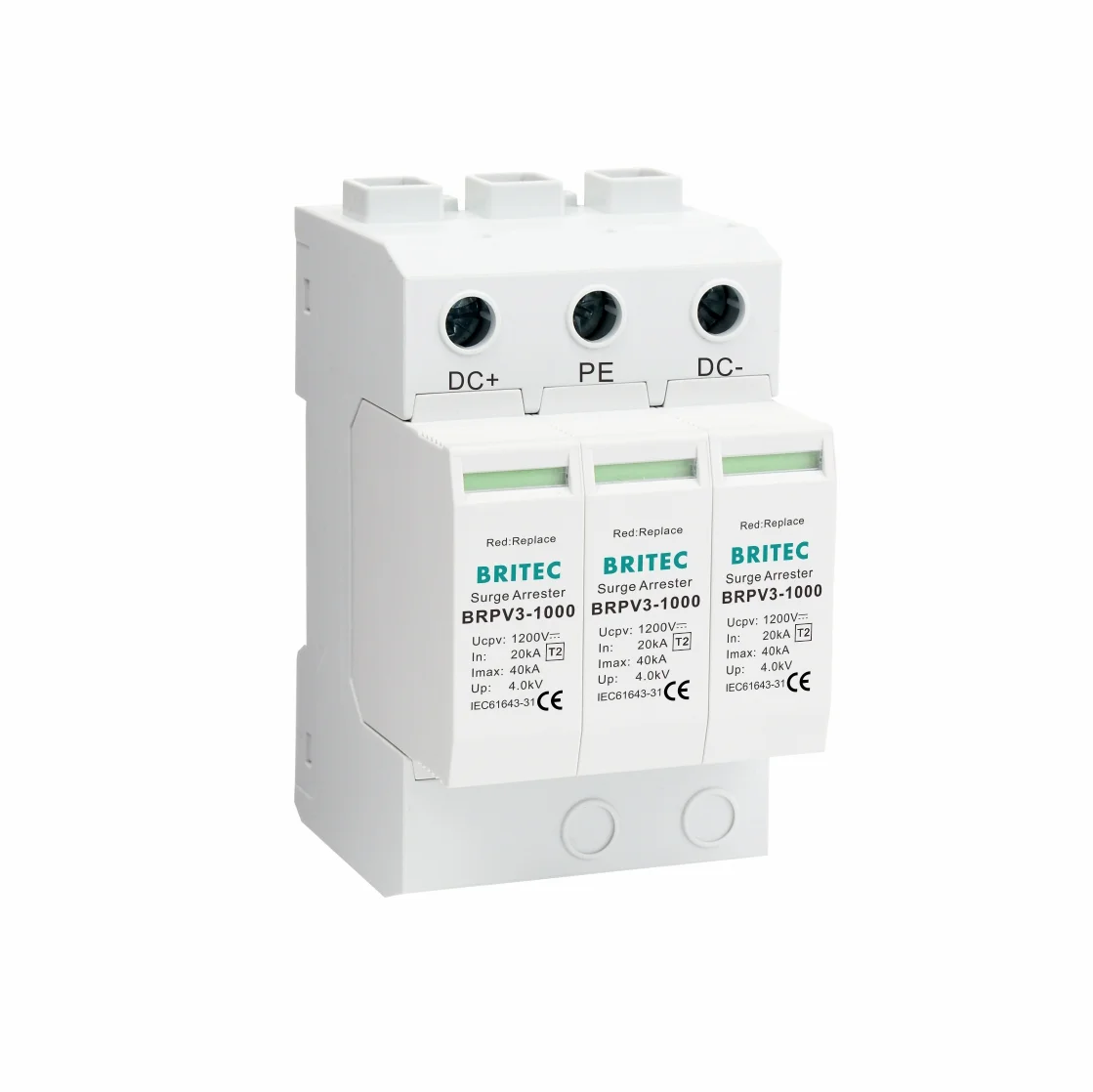
● PV combiner boxes and solar DC cabinets exposed to direct sun, where internal temperature spikes track the panel temperature.
These are exactly the environments where, as discussed in our guide to 10kA SPDs for branch circuits, the 10kA class is most often specified — which makes temperature awareness doubly important.
The good news is that derating is predictable and manageable. Follow these steps when selecting or reviewing a 10kA-class SPD:
● Measure the enclosure worst-case operating temperature, not the room temperature. Solar gain and internal loads can add 20 °C or more.
● Compare that site maximum against the SPD rated operating range. Britec Type 3 units are rated −40 °C to +80 °C; sustained operation near +80 °C leaves little margin.
● If the site runs hot, upsize deliberately: choose a higher In and Imax, or a device rated for a wider temperature range, so the derated value still clears your required protection level.
● Provide ventilation or spacing headroom; never bury the SPD in an unvented box directly beside a heat source.
● Specify devices with a visible green/red status window and, for critical circuits, optional remote signalling so condition can be monitored without opening the panel.
● Build thermal and visual inspection into maintenance, and replace any unit showing a red fault window or elevated leakage.
Not sure what temperature your panels actually reach, or which kA rating to specify? Send us your enclosure drawing and site conditions and we will size the SPD correctly.
Request a specification review
Britec offers 10kA-class devices engineered for the operating envelopes above. Two representative options:
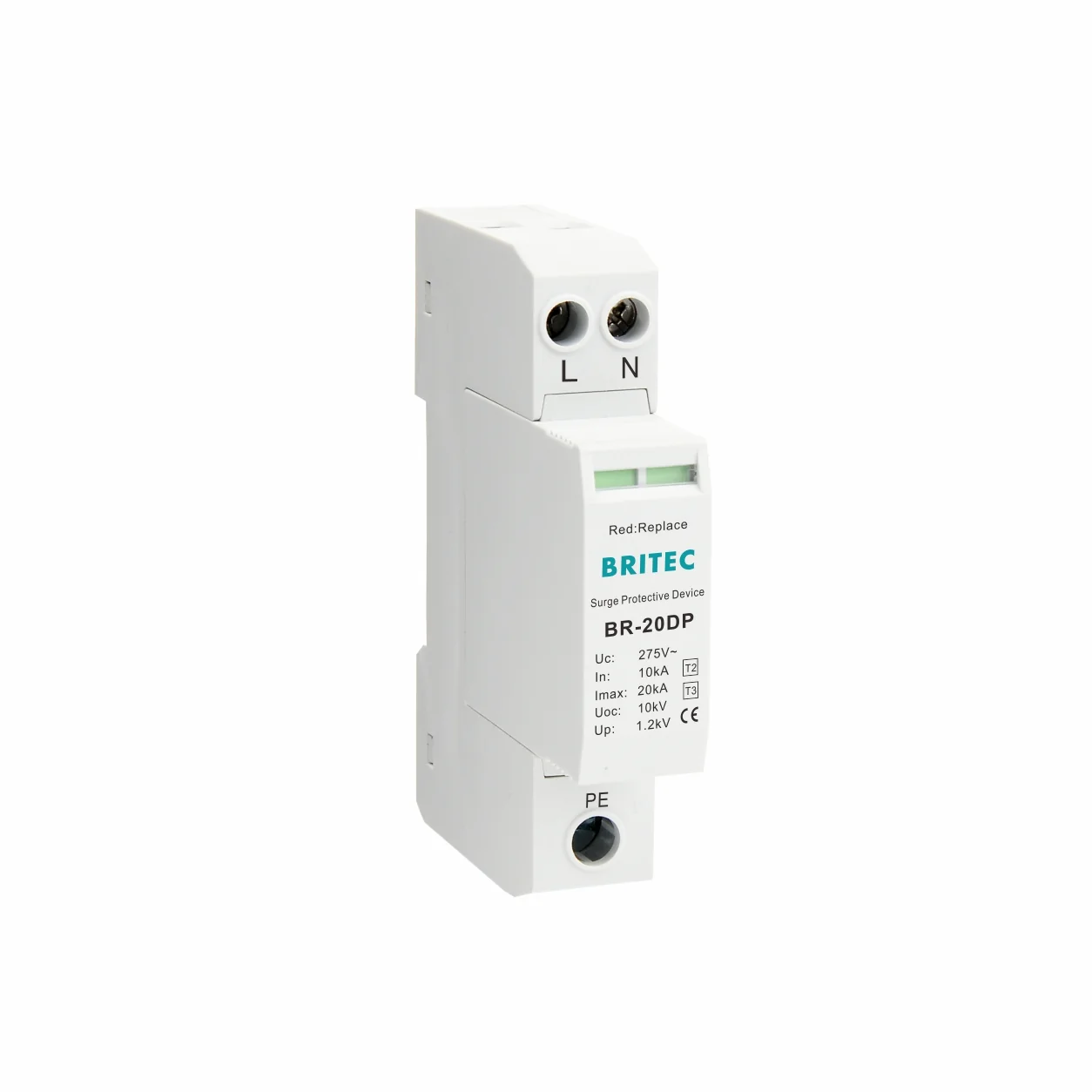
IL BR-20DP 2P 20kA Type 3 SPD is a Class III / Type 3 device with Uc of 275 V or 320 V, In of 10 kA (8/20 µs), Imax of 20 kA, Up ≤ 1200 V, response time ≤ 25 ns, an operating range of −40 °C to +80 °C, 35 mm DIN-rail mounting, UL94-V0 housing and IP20 protection. It is suited to the main or sub-distribution board of a low-voltage installation and is available with optional remote signalling.
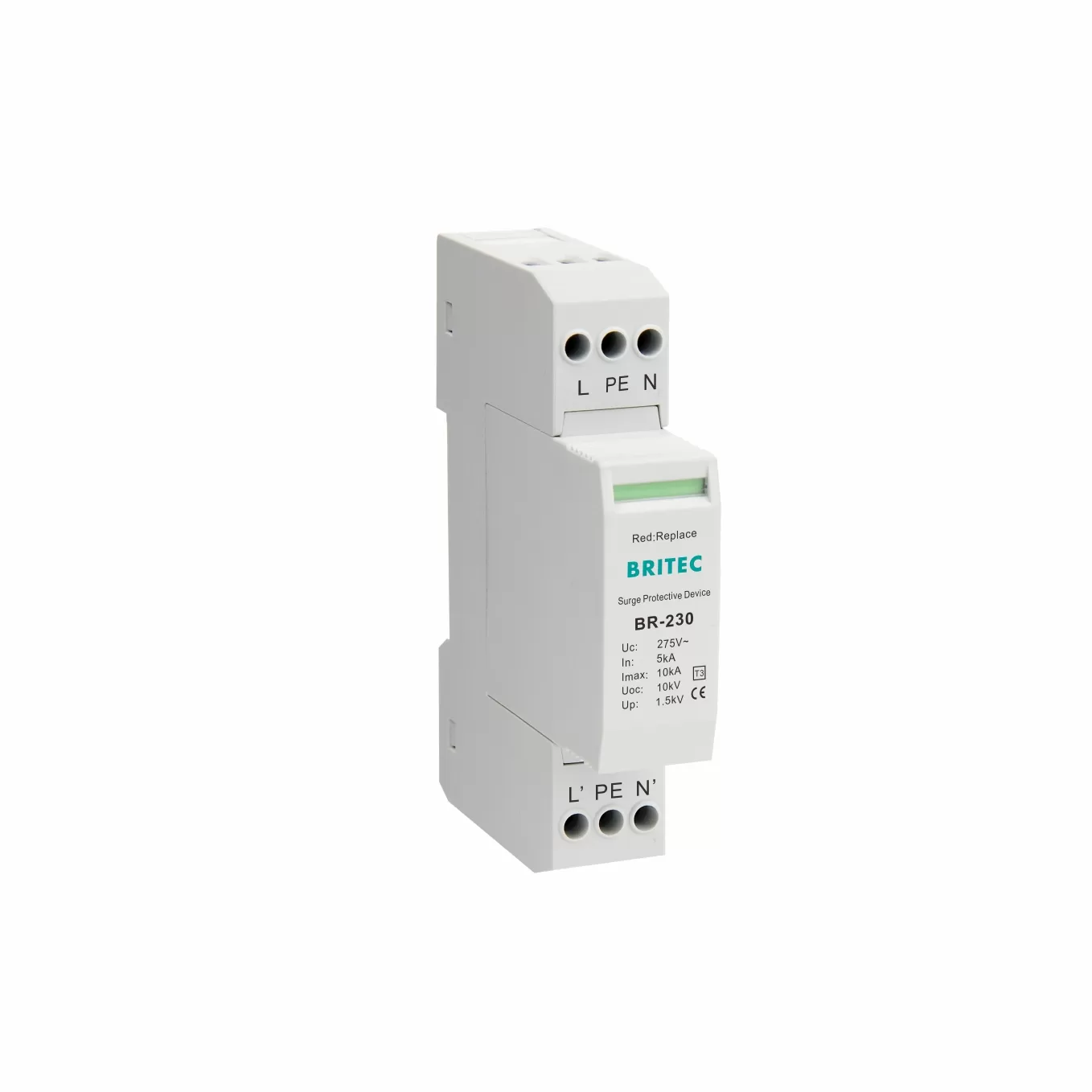
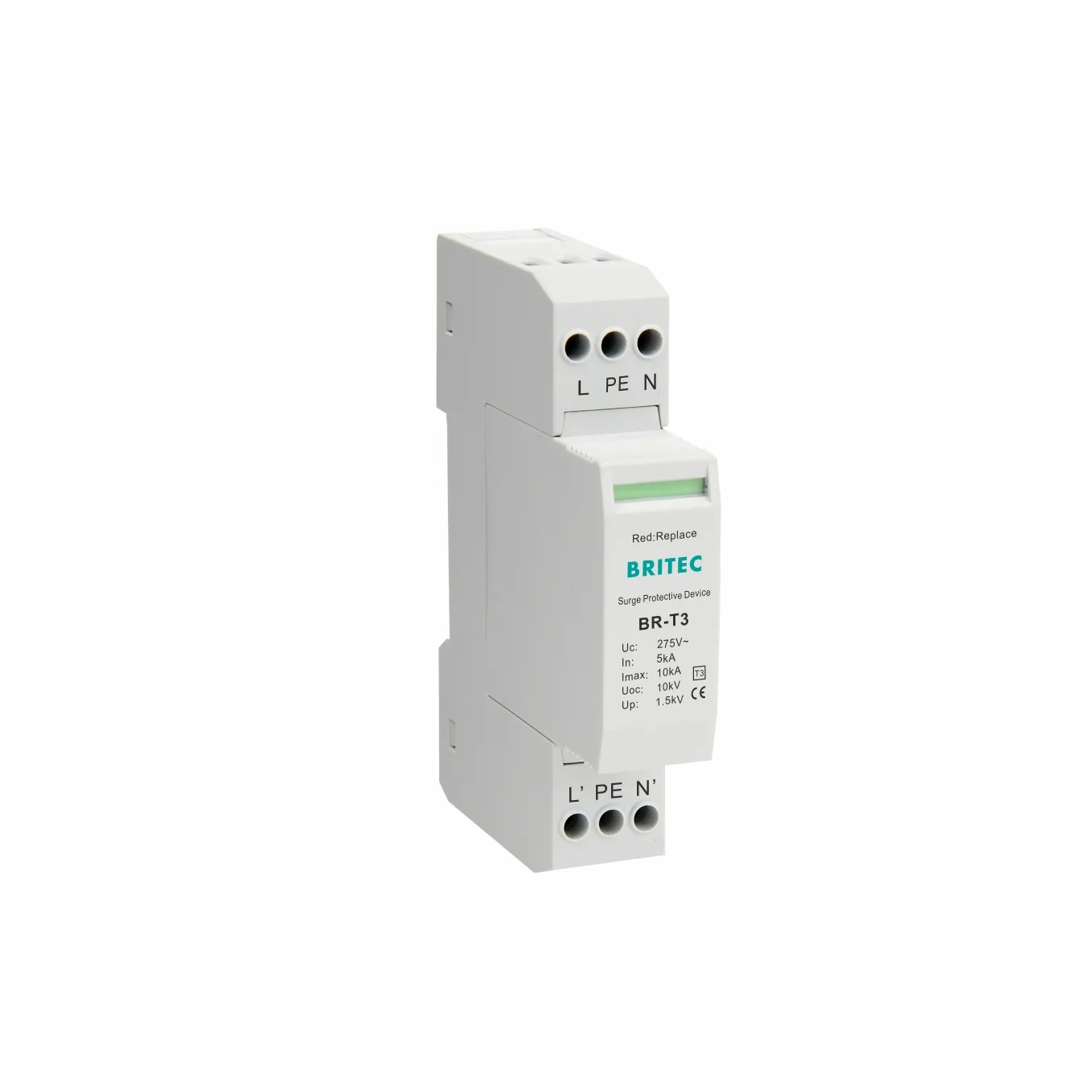
IL BR-T3 Type 3 surge protector is a compact terminal-equipment protector in the same 10kA class, ideal for the point-of-use layer close to sensitive loads. Both sit within our broader family of AC surge protection devices, where higher In/Imax Type 2 units can be selected when the site demands more headroom against heat derating.
Does a 10kA SPD really lose surge capacity in heat?
Yes. The metal-oxide varistor has a negative temperature coefficient, so higher operating temperature lowers its clamping voltage, raises leakage current and reduces the surge current it can still absorb. The 10 kA rating is a reference-temperature value, not a constant field value.
At what temperature does derating become significant?
Minor effects appear above about 40 °C, become material around 55 °C to 70 °C, and reach roughly 40% loss of relative capability near the +80 °C upper rating. The precise curve is in each product datasheet.
Is Imax (20 kA) also affected by temperature?
Yes. Both In and Imax are reference-condition ratings. A higher Imax gives more single-event headroom, but it does not make the device immune to heat; it simply starts from a larger number before derating.
How do I know if my SPD has been heat-damaged?
Watch the status window: a red indicator means the thermal disconnector has tripped and the module should be replaced. For gradual ageing, optional remote signalling can report leakage trends before a hard fault occurs.
Should I choose a higher kA rating for hot sites?
Often yes. If the enclosure runs hot, specifying a higher In and Imax means the derated value still meets your protection requirement. Pair the upsize with ventilation and a temperature-aware layout rather than relying on the datasheet number alone.
Does IEC 61643 certification cover high-temperature operation?
Certification confirms the device meets In/Imax at reference test conditions. It does not re-rate the product for a hot enclosure. The standard proves the design; it does not override the physics of temperature derating on site.
A 10kA SPD is only a 10kA SPD at its rated temperature. In hot, enclosed or sun-exposed installations the real capability can fall well below the label, and service life shortens accordingly. Specify from the enclosure temperature up, give the device ventilation and headroom, monitor its status, and choose a rating that survives derating — not just one that looks right on paper.
Get a site-specific SPD recommendation that accounts for your real operating temperature. Our team will match the right 10kA-class device to your panel and climate.
Contact Britec for a quote
● Why 10kA SPDs Are Ideal for Branch Circuits — where the 10kA class fits in a layered protection scheme.
● Common AC Surge Protective Device Failure Causes and Solutions — how heat, ageing and faults end an SPD.
● Type 3 Surge Protective Device Selection Guide — matching Type 3 devices to sensitive loads.
● What Causes Solar DC SPDs to Overheat or Fail Prematurely — the heat-failure mechanism in PV enclosures.
● SPD Maximum Continuous Operating Voltage (Uc) Explained — why Uc must clear your system and temperature profile.
● 4 Pole SPD Maintenance Guide for Electrical Systems — inspection steps that catch heat ageing early.