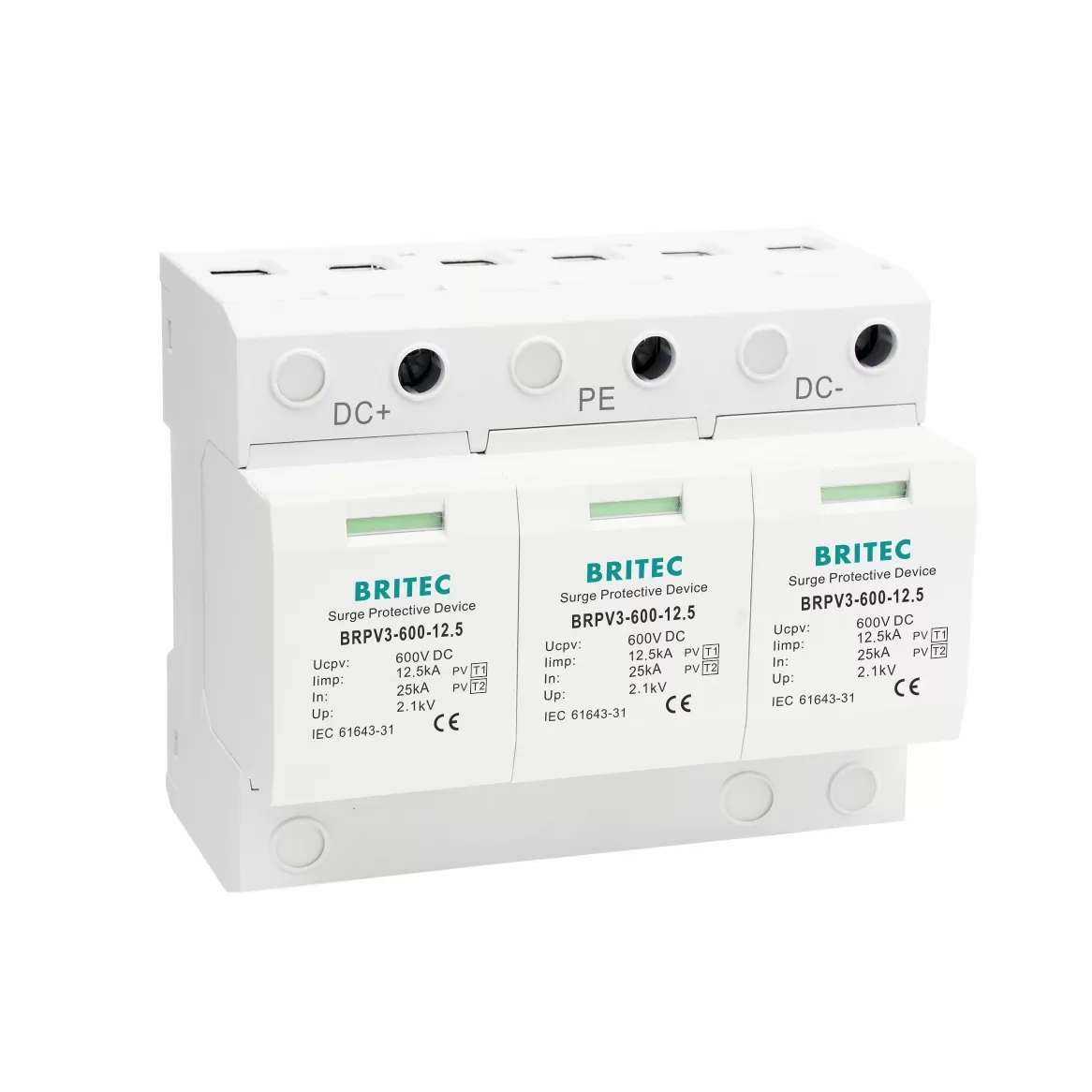

Selecting a solar SPD is not a one-size-fits-all decision. The right DC surge protective device depends almost entirely on the electrical specifications printed on your PV inverter datasheet. At Britec Electric, our engineering team has manufactured IEC/EN 61643-31 compliant surge protection devices since 2003 from our Wenzhou, Zhejiang facility, holding ISO 9001, TÜV, CE and Intertek SEMKO certifications. In this guide we walk B2B buyers, EPCs and O&M teams through a specification-driven selection method so the SPD you install actually protects the inverter instead of becoming a liability.
A PV inverter converts the direct current from the solar array into grid-compliant alternating current, and its DC input stage is continuously exposed to the open-circuit voltage of the strings plus any transient overvoltages coupled from lightning or grid faults. A surge protective device placed at the DC input must survive the highest voltage the array can present and clamp fast enough to keep the inverter’s sensitive IGBTs, MPPT controllers and DC capacitors below their impulse withstand rating.
Choosing the SPD before reading the inverter nameplate is the most common cause of premature SPD failure, nuisance tripping of the DC breaker, or worse, a surge that bypasses the protector and damages the inverter. The good news: every parameter you need is already on the inverter datasheet. This article translates those inverter numbers into the four SPD ratings that matter — Ucpv, In/Imax, Up and type — so your specification is repeatable across projects and across inverter brands.
Before comparing models, pull the inverter’s DC-side datasheet and locate five values. The table below maps each inverter parameter to the SPD rating it controls.
| Inverter parameter | Where to find it | SPD rating it sets |
|---|---|---|
| Maximum system / open-circuit voltage (Voc) | Nameplate “Max DC input voltage” or VDC max | Ucpv (max continuous operating voltage) |
| Lightning exposure / LPS | Site risk assessment, IEC 62305 | SPD Type (Type 2 or Type 1+2) |
| Local thunderstorm density (Ng) | Regional data / IEC 62305 | In / Imax (discharge current) |
| Inverter impulse withstand (Uw) | Inverter IEC 62109 rating | Up (voltage protection level) |
| Array topology and earthing | System design drawings | Number of poles and mounting |
In short, the SPD is specified backwards from the inverter rather than forwards from a catalogue:
● Maximum PV open-circuit voltage (Voc,max) → defines the SPD continuous operating voltage Ucpv.
● Lightning protection concept and exposure → defines whether you need Type 2 or Type 1+2.
● Expected surge current in the region → defines nominal discharge current In and maximum Imax.
● Impulse withstand voltage of the inverter (Uw) → defines the maximum Up.
● Array topology (grounded, ungrounded, pole count) → defines the pole count and mounting.
The single most important number is the maximum DC voltage the array can present to the SPD. Inverter datasheets list a “maximum PV input voltage” (commonly 1000 V for commercial systems, 1500 V for utility scale, 600 V for older residential units). But the array open-circuit voltage rises in cold weather because crystalline silicon modules have a negative voltage temperature coefficient of roughly −0.3 %/°C. A string sized for 900 V at 25 °C can exceed 1000 V on a −10 °C morning, so the SPD must be rated for the worst-case cold Voc, not the nominal nameplate.
Rule of thumb: the SPD Ucpv must exceed the highest expected Voc after the temperature correction, with margin. For 1000 V class systems Britec specifies a Ucpv of 1200 V; for 1500 V systems a Ucpv of 1500 V or higher. Never fit a 600 V AC SPD onto a 1000 V DC string — the continuous voltage alone will destroy it. For a 1000 V inverter, the BRPV3-1000 Type 2 PV surge arrester (Ucpv 1200 V, In 20 kA, Up ≤ 4.0 kV) is the standard match. For 1500 V utility-scale inverters, choose the BRPV3-1500-12.5 T1+T2 PV surge arrester rated to 1500 V.
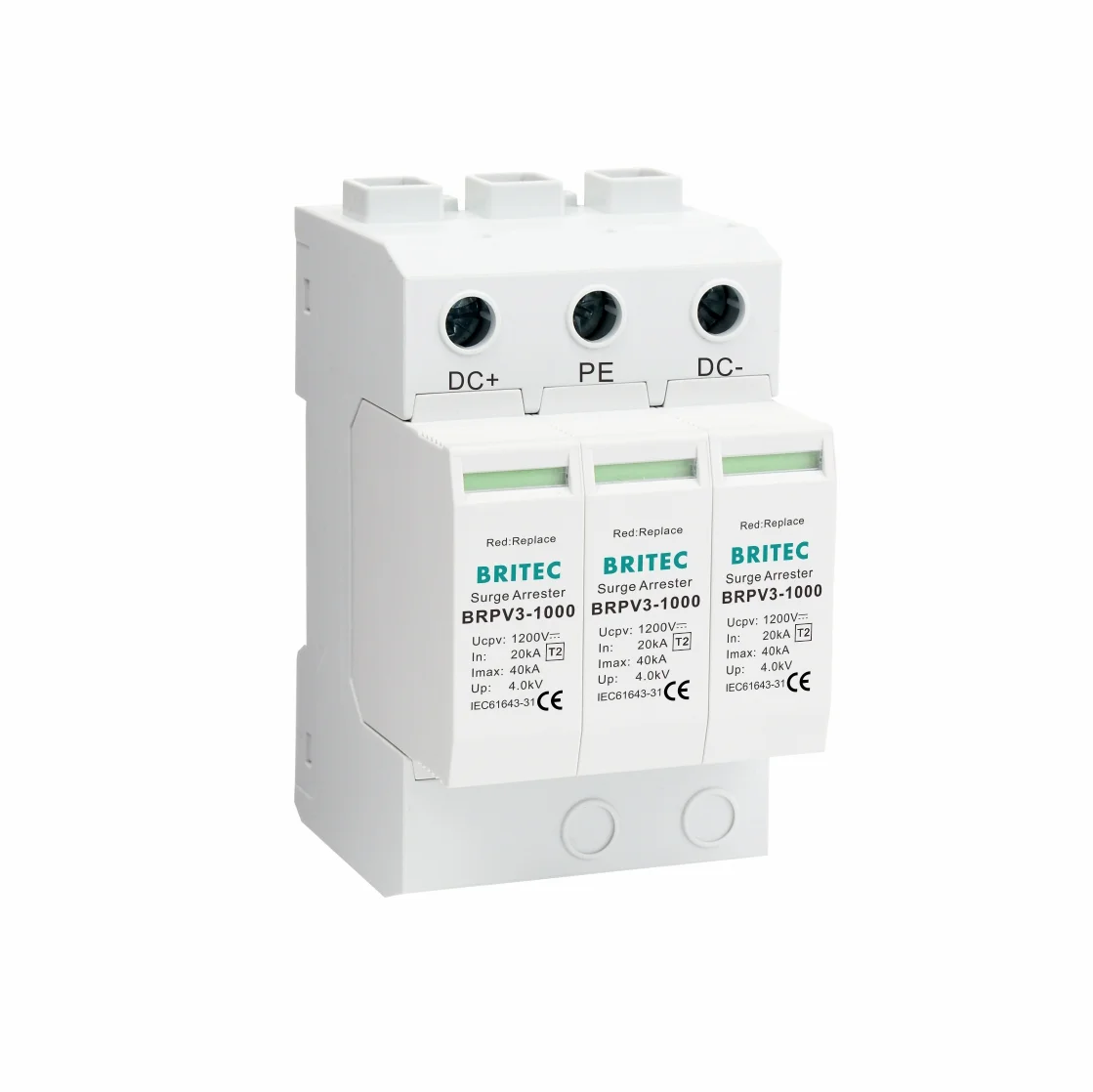
BRPV3-1000 Type 2 — 1000 V class solar SPD (Ucpv 1200 V, In 20 kA). Click to view full specifications.
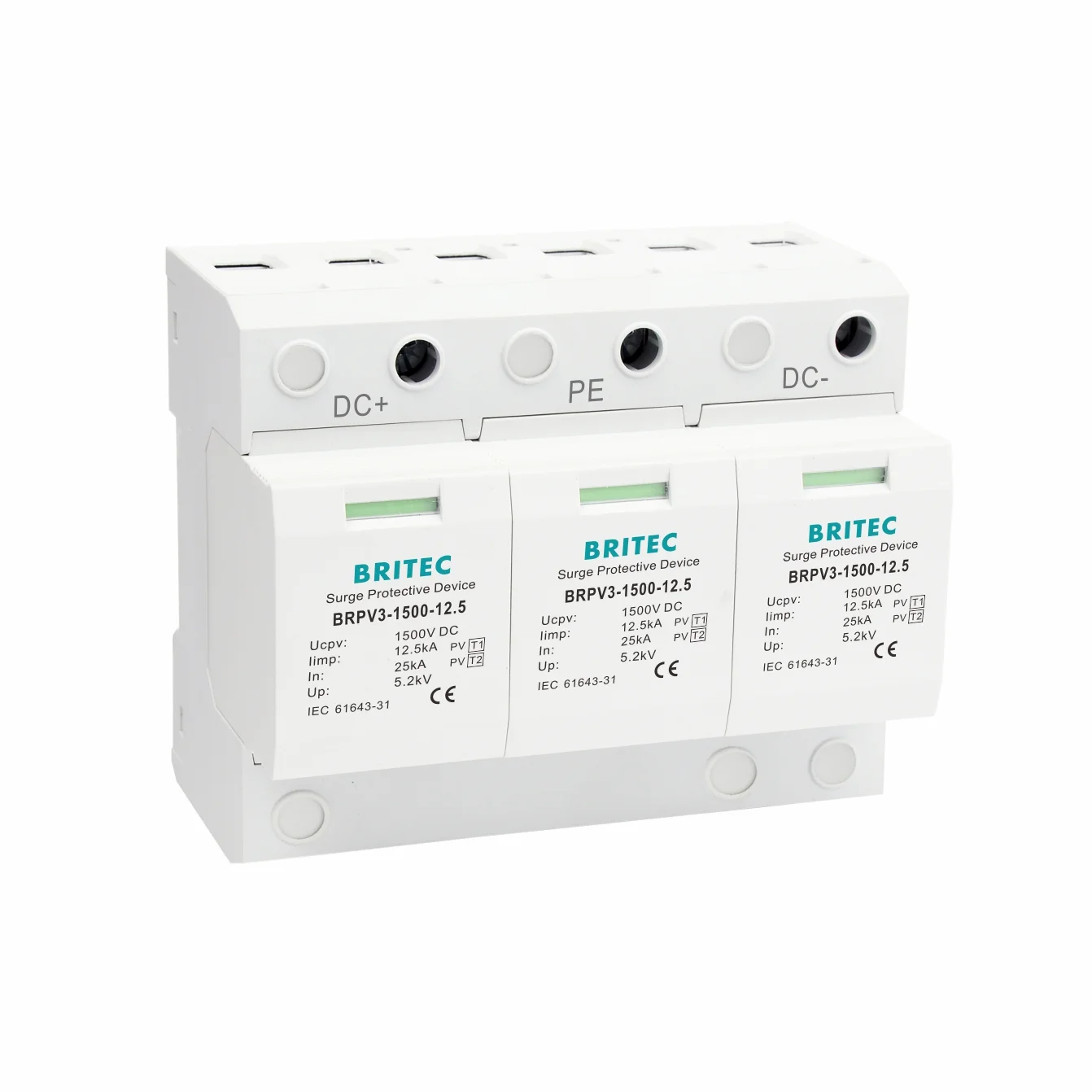
BRPV3-1500-12.5 T1+T2 — 1500 V class solar SPD for utility-scale inverters. Click to view full specifications.
DC SPDs follow IEC/EN 61643-31 and are classed by the surge they can absorb. A Type 2 device handles induced (indirect) surges with a nominal discharge current In (8/20 µs). A Type 1+2 (combination) device adds an impulse current Iimp (10/350 µs) rating to survive a portion of a direct lightning strike where the SPD is installed downstream of an external lightning protection system (LPS). If your inverter or combiner box sits inside a structure protected by an LPS, or the array is exposed on a rooftop or open field with direct-strike risk, specify Type 1+2. If the installation is indoor, well shielded, and only indirect surges are expected, a Type 2 device is sufficient and more economical.
ที่ BRPV3-1000-20 Type 1+2 PV surge arrester carries a 20 kA T1+T2 rating for harsher lightning zones, while the BRPV3-1000 Type 2 covers lower-risk sites. Always coordinate the SPD type with the project’s lightning protection study rather than defaulting to the cheapest option.
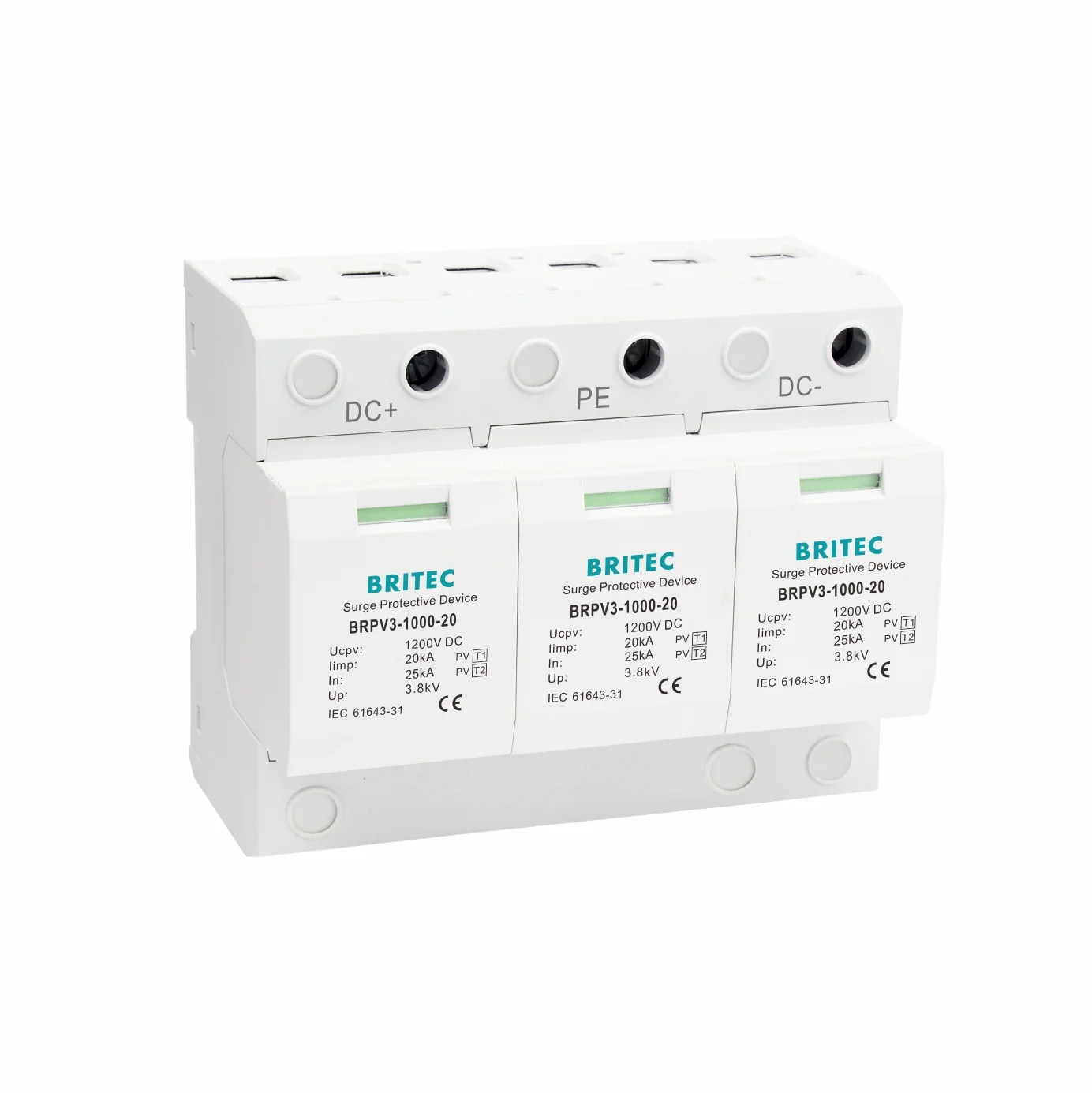
BRPV3-1000-20 Type 1+2 — 20 kA T1+T2 rated for high lightning-risk 1000 V sites. Click to view full specifications.
Not sure which SPD type your inverter needs?Send us your PV inverter datasheet and Britec engineers will confirm whether you need Type 2 or Type 1+2 — with the exact model recommendation.
Talk To Our Engineers
In (8/20 µs) is the current the SPD can repeatedly absorb without degradation; Imax is the maximum it can survive once. Select In from the site’s thunderstorm ground-flash density (Ng) and the distance from the array to the LPS. Britec’s PV range starts at In 20 kA for combiner-box and inverter-DC applications, which covers most commercial roofs and ground mounts.
A common error is copying the AC-side kA rating onto the DC side. DC arcs are harder to extinguish than AC arcs, so the SPD’s built-in thermal disconnector and coordination with the upstream DC circuit breaker matter more than a headline kA number. Specify Imax at least 40 kA for exposed sites and verify the SPD carries a short-circuit current rating (Isc) matched to the array short-circuit current so the protector fails safely instead of welding shut.
Up is the residual voltage the SPD lets through while clamping. Your inverter’s DC input is rated to an impulse withstand voltage (Uw) under IEC 62109, typically 4 kV for PV equipment. The selected SPD Up must be lower than Uw; otherwise the clamped surge still exceeds what the inverter can tolerate. Britec PV SPDs hold Up ≤ 4.0 kV, aligning with the 4 kV withstand of modern 1000 V and 1500 V inverters.
When several protectors sit in series (for example a Type 1+2 at the combiner and a Type 2 at the inverter), check the combined let-through against Uw rather than each device in isolation. A lower Up also protects downstream DC-DC converters and the inverter’s MPPT stage more effectively, which is where most lightning-related inverter failures actually start.
PV arrays are usually ungrounded or have a single pole grounded, so a 2-pole SPD (protecting + to PE and − to PE) is typical; 3-pole versions suit systems with a neutral or mixed topology. Match the pole count to the array earthing design rather than defaulting to the AC convention. Mounting is standardized on a 35 mm DIN rail inside the combiner box, the inverter’s DC isolation compartment, or a dedicated DC distribution cabinet — keep lead lengths short to preserve the low Up.
For O&M efficiency specify a device with a visual green/red status window and an optional remote-signaling contact that reports end-of-life to the site monitoring system, so a failed SPD is replaced before it leaves the inverter unprotected. Britec’s PV range offers the remote-signal option across the BRPV3 family.
Consider two projects. Project A uses a 1000 V commercial inverter with maximum Voc 1000 V after temperature correction, indirect-surge exposure, moderate Ng, inverter Uw 4 kV and an ungrounded 2-pole array. The match is BRPV3-1000 Type 2: Ucpv 1200 V, In 20 kA, Imax 40 kA, Up ≤ 4.0 kV, 2-pole. Project B is a 1500 V utility plant in a high Ng region with an LPS; it needs BRPV3-1500-12.5 T1+T2: Ucpv 1500 V, 12.5 kA T1 impulse plus 20 kA T2, Up within inverter limits, 1500 V class. The comparison below shows how the three Britec solar SPDs map to different inverter specs.
| Model | System voltage | พิมพ์ | In / Imax | ขึ้น | Best for |
|---|---|---|---|---|---|
| BRPV3-1000 Type 2 | 1000 V (Ucpv 1200 V) | ประเภทที่ 2 | In 20 kA / Imax 40 kA | ≤ 4.0 kV | Standard 1000 V commercial & roof |
| BRPV3-1500-12.5 T1+T2 | 1500 V | T1+T2 | 12.5 kA T1 / 20 kA T2 | per spec | 1500 V utility-scale with LPS |
| BRPV3-1000-20 T1+2 | 1000 V (Ucpv 1200 V) | T1+2 | In 20 kA | ≤ 4.0 kV | High lightning-risk 1000 V sites |
Need a matched SPD for your exact inverter model?Share the maximum DC voltage, lightning zone and pole count, and we will return a written specification with the correct Ucpv, In and Up.
Request A Free Spec
● Fitting a 600 V or AC-rated SPD onto a 1000 V / 1500 V DC string — continuous overvoltage destroys it.
● Ignoring the temperature coefficient of Voc and under-sizing Ucpv for cold climates.
● Using an AC SPD on the DC side because it “looks the same” — AC and DC interruption physics differ.
● Choosing Imax without coordinating the SPD’s short-circuit rating with the array Isc and the DC breaker.
● Forgetting remote signaling, so a failed SPD goes unnoticed until the inverter is damaged.
● Matching pole count to AC habits instead of the actual PV earthing topology.
What does Ucpv mean on a solar SPD, and how is it related to my inverter’s maximum voltage?
Ucpv is the maximum continuous operating voltage the SPD can withstand indefinitely. It must exceed the array’s highest open-circuit voltage (Voc) after cold-temperature correction, with margin. For a 1000 V inverter, specify Ucpv ≥ 1200 V; for a 1500 V inverter, Ucpv ≥ 1500 V.
Can I use an AC surge protector on the DC side of a PV inverter?
No. AC SPDs are tested to IEC/EN 61643-11 and assume AC zero-crossing to extinguish the arc. DC arcs do not self-extinguish at the same point, so a DC-rated device tested to IEC/EN 61643-31 with a proper thermal disconnector is required on the PV side.
Should I choose a Type 2 or a Type 1+2 solar SPD?
Choose Type 1+2 when the inverter or combiner is inside a structure with an external lightning protection system, or where direct-strike risk is high (open fields, tall rooftops). Choose Type 2 for indoor, well-shielded sites with only indirect surges. Base the decision on the project’s IEC 62305 risk assessment.
How do I size the kA rating (In and Imax) for a PV surge arrester?
Start from the regional thunderstorm ground-flash density (Ng) and the distance to the LPS. Britec’s PV devices begin at In 20 kA, which suits most commercial roofs and ground mounts; specify Imax ≥ 40 kA for exposed sites and confirm the short-circuit rating matches the array Isc.
What Up (voltage protection level) is safe for my inverter?
The SPD Up must stay below the inverter’s impulse withstand voltage Uw (commonly 4 kV under IEC 62109). Britec PV SPDs hold Up ≤ 4.0 kV, matching modern 1000 V and 1500 V inverters. When multiple SPDs are in series, verify the combined let-through against Uw.
Where should the SPD be installed — combiner box or inverter DC input?
Both locations are valid. Install at the combiner box to protect each string group, and/or at the inverter DC input as the last line of defense. Keep conductor lengths short and coordinate with the DC breaker. Many designs use a Type 1+2 at the combiner and a Type 2 at the inverter.
How many poles does a solar SPD need?
A 2-pole device (protecting + to PE and − to PE) suits most ungrounded PV strings. 3-pole versions are used where a neutral or mixed topology exists. Match the pole count to the earthing design, not to AC distribution habits.
Does a 1500 V inverter need a different SPD than a 1000 V system?
Yes. A 1500 V inverter requires an SPD with Ucpv ≥ 1500 V and insulation rated for the higher bus, such as the BRPV3-1500-12.5 T1+T2. Reusing a 1000 V-class SPD on a 1500 V string will fail immediately under continuous voltage.
How do I know when a solar SPD needs replacement?
A green/red status window shows end-of-life locally, and the optional remote-signaling contact reports it to your monitoring system. Inspect at each O&M visit and replace the module as soon as the window turns red or the signal triggers. See our guide on replacement intervals for a full schedule.
Ready to specify your solar SPD?Get a written recommendation, datasheets and a volume quote from Britec’s engineering team today.
Contact Britec For A Quote
● How Solar SPD Protects Photovoltaic Systems From Lightning Damage
● Type 1 vs 1+2 vs 2 vs 3 DC SPD: Which To Choose
● 1500V vs 1000V DC SPD: Should You Upgrade
● Electrical SPD For Solar PV Systems: Do You Really Need It