
If you are specifying surge protection for a solar project, the honest answer to “should I move to 1500V?” is almost never about the SPD. It is about the array. A 1500V SPD only makes sense when the string voltage, modules, connectors, cables, and inverter are already rated for it — swapping the protector alone changes nothing and creates a false sense of safety.
Once the array is 1500V, though, the SPD selection changes in three specific ways: the maximum continuous operating voltage (Ucpv) must rise, the voltage protection level (Up) rises with it, and the margin against your inverter’s impulse withstand has to be re-checked rather than assumed. This guide walks through each one with real numbers, so you can decide whether an upgrade is worth the money or whether your 1000V-class protection is already doing its job.
Utility-scale PV moved from 1000V to 1500V DC for one reason: the same power at higher voltage means lower current, and lower current means smaller conductors, fewer strings, and fewer combiner boxes. Industry estimates commonly put the balance-of-system saving in the range of $0.05–$0.10 per watt on large ground-mount projects, with string counts dropping by roughly a third because more modules fit in series before hitting the voltage ceiling.
That change is not neutral for surge protection. Three parameters move with the system voltage:
● ยูพีวี — the maximum continuous DC voltage the SPD can sit across indefinitely. It has to exceed your string’s worst-case open-circuit voltage, not its nominal rating.
● ขึ้น — the voltage protection level, or the residual voltage the SPD lets through to your inverter during a surge. It climbs as Ucpv climbs.
● Iscpv — the short-circuit current rating, which must exceed the prospective short-circuit current of the PV array it protects.
The trap is treating these as a matched set that scales automatically. They do not. The relationship between Up and your equipment’s withstand voltage is what actually decides whether a 1500V design is as well protected as a 1000V one — and, as the next sections show, the answer is often better than engineers expect.
Ucpv is the single most common specification error in PV surge protection. The rule is straightforward but frequently misapplied: Ucpv must be higher than the array’s maximum open-circuit voltage at the lowest temperature the site will ever see — not the system’s nominal nameplate voltage.
Modules produce higher voltage when cold. A string that measures 1000V at standard test conditions can exceed that substantially on a clear winter morning, and a 1500V-class string has even more headroom to grow. This is precisely why Britec’s “1000V” PV devices are rated Ucpv 1200V rather than 1000V — the extra 200V is the cold-temperature margin, not marketing slack.
The failure mode when you get this wrong is unpleasant and slow. An SPD with too low a Ucpv begins conducting during normal operation, heats up, and drives its metal-oxide varistors toward thermal runaway. The device does not fail dramatically; it simply degrades until it can no longer protect anything, and the indication window turns red on a routine inspection months later.
One honest caveat for procurement teams: some EPC specifications call for 1.2× headroom on top of the nominal system voltage, which on a 1500V array would imply a Ucpv above 1500V. Most PV SPDs type-tested to IEC 61643-31 top out at Ucpv 1500V. If your project specification demands that extra factor, raise it with the supplier before ordering rather than assuming a 1500V device satisfies it.
This is the section most selection guides skip, and it is the one that decides whether upgrading is safe.
An SPD does not eliminate a surge; it clamps it. Whatever voltage passes through — Up — lands on your inverter’s DC input. That value must stay below the equipment’s impulse withstand voltage (Uw) with margin. The widely used engineering rule is Up < 0.8 × Uw.
Here is the part that surprises people. Raising the system voltage raises Uw as well, because equipment built for 1500V service has to be insulated for it. Per the withstand values referenced in EN 62109-1 and IEC 60664-1 for overvoltage category II:
| Maximum string open-circuit voltage | Equipment impulse withstand (Uw) | Allowable Up (0.8 × Uw) |
| 1000 V | 6 kV | 4.8 kV |
| 1500 V | 8 kV | 6.4 kV |
Now place Britec’s PV devices against those limits:
| Model | Class | ยูพีวี | In / Imax | ขึ้น | Allowable Up | Margin |
| BRPV3-1000 | ประเภทที่ 2 | 1200 โวลต์ | 20 / 40 kA | ≤4.0 kV | 4.8 kV | 800 V |
| BRPV3-1500 | ประเภทที่ 2 | 1500 V | 20 / 40 kA | ≤5.2 kV | 6.4 kV | 1200 โวลต์ |
| BRPV3-1000-12.5 | แบบที่ 1+2 | 1200 โวลต์ | 25 / 60 kA | ≤3.8 kV | 4.8 kV | 1000 V |
| BRPV3-1500-12.5 | แบบที่ 1+2 | 1500 V | 25 / 60 kA | ≤5.2 kV | 6.4 kV | 1200 โวลต์ |
Read the margin column carefully. Going from 1000V to 1500V raises Britec’s Type 2 Up from ≤4.0kV to ≤5.2kV — but it raises the allowable ceiling from 4.8kV to 6.4kV by more. The protection margin does not shrink; it gets slightly wider.
That conclusion depends entirely on your inverter genuinely being 1500V-class equipment with an 8kV withstand. If you are protecting mixed or legacy hardware, verify the Uw on the inverter datasheet before relying on this arithmetic.
Voltage class and SPD class are independent decisions, and conflating them is the second most common error.
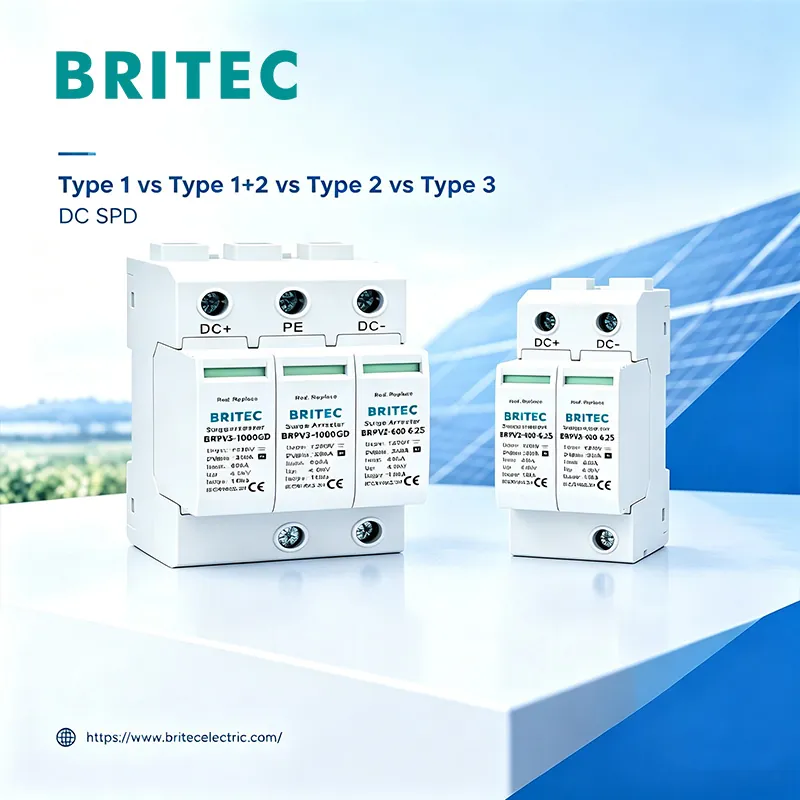
ประเภทที่ 2 devices handle induced surges and switching transients on the 8/20µs waveform. They belong at combiner boxes and inverter DC inputs where the array is not directly exposed.
แบบที่ 1+2 devices additionally handle the 10/350µs waveform associated with partial lightning current. They are the right call when the array sits in open ground with high ground-flash density, or where IEC 62305 risk assessment puts the site at the boundary between lightning protection zones.
Both are available at each voltage class. On the 1500V side, the BRPV3-1500-12.5 carries Iimp 12.5kA with Q 6.25As and specific energy W/R 39kJ/Ω, alongside In 25kA and Imax 60kA. The BRPV3-1500-6.25 offers a lower Iimp of 6.25kA where the risk assessment does not justify the larger device. Both carry Iscpv 10kA and residual current Ipe below 0.02mA.
Note that In and Imax are unrelated to system voltage — the 1000V and 1500V versions of the same class carry identical discharge ratings. Voltage class changes what the device must withstand continuously; lightning risk changes what it must absorb in an instant.
Physically, a 1500V PV SPD is not simply a 1000V device with a different label. Designers get the higher Ucpv by stacking more varistor discs in series, and every disc added raises the clamping voltage. That is the mechanical reason Up climbs from ≤4.0kV to ≤5.2kV — it is a consequence of physics, not a specification shortcut.
Two consequences follow. First, more discs mean a physically larger device: both 1500V units are 3-modular on a 35mm DIN rail, so verify your combiner box or inverter cabinet has the rail space before committing. Second, leakage current and thermal behaviour matter more, which is why the thermal disconnector and fault indication are non-negotiable on 1500V DC rather than optional extras.
Both 1500V families specify an operating temperature range of -40°C to 80°C, green/red fault indication, and thermoplastic UL94-V0 enclosures. All accept 4mm² to 35mm² conductors.
Work through these in order. The first two questions end the discussion for most projects.
● Is your array already 1500V-rated? If modules, connectors, cables, and inverter are 1000V-class, there is nothing to upgrade to. Fit correctly rated 1000V-class protection and stop.
● Is this a new build or a repowering? On new utility-scale builds above roughly 5MW, 1500V is now standard and the SPD question is simply which 1500V model. On repowering, the economics depend on whether you are replacing the inverters anyway.
● Have you computed worst-case Voc? Take module Voc, apply the temperature coefficient at your site’s record low, multiply by modules in series. That number — not the nameplate — sets your minimum Ucpv.
● Have you confirmed inverter Uw? Look for the impulse withstand on the inverter datasheet. If it is 8kV, a ≤5.2kV Up device has comfortable margin. If it is 6kV, it does not, and you need a lower-Up solution.
● Has an IEC 62305 risk assessment been done? This decides Type 2 versus Type 1+2. Skipping it means guessing at the single largest cost driver in the SPD bill of materials.
● Do you need remote signalling? On a multi-megawatt site, physically checking hundreds of indication windows is not a maintenance plan. Every PV model covered here is available with a remote signalling contact under a separate order code.
Send us your module Voc, modules per string, lowest recorded site temperature, and inverter impulse withstand. Our engineers will confirm the Ucpv and Up your array actually requires — and tell you if 1000V-class protection is sufficient.
1500V is not universally better, and pretending otherwise costs credibility with engineers. Stay with 1000V-class protection when:
● The array is 1000V-class. This covers essentially all residential and most commercial rooftop systems, and any existing site not being repowered.
● The system is small. Below roughly 250–300kW DC, the 1500V inverter premium typically exceeds the cable and combiner savings, particularly where DC home-run lengths are short.
● You are replacing like-for-like. If a 1000V SPD has reached end of life on a 1000V array, the correct replacement is a 1000V-class device — the BRPV3-1000 at Ucpv 1200V. Fitting a 1500V device there buys nothing and raises Up unnecessarily.
● Local code or insurer requirements cap the voltage. Some jurisdictions and insurance frameworks still treat 1000V as the ceiling for certain building-mounted applications.
It is worth stating plainly, because this question comes up constantly: you cannot convert a 1000V array to 1500V by changing the surge protectors.
Every component in the DC path has a voltage rating — module certification, connector insulation, cable jackets, isolators, and the inverter’s maximum DC input. The SPD is the cheapest item on that list and the only one that does not determine the system voltage. Replacing it with a 1500V device on a 1000V array simply gives you a protector with a higher-than-necessary Ucpv and a correspondingly higher Up, which is a small step backwards in protection quality.
The genuine upgrade path for an existing 1000V site is repowering: new modules and inverters rated for 1500V, re-strung arrays, and new DC collection infrastructure. That is a capital decision driven by energy yield and land use, not by surge protection. When it happens, the SPD specification follows automatically.
What you can upgrade on an existing 1000V array is the protection quality itself — moving from no SPD to a correctly rated Type 2, from Type 2 to Type 1+2 where the risk assessment supports it, or from a standard device to one with remote signalling. Those changes reduce real failure risk without touching the array voltage.
Choose the SPD voltage class from the array, never the other way round. If your strings are 1000V-class, specify Ucpv 1200V devices and spend the budget on discharge capacity or remote monitoring instead. If you are building at 1500V, specify Ucpv 1500V devices — and confirm your inverter’s Uw is 8kV so the ≤5.2kV Up still clears the 0.8 rule with 1200V to spare.
The two specifications that get projects into trouble are always the same: Ucpv sized from the nameplate instead of worst-case cold Voc, and Up checked in isolation instead of against the inverter withstand it is meant to protect.
Britec Electric has manufactured surge protective devices since 2003 under ISO 9001 and ISO 14001. Send your single-line diagram or string schedule and we will mark up the positions, classes, and order codes — including remote-signalling variants — for your project.
Can I use a 1000V DC SPD on a 1500V PV system?
No. A 1000V-class device typically carries Ucpv around 1200V, which is below the worst-case open-circuit voltage of a 1500V string. It would conduct continuously, overheat, and fail — potentially without an obvious external sign until the indication window is checked.
Why is the Ucpv of a “1000V” SPD actually 1200V?
Because Ucpv must cover the array’s maximum open-circuit voltage, not its nominal rating. Module voltage rises as temperature falls, so a nominally 1000V string can exceed 1000V on a cold morning. The extra 200V is the margin that keeps the SPD from conducting during normal operation.
Does a 1500V SPD protect worse than a 1000V one?
Not if the equipment is genuinely 1500V-class. Up does rise — from ≤4.0kV to ≤5.2kV on Britec’s Type 2 range — but the inverter’s impulse withstand rises from 6kV to 8kV, so the allowable Up goes from 4.8kV to 6.4kV. The margin widens slightly rather than shrinking.
Can I upgrade an existing 1000V array to 1500V by changing the SPDs?
No. System voltage is set by module, connector, cable, and inverter ratings. The SPD does not set it. Converting requires repowering the array; the SPD specification then follows the new array voltage.
Do I still need Type 1 protection at 1500V?
Voltage class and SPD class are separate decisions. Type 1+2 (10/350µs) is driven by lightning risk per IEC 62305, not by system voltage. Both classes exist at 1000V and 1500V, so choose the class from the risk assessment and the voltage class from the array.
What is Iscpv and does it matter more at 1500V?
Iscpv is the short-circuit current rating — the fault current the SPD can safely interrupt at end of life. It must exceed the array’s prospective short-circuit current. Larger 1500V arrays concentrate more strings behind each device, so verify it rather than assuming. Britec’s 1500V Type 1+2 units are rated Iscpv 10kA.
Should I specify remote signalling on 1500V PV SPDs?
Yes, on anything utility-scale. Inspecting hundreds of indication windows across a site is impractical, and a failed SPD leaves the inverter unprotected while everything still looks normal. Remote signalling variants are available under separate order codes on every PV model discussed here.
How do I know when an existing PV SPD needs replacing?
The indication window turning red is the primary signal, driven by the thermal disconnector. Beyond visual checks, routinely scheduled replacement based on site lightning exposure is standard practice, since varistors degrade cumulatively from repeated small surges with no visible warning.
Does UL 1449 matter if my project follows IEC standards?
Only for North American projects. IEC 61643-31:2018 is the product standard for PV DC SPDs in IEC markets, with IEC 61643-32 covering selection and application. UL 1449 5th Edition is the relevant North American standard and covers photovoltaic applications up to 1500V DC. Confirm which framework your AHJ requires before writing the specification.
● คู่มือที่ครอบคลุมเกี่ยวกับการเลือกอุปกรณ์ป้องกันไฟกระชากพลังงานแสงอาทิตย์ (Solar SPD) — the full selection framework behind the voltage decisions above.
● IEC 61643-31: Requirements and Test Methods for SPDs for Photovoltaic Installations — what the PV product standard actually tests.
● PV Surge Protection Type 1+Type 2 range — browse Britec’s combined-class PV devices at 600V, 1000V, and 1500V.