
Direct current surge protective devices (DC SPDs) sit between your photovoltaic array, battery bank or DC charger and expensive inverters, controllers and loads. Pick the wrong type and you either overspend on ratings you do not need or leave a direct-lightning path unprotected. This guide compares Type 1, Type 1+2, Type 2 and Type 3 DC SPDs against the IEC 61643-31 standard so specifiers, EPCs and procurement teams can choose with confidence. If you want the full product range first, start with our DC surge protector category.
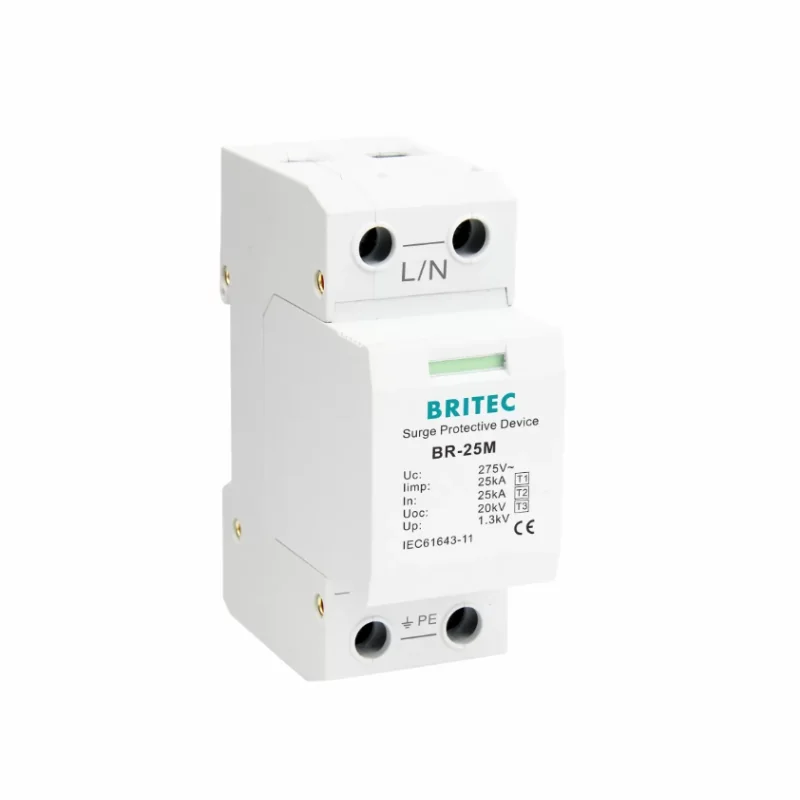
A DC surge protective device clamps dangerous overvoltage on a direct-current circuit to a safe level. The Type class describes the surge stress the device is built to absorb, not its voltage. Types follow the same logic as IEC 61643-11 for AC systems but are applied to DC circuits up to 1500 V. Choosing the correct type is a function of where the device sits in your installation and how much lightning or switching energy it must survive.
Type 1 (Class I) devices are tested with a 10/350 µs current waveform and rated by Imp (nominal discharge impulse current). They absorb the partial lightning current that can enter a building when an external lightning protection system (LPS) is present. In DC systems this means the boundary of an exposed PV array or a DC line entering a structure protected by an air-termination system.
Use Type 1 when the installation has an LPS, or when the DC line runs outdoors with direct-strike risk. Pure Type 1 DC SPDs are less common than combined types; many PV projects place a Type 1+2 device at the same boundary. For the detailed boundary-protection difference, see our post on the Type 1 vs Type 1+2 difference.
Type 1+2 (Class I+II) devices combine an Iimp-tested section with an 8/20 µs section, handling both the direct-strike current and the downstream induced or switching surges in one compact module. For PV and other DC systems with a lightning protection concept, this is the most efficient way to protect the inverter DC input and the combiner box at the boundary.
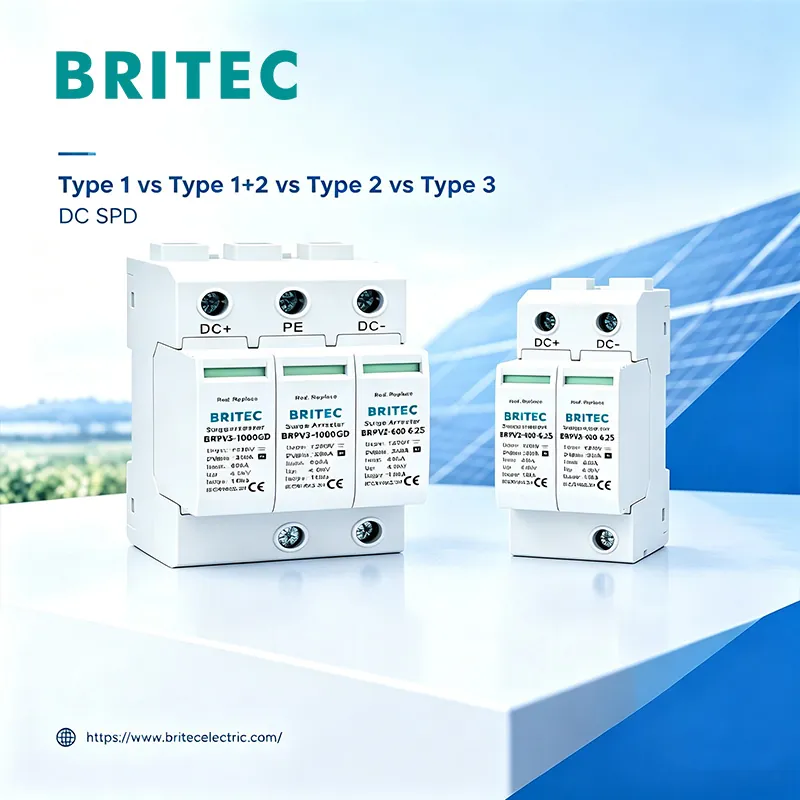
Britec’s Type 1+2 PV surge arrester (BRPV3-1000-20, 1000 V, 20 kA T1+2) is a typical example for 1000 V PV strings, with T1+T2 versions also available up to 1500 V.
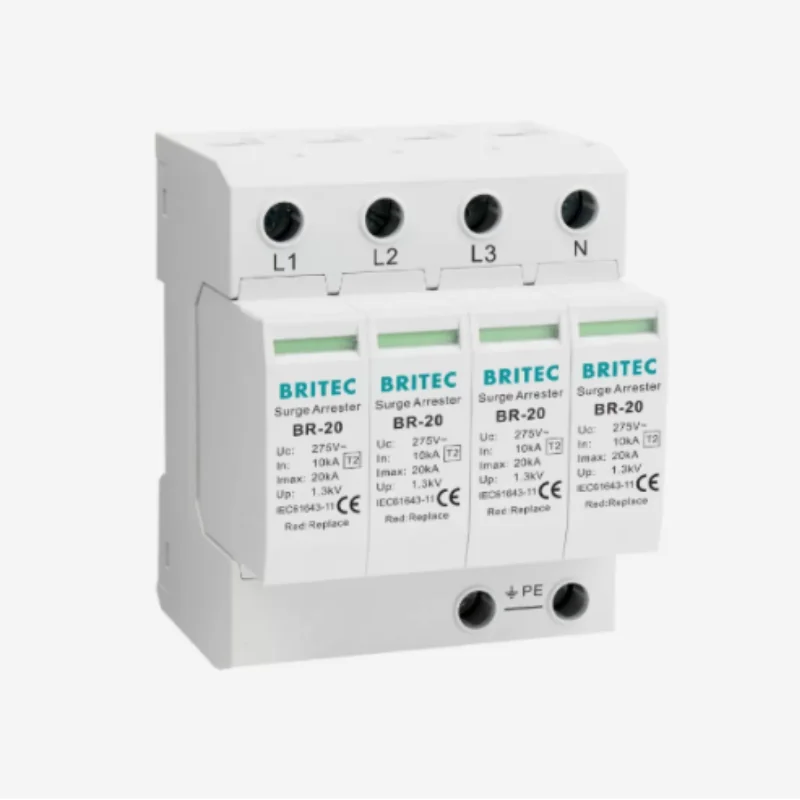
Type 2 (Class II) devices are tested with an 8/20 µs waveform and rated by Em (nominal discharge current) and IMAX (maximum discharge current). They protect against indirect lightning and switching surges in the distribution and within the DC plant — at PV string level, in battery energy storage systems (BESS), and on the DC sides of EV charging stations.
Where no direct-strike path exists, Type 2 is usually sufficient and the most cost-effective choice. A practical example is the Type 2 DC SPD (BR-40 48, 48 V DC, 40 kA) used on low-voltage DC busbars and control power.
Type 3 (Class III) devices use a combination wave (1.2/50 µs open-circuit voltage and 8/20 µs short-circuit current) and provide a very low voltage protection level (Up) right at the sensitive load. They must never be installed alone — a Type 3 device is only effective behind a coordinated Type 1 or Type 2 device, with enough separation or a coordination component.
In DC systems, Type 3 is placed at DC-powered control cabinets, telemetry and communication equipment where residual overvoltage must stay below the equipment’s withstand voltage.
| Atributo | Tipo 1 | Tipo 1+2 | Tipo 2 | Tipo 3 |
|---|---|---|---|---|
| Testar forma de onda | Iimp 10/350 µs | Iimp + In 8/20 µs | In / Imax 8/20 µs | Combination wave |
| Protection role | Direct lightning current | Boundary (direct + indirect) | Indirect / switching surges | Fine, equipment-level |
| Typical DC location | LPS boundary, exposed DC entry | Inverter DC input, combiner with LPS | String, BESS, EV DC | At sensitive DC loads |
| Coordination | With T2/T3 downstream | Can replace T1 + T2 | Behind T1 if direct risk; ahead of T3 | Always behind T1 / T2 |
| Common DC use | Exposed PV with LPS | PV systems with lightning protection | PV strings, batteries, EV | DC controllers, comms |
Work through these checks in the order shown:
● Is there an external lightning protection system (LPS) or an exposed outdoor DC run? — If yes, you need Type 1 or Type 1+2 at the boundary.
● What is the DC voltage (Uc)? — Size Uc above the PV open-circuit voltage (for example 1000 V or 1500 V systems), with low-temperature margin.
● Where in the cascade is the device? — Boundary equals T1 or T1+2; distribution equals T2; at equipment equals T3 (always behind T1/T2).
● What ratings are required? — Iimp for direct strike, In and Imax for distribution, Up for fine protection.
● Plan coordination — pair SPDs with a surge protective device dedicated backup (SCB) and respect the T1, T2 and T3 cascade. For a deeper walkthrough, read our DC surge protection guide.
Need help specifying the right DC SPD type?
Our application engineers can review your single-line diagram and recommend Type 1, Type 1+2, Type 2 or Type 3 devices with matched voltage, Iimp or In, and full coordination. Get a free selection check.
● Installing Type 3 alone — it has no direct-strike capacity and must sit behind Type 1 or Type 2.
● Under-rating Uc — PV open-circuit voltage rises as temperature falls; size with margin.
● Mixing brands without coordination data — energy coordination depends on matched components.
● Forgetting the SCB — a dedicated backup protector prevents thermal runaway after end-of-life.
● Skipping 1500 V where applicable — larger PV plants need 1500 V rated DC SPDs.
Q1: What is the difference between Type 1 and Type 2 DC SPD?
A: Type 1 is built to absorb direct lightning current (10/350 µs, rated by Iimp) and is used at the boundary where an LPS exists. Type 2 handles indirect and switching surges (8/20 µs, rated by In and Imax) and is used at the distribution level. Many DC systems use a Type 1+2 device to cover both at the boundary.
Q2: When do I need a Type 1+2 DC SPD instead of Type 2?
A: Choose Type 1+2 when the DC line enters a structure that has an external lightning protection system, or when the array or combiner is exposed to direct-strike risk. If there is no LPS and only indirect surge risk, a Type 2 device is usually enough.
Q3: Can I install a Type 3 DC SPD by itself?
A: No. A Type 3 device only lowers residual overvoltage at the equipment and must be installed behind a coordinated Type 1 or Type 2 device, with adequate separation or a coordination component, as required by IEC 61643-31.
Q4: What standard covers DC SPDs?
A: DC SPDs are covered by IEC 61643-31 (requirements and test methods for SPDs connected to DC systems and photovoltaic installations). The Type classification and coordination principles align with IEC 61643-11 for AC systems and IEC 62305 for lightning protection.
Q5: How do I choose the right Type for a solar PV system?
A: At the array boundary with an LPS, use Type 1+2 (or a Type 1 plus Type 2 cascade). At the string or distribution level without direct-strike risk, use Type 2. At sensitive DC loads, add Type 3 behind the Type 2. Size Uc for the PV open-circuit voltage (1000 V or 1500 V).
Q6: What do Iimp, In and Imax mean for a DC SPD?
A: Iimp is the impulse current a Type 1 device can withstand (10/350 µs). In is the nominal discharge current for Type 2 (8/20 µs), and Imax is the maximum it can survive once. Higher values mean stronger surge endurance.
Q7: Do DC SPDs need a dedicated backup protector?
A: Yes. A surge protective device dedicated backup (SCB) is recommended to isolate a failed SPD safely and prevent thermal runaway or upstream breaker tripping. Britec supplies coordinated SCBs for its DC SPD ranges.
Q8: What voltage rating (Uc) should a DC SPD have?
A: Uc must exceed the maximum continuous DC voltage, including the PV open-circuit voltage at the lowest expected temperature. Common ratings are 48 V, 600 V, 1000 V and 1500 V DC depending on the system.
Q9: Are Type 1+2 DC SPDs suitable for 1500 V PV systems?
A: Yes, provided the device is rated for 1500 V DC (Uc and clearance). Britec offers T1+T2 PV arresters up to 1500 V for large utility-scale arrays.
Q10: How many poles or modules does a DC SPD need?
A: It depends on the DC circuit topology — two-pole for plus or minus and PE, and more poles for multi-string or bipolar 1500 V arrangements. Match the module count to your string configuration and the SPD’s rated voltage per pole.
Still unsure which DC SPD type your project needs?
Britec Electric has manufactured surge protective devices since 2003, with products certified by Intertek SEMKO, TUV and CE. Send us your single-line diagram and we will return a coordinated, standards-based recommendation — usually within 24 hours.
● Comprehensive Guide To DC Surge Protectors In 2026 — the full DC SPD buyer and design reference.
● Type 1 Surge Protector vs Type 1+2: Key Differences — deeper look at boundary protection.
● How Do I Know What Type Of Surge Protector I Need — a decision framework for any system.
● 1500V vs 1000V DC SPD: Should You Upgrade Your PV System? — voltage rating guidance for large plants.