
You are specifying protection for a building with a lightning protection system, and two options sit in front of you. One is a Type 1 surge protector built around a spark gap, rated to discharge 25kA of partial lightning current. The other is a Type 1+2 combined unit built around varistors, rated 12.5kA but with a voltage protection level nearly a kilovolt lower.
The first number says the Type 1 device is twice as capable. The second says the combined unit protects your equipment better. Both are true, and understanding why is what makes this decision straightforward instead of confusing. Five differences separate these devices, and each one points to a different kind of installation.
A Type 1 lightning current arrester exists to survive partial lightning current — the share of a direct strike conducted into your installation through the lightning protection system, earthing network or incoming supply. Its job is to divert enormous energy safely to earth. It is not designed to manage the low-level switching transients that occur hundreds of times a day.
A Type 1+2 combined surge protector performs both duties in one housing: it discharges partial lightning current on the 10/350 µs waveform and suppresses induced and switching surges on the 8/20 µs waveform. That is why the datasheet quotes Iimp, In and Imax together rather than Iimp alone.
One practical note before you compare products: many devices sold in “Type 1” product categories are dual-classified Type 1+2 on the datasheet. Read the classification line rather than the category name, because that line determines what the device is actually tested to do.
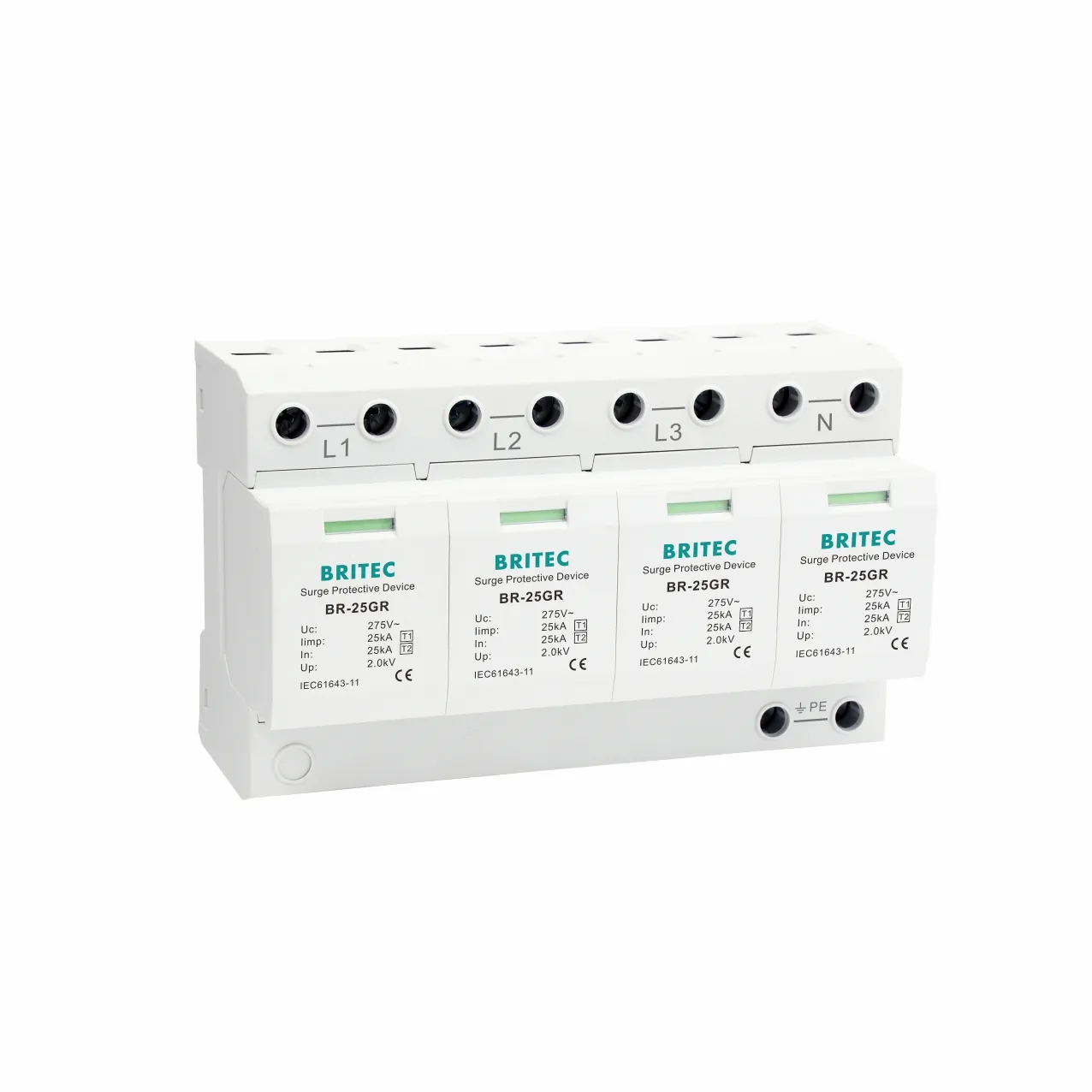
The BR-25GR is a spark-gap device rated Iimp 25kA on 10/350 µs — built for lightning current capacity above all else.
The waveforms behind these ratings describe two different physical events. The 10/350 µs pulse rises in ten microseconds and takes 350 microseconds to fall to half value — a long tail carrying enormous charge, representing a lightning discharge. The 8/20 µs pulse is over in a fraction of that time and carries a small fraction of the energy at the same peak current.
This is why you cannot compare kA figures across waveforms. Charge quantity tells the real story: Britec’s BR-25GR spark-gap device carries Q of 12.5 As and specific energy of 156 kJ/Ω, while the varistor-based BR-12.5M rates 39 kJ/Ω on its line-to-neutral path. The spark gap moves far more energy; the varistor responds far faster.
Up is the parameter that decides whether your equipment survives, and here the ranking reverses. A spark-gap Type 1 device such as the BR-25GR has a Up of ≤2.0kV — excellent for its discharge duty, but higher than sensitive electronics tolerate. The varistor-based BR-12.5M reaches ≤1.3kV on the line-to-neutral path.
Response time compounds the difference. A spark gap needs ≤100 ns to strike its arc; a varistor conducts within ≤25 ns. During that gap, voltage continues rising at the load. A dedicated Type 1 device therefore almost always needs a Type 2 stage downstream, whereas a combined Type 1+2 unit may protect a straightforward installation on its own.
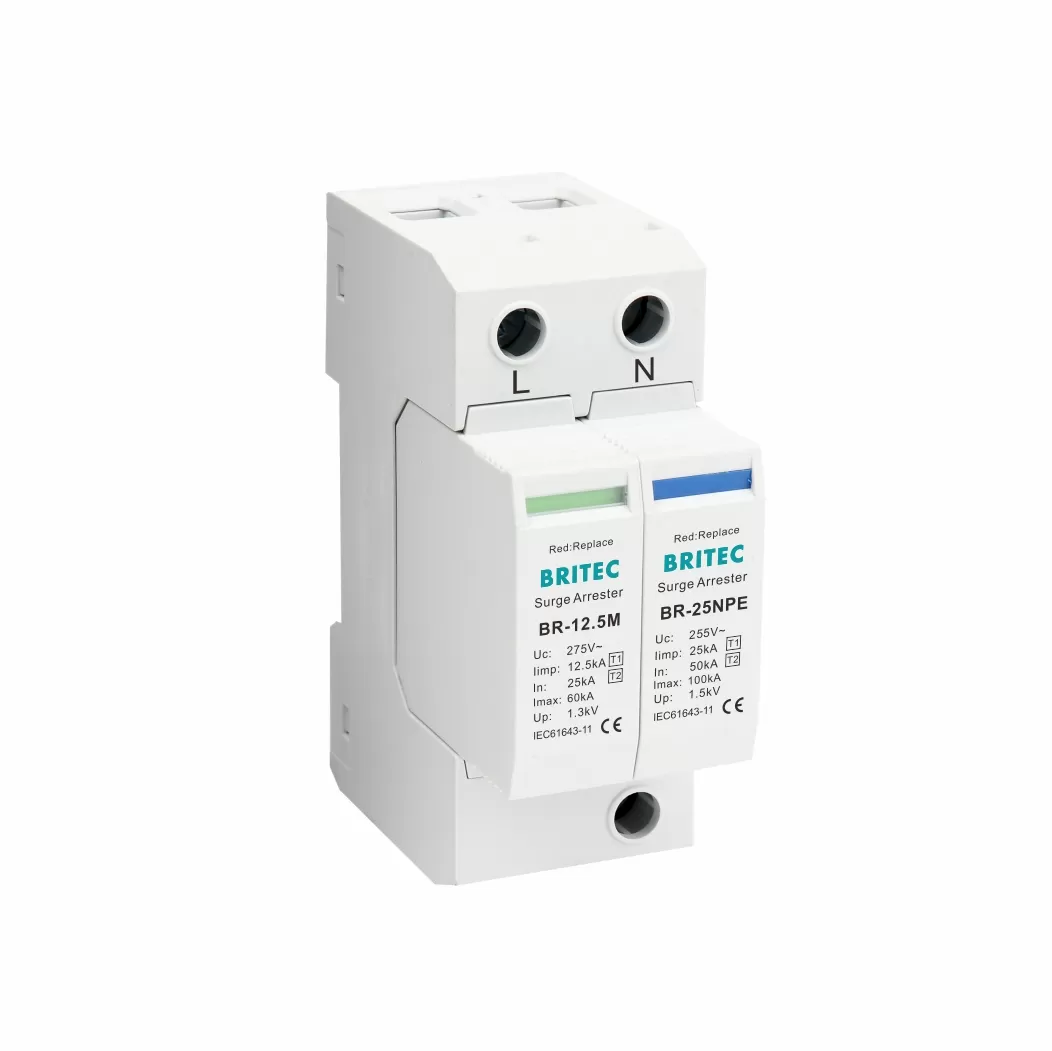
The BR-12.5M combines both duties in one plug-in module, trading lightning current capacity for a voltage protection level of ≤1.3kV.
Choosing a dedicated Type 1 device commits you to a two-stage scheme: the Type 1 unit at the origin plus a Type 2 device downstream, with either about ten metres of cable between them or a decoupling inductor so the stages share energy in the intended sequence. That means two sets of modules, two backup protection devices and two positions on the rail.
A Type 1+2 unit collapses that into one device and one set of connections. It also simplifies the backup arrangement: the BR-12.5M specifies a maximum backup fuse of 125 A gG, against 315 A gG for the BR-25GR — a difference worth checking against the overcurrent device already in the board, since it may decide whether you need to add one at all.
On unit price a Type 1+2 device costs more than a Type 1 device of similar pole count, which makes the comparison look settled until you price the full scheme. Add the downstream Type 2 device, its backup protection, the extra rail space and the additional installation labour, and a two-stage arrangement usually costs more installed than a single combined unit.
The two-stage scheme earns its cost on high-exposure sites, where the Type 1 device’s far greater energy capacity is genuinely needed and the Type 2 stage can be sized and positioned independently. On a moderate installation, paying for that capability leaves it unused.
The table compares two real products — the spark-gap BR-25GR 4P and the varistor-based BR-12.5M 1P+N, both in their 275V versions — to show how the differences appear on an actual datasheet.
| Parameter | Type 1 (BR-25GR 4P, spark gap) | Type 1+2 (BR-12.5M 1P+N, varistor) |
| Classification | Type 1 + Type 2 / Class I + II | Type 1 + Type 2 / Class I + II |
| Iimp (10/350 µs) | 25 kA | 12.5 kA (L-N), 25 kA (N-PE) |
| In (8/20 µs) | 25 kA | 25 kA (L-N), 50 kA (N-PE) |
| Imax (8/20 µs) | 100 kA | 60 kA (L-N), 100 kA (N-PE) |
| Omhoog | ≤ 2.0 kV | ≤ 1.3 kV (L-N), ≤ 1.5 kV (N-PE) |
| Reactietijd | ≤ 100 ns | ≤ 25 ns (L-N), ≤ 100 ns (N-PE) |
| Specific energy W/R | 156 kJ/Ω | 39 kJ/Ω (L-N), 156 kJ/Ω (N-PE) |
| Max. reservezekering | 315 A gG | 125 A gG |
| Isccr | 25 kA rms | 25 kA rms |
| Downstream Type 2 needed? | Almost always | Often not, on simple installations |
| Typical use | High-exposure sites, primary protection | General protection, small installations with LPS |
Read across the Up and response-time rows and the trade-off becomes explicit: the device with twice the lightning current rating lets through 700 V more and takes four times longer to start conducting. Neither figure makes one product better — they make each product right for a different job.
Four scenarios cover most projects.
Choose a dedicated Type 1 device where exposure is high and a coordinated scheme is planned anyway: an industrial site with an external lightning protection system, an overhead supply, or a structure in a high ground flash density region. The greater energy capacity is genuinely required, and the Type 2 stage downstream is being specified regardless.
Choose a Type 1+2 combined unit where the building has an LPS but the installation is otherwise straightforward — a commercial premises, a small industrial unit, a residential property with lightning protection. One device, one set of connections, and a Up low enough to protect the equipment behind it.
Choose Type 1+2 whenever panel space is the binding constraint. Retrofit work in a full board frequently rules out two stages on width alone, and the combined unit is the only arrangement that fits.
And where no lightning protection system exists and the supply is underground in a low-exposure area, neither may be required — a Type 2 device at the origin is often the correct and considerably cheaper specification. Let the IEC 62305 risk assessment decide rather than fitting Type 1 protection by default.
Britec Electric Wenzhou has manufactured surge protective devices since 2003, with ISO 9001 and ISO 14001 certification, products tested to IEC 61643-11 and UL 1449, and an impulse laboratory on site — so both 10/350 µs and 8/20 µs waveforms are verified on production batches rather than only on certification samples.
Both technologies are available across the range. Spark-gap series such as the BR-25GR and BR-25VG deliver Iimp up to 25kA per pole with Imax of 100kA, while varistor-based series including the BR-12.5M and BR-25M offer Up down to 0.8kV with ≤25 ns response. Configurations cover 1P, 1P+N, 2P, 3P, 3P+N and 4P for TN-C, TN-S and TT systems, with Uc options from 150V to 350V, plug-in replaceable modules, green/red status windows and optional remote signalling. Cross-reference support is available if you are replacing devices from another brand.
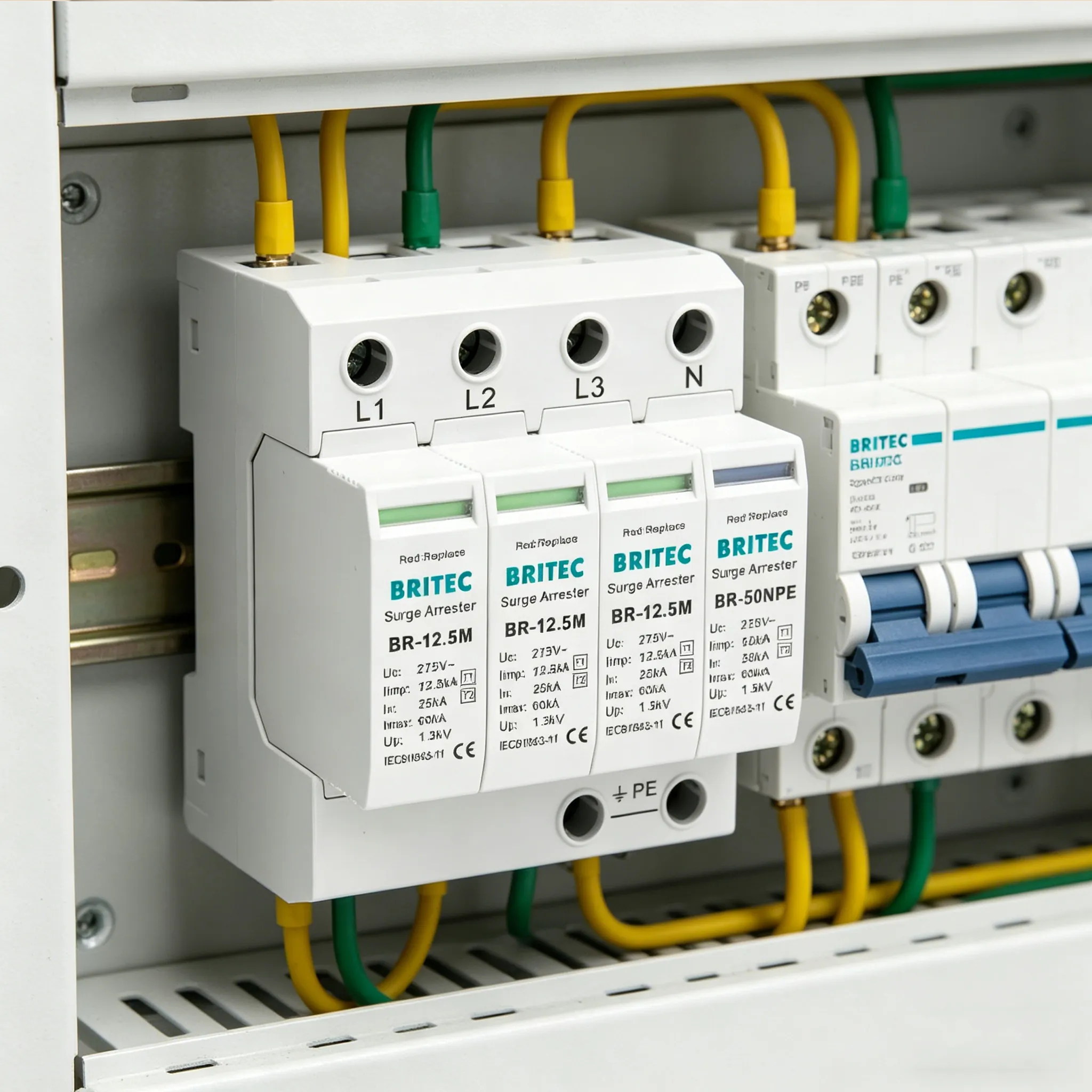
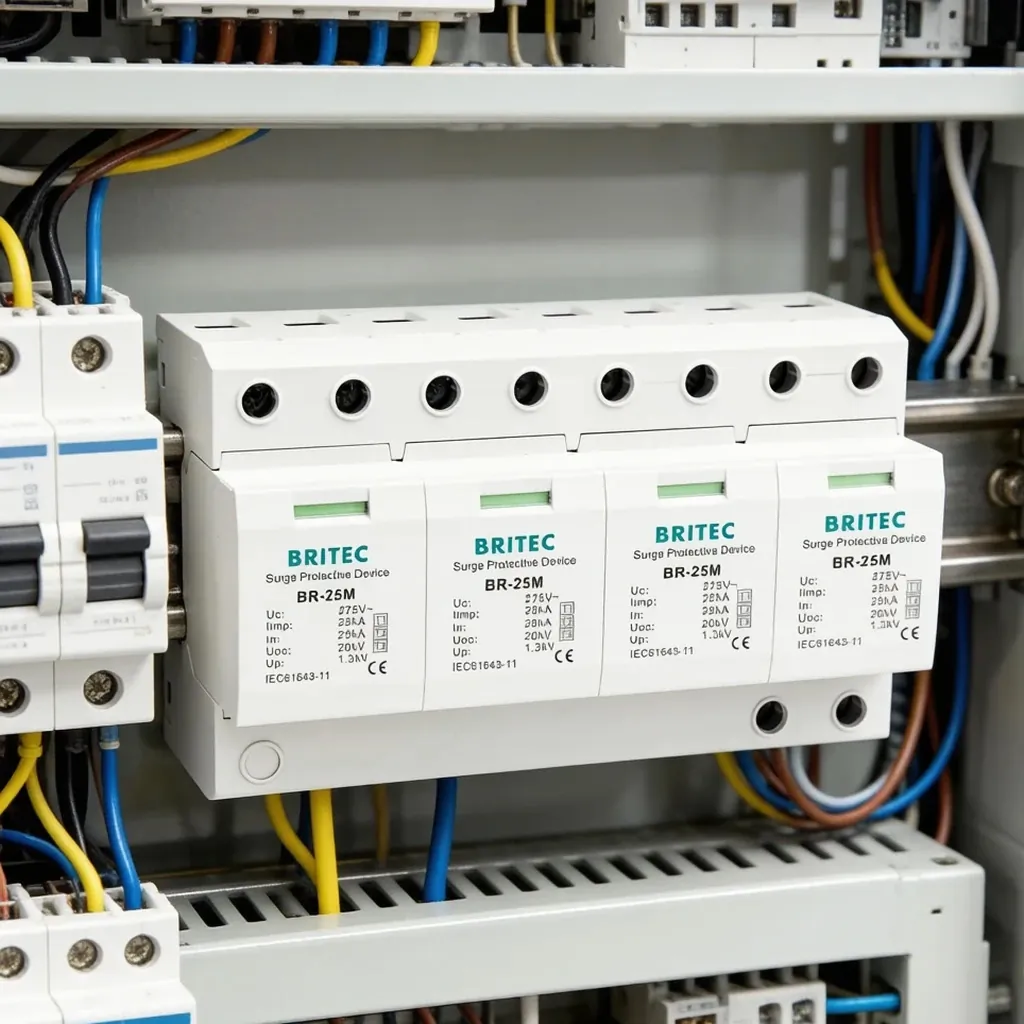
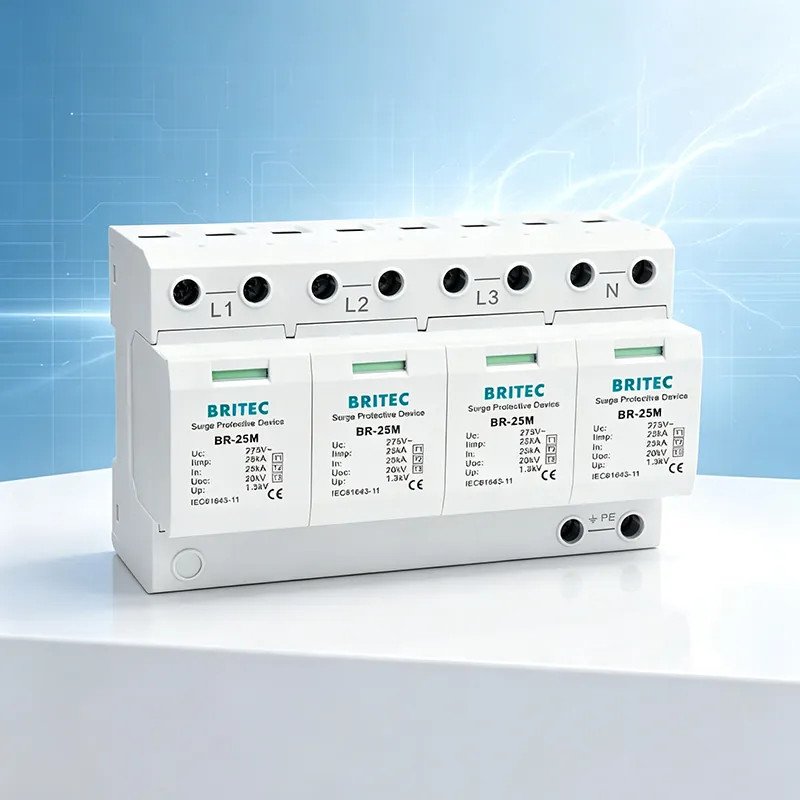
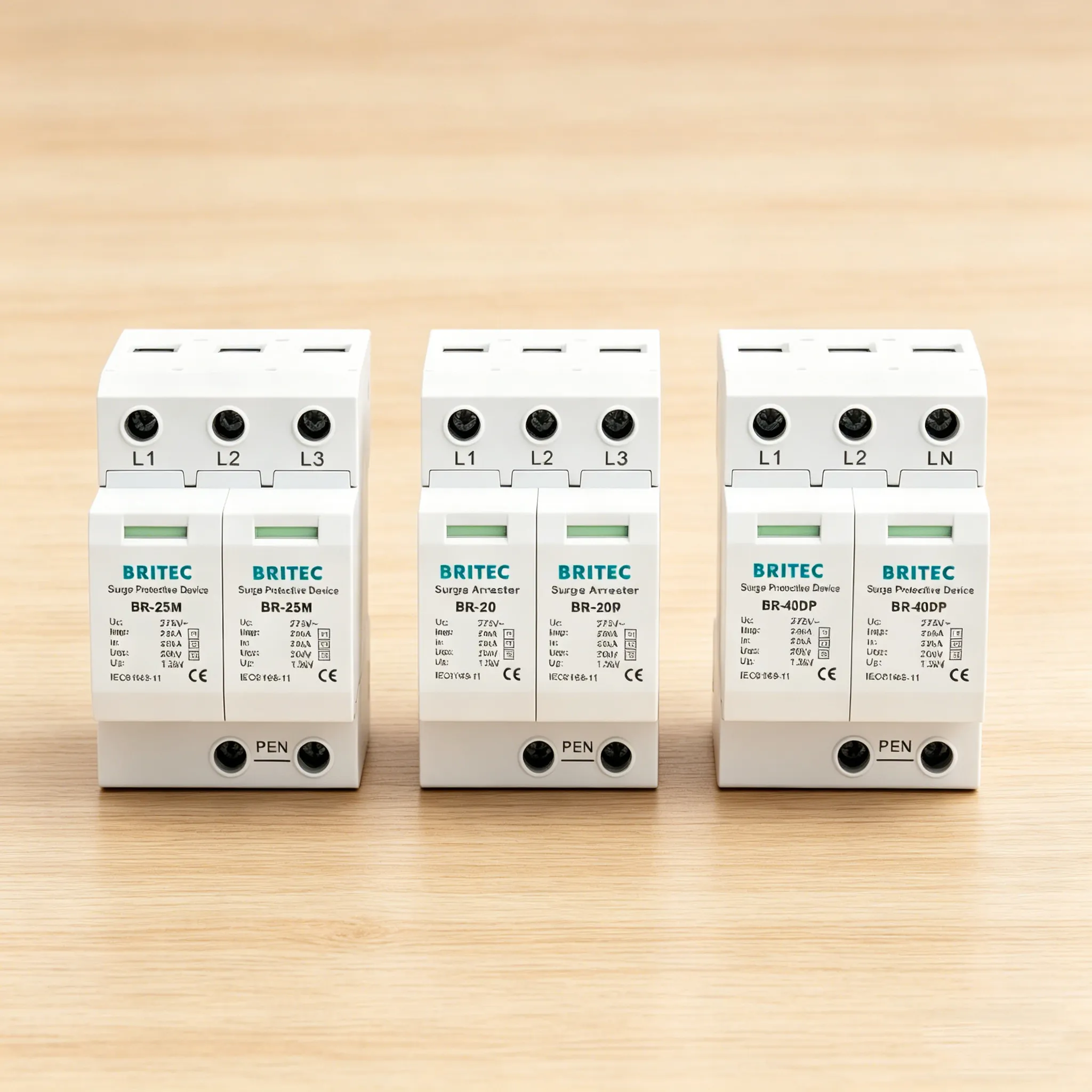
The Type 1+2 range in 3P+N configuration for TT and TN-S systems — combined lightning current and surge protection in a single DIN rail unit.
Yes, and it is often the better choice for a home with a lightning protection system. A single combined unit fits a domestic consumer unit where two stages would not, and its lower voltage protection level suits household electronics. Where the property has no LPS and an underground supply, a Type 2 device is usually sufficient.
Usually, provided the rail space and backup protection align. Check three things: available module width, whether the existing upstream overcurrent device is at or below the specified maximum backup fuse, and whether conductor routing allows total lead length under 0.5 metres. Retrofits often favour combined units precisely because a two-stage scheme will not fit.
Around ten metres of cable between stages is the common guideline, allowing conductor inductance to provide the decoupling that lets each stage take its intended share of energy. Where that distance is impractical, a decoupling inductor achieves the same effect — or a combined Type 1+2 unit removes the coordination question altogether.
Not necessarily, because the technologies age differently. Spark gaps degrade through electrode erosion with each operation, while varistors degrade cumulatively as leakage current rises. Both are rated for years of normal service, and both carry status indication so you can check rather than estimate — inspect the window after any significant storm.
IEC 61643-11 and EN 61643-11 define the classification: Class I testing with Iimp on the 10/350 µs waveform corresponds to Type 1, Class II testing with In on 8/20 µs to Type 2, and devices meeting both are designated Type 1+2 or Class I+II. IEC 62305 covers the risk assessment that determines whether Type 1 protection is required in the first place.
The choice between a Type 1 surge protector and a Type 1+2 combined unit is not a question of which device is stronger but of which trade-off suits your installation — a spark-gap Type 1 device such as the BR-25GR moves far more energy at 25kA Iimp and 156 kJ/Ω, and needs a Type 2 stage downstream because its 2.0kV protection level and 100 ns response leave sensitive equipment exposed, while a varistor-based Type 1+2 unit like the BR-12.5M accepts half the lightning current rating in exchange for a 1.3kV protection level, a 25 ns response and a single device on the rail; specify the two-stage scheme where exposure genuinely demands it, choose the combined unit where the installation is straightforward or panel space is tight, and in both cases read the classification line on the datasheet rather than the category the product is listed under. If you are specifying service entrance protection for a project, contact Britec Electric at [email protected] or +86 0577-6260 5321 for datasheets, certificates and a quotation on the configurations your installation requires — our technical team responds to all enquiries within 24 hours.