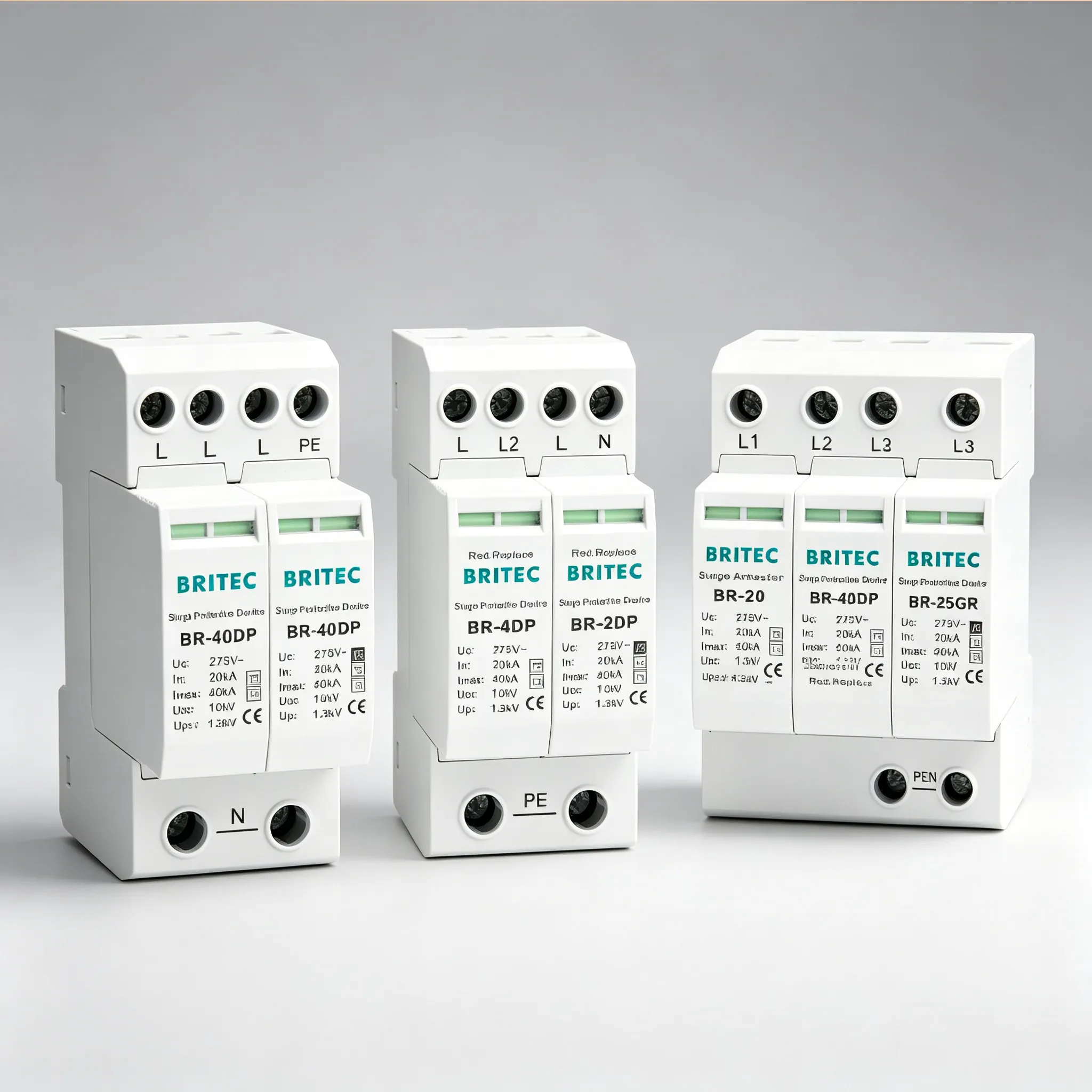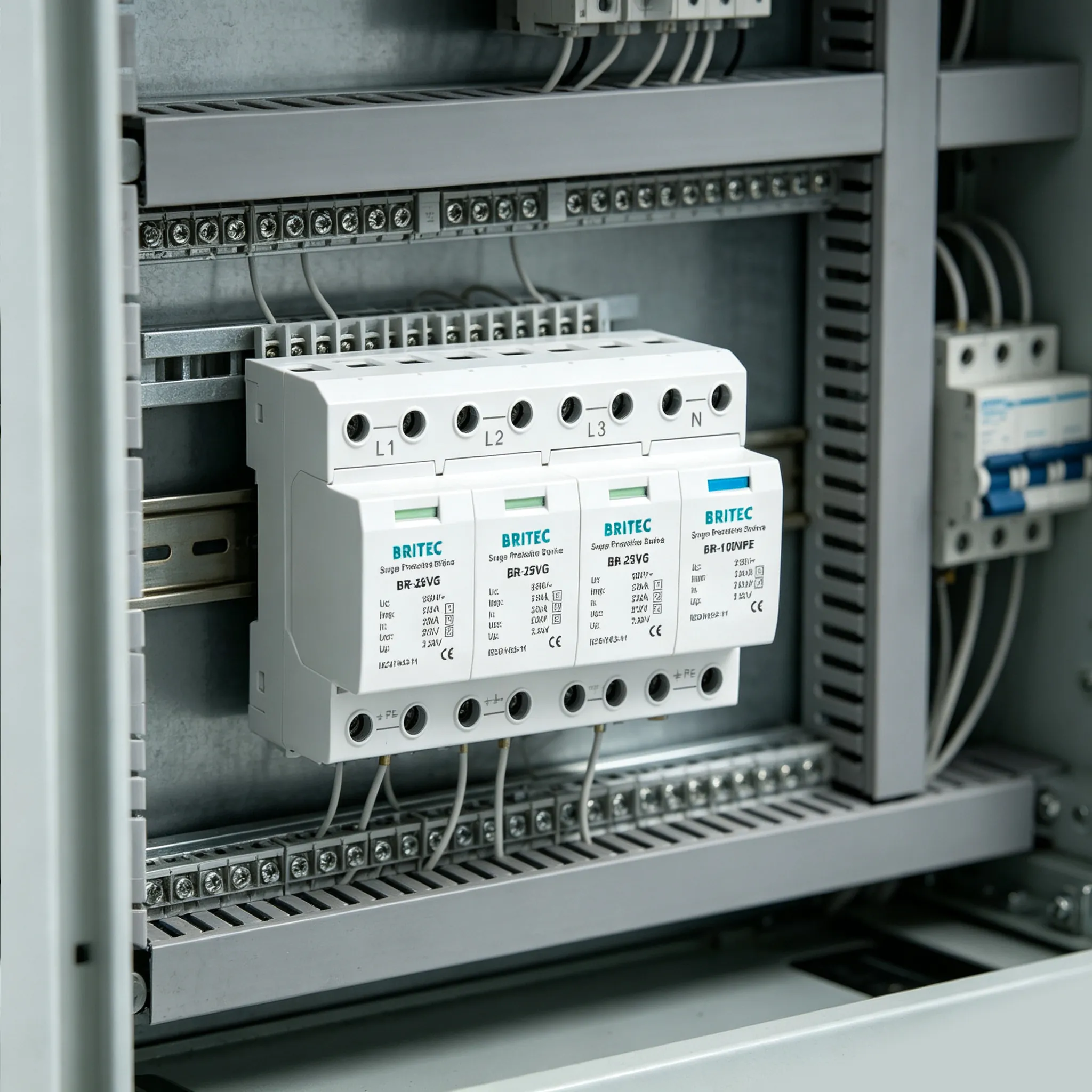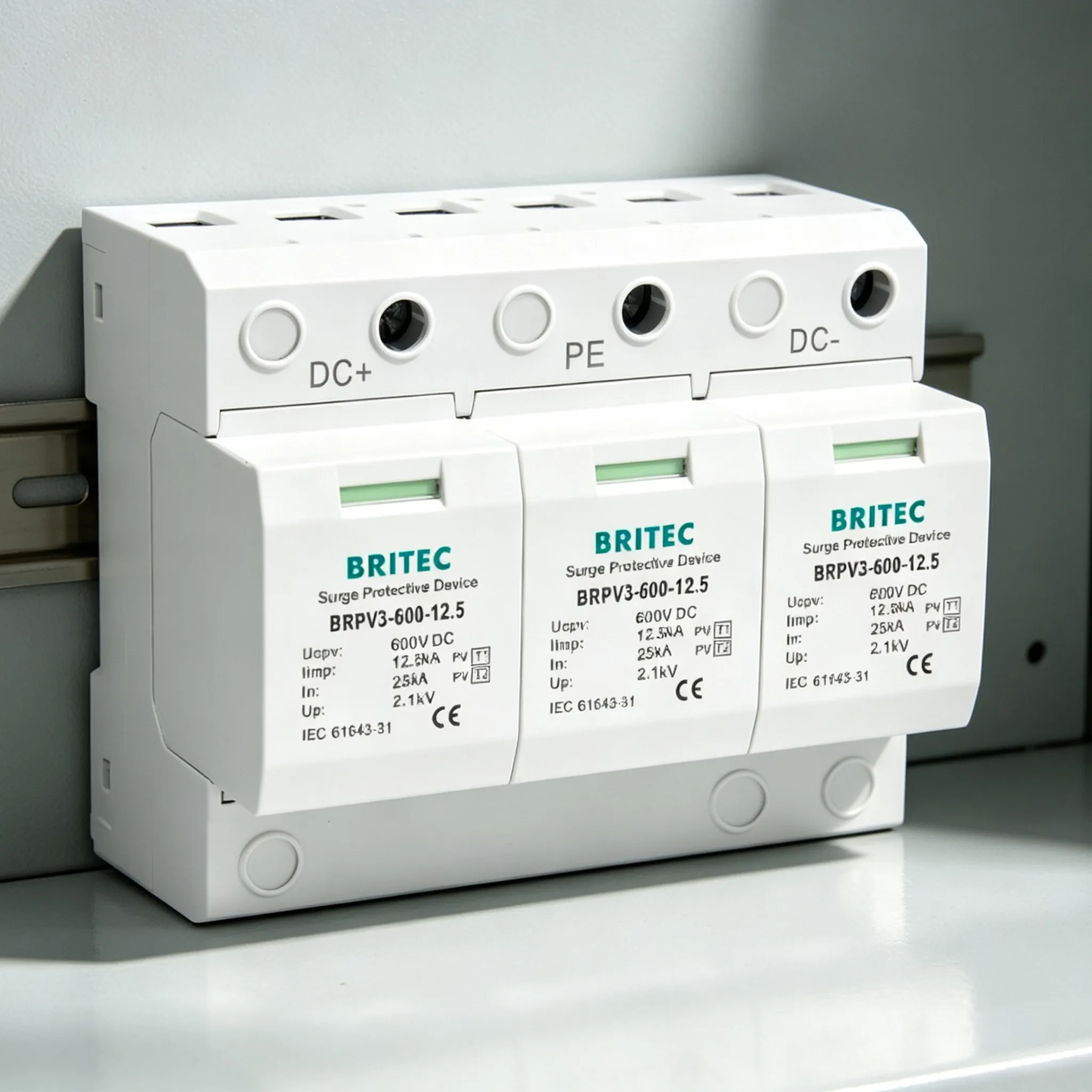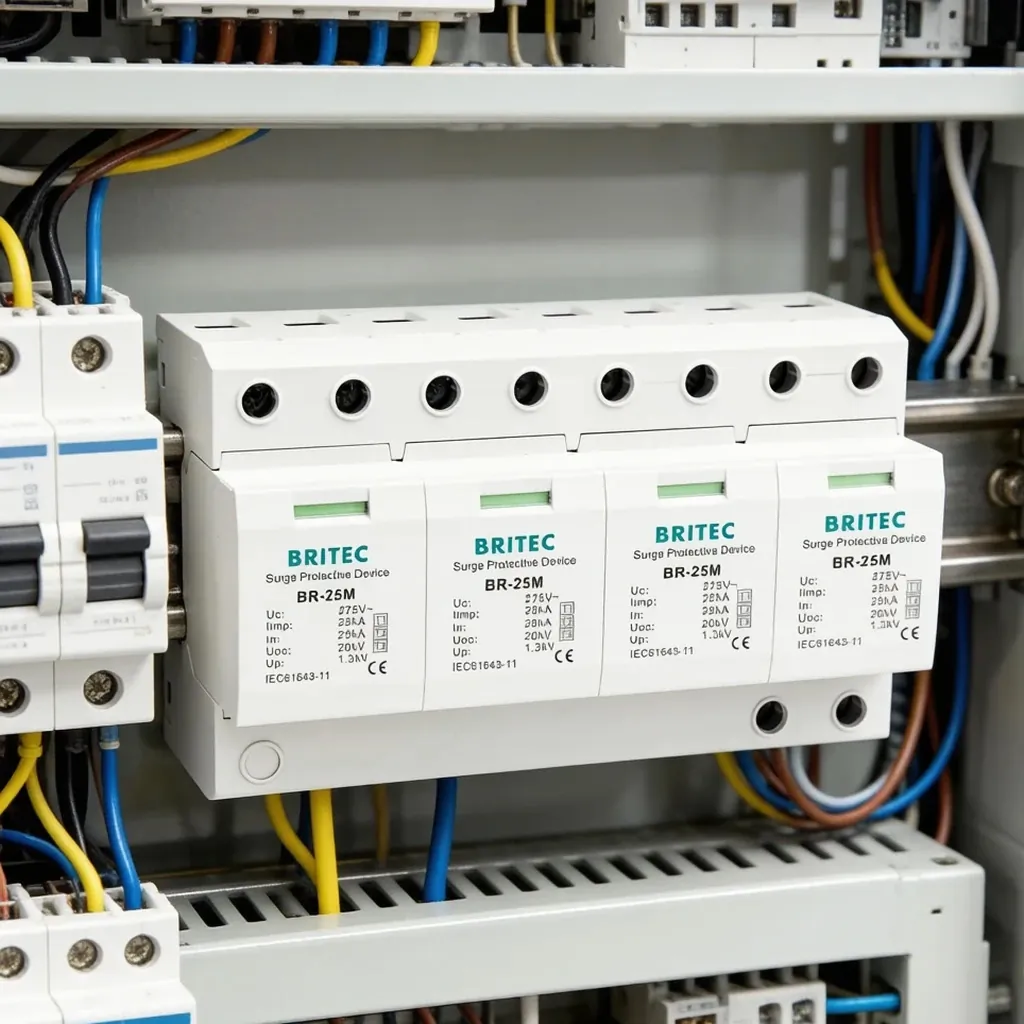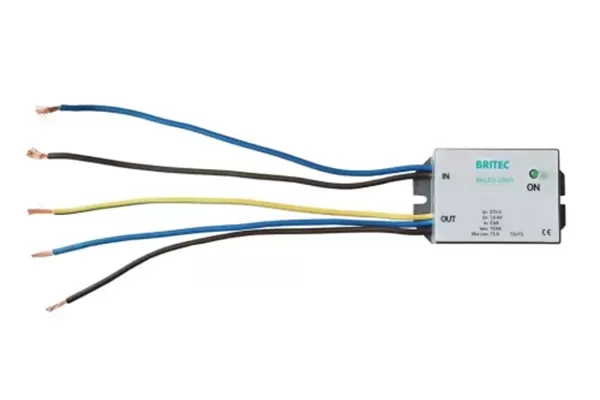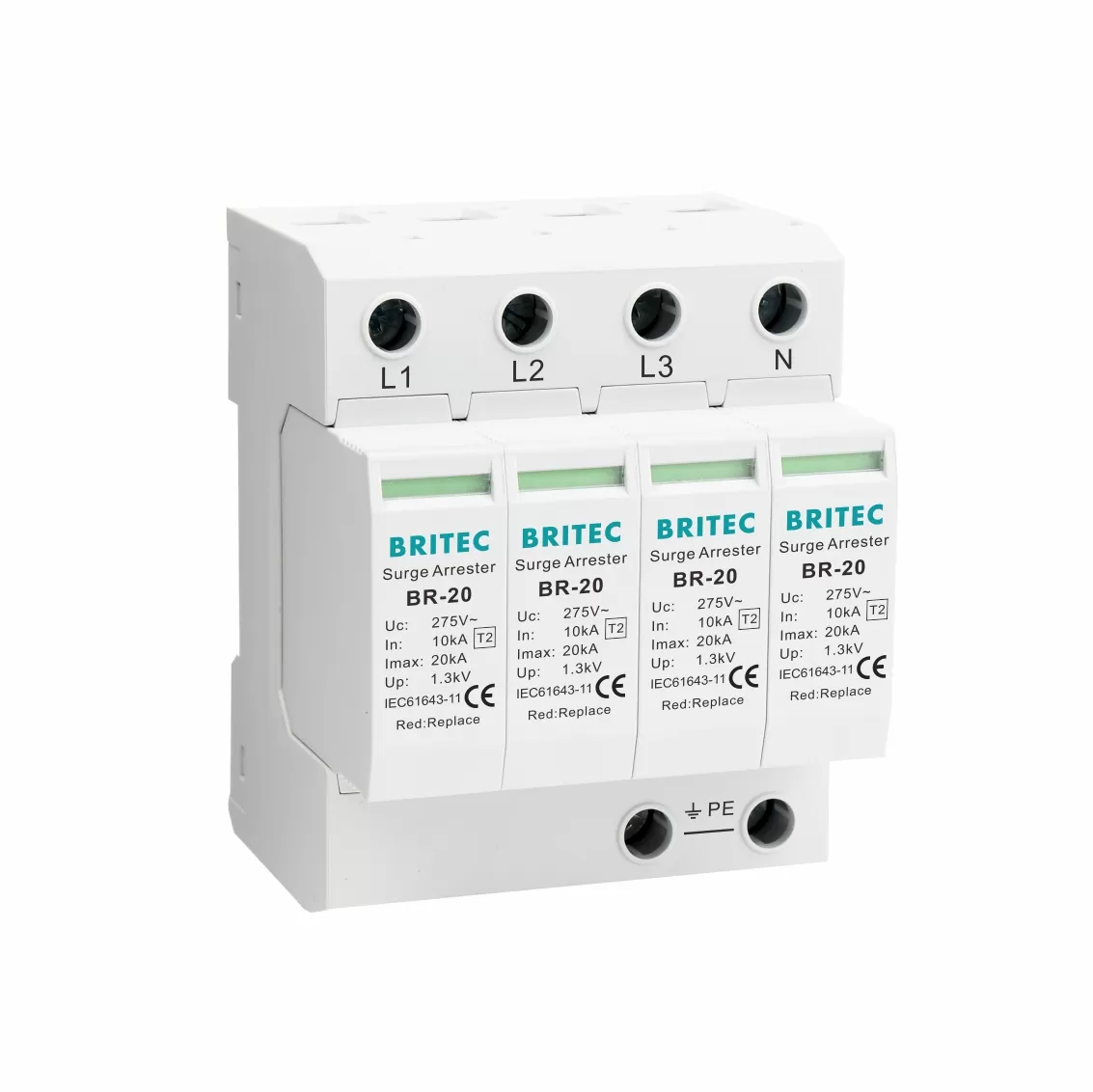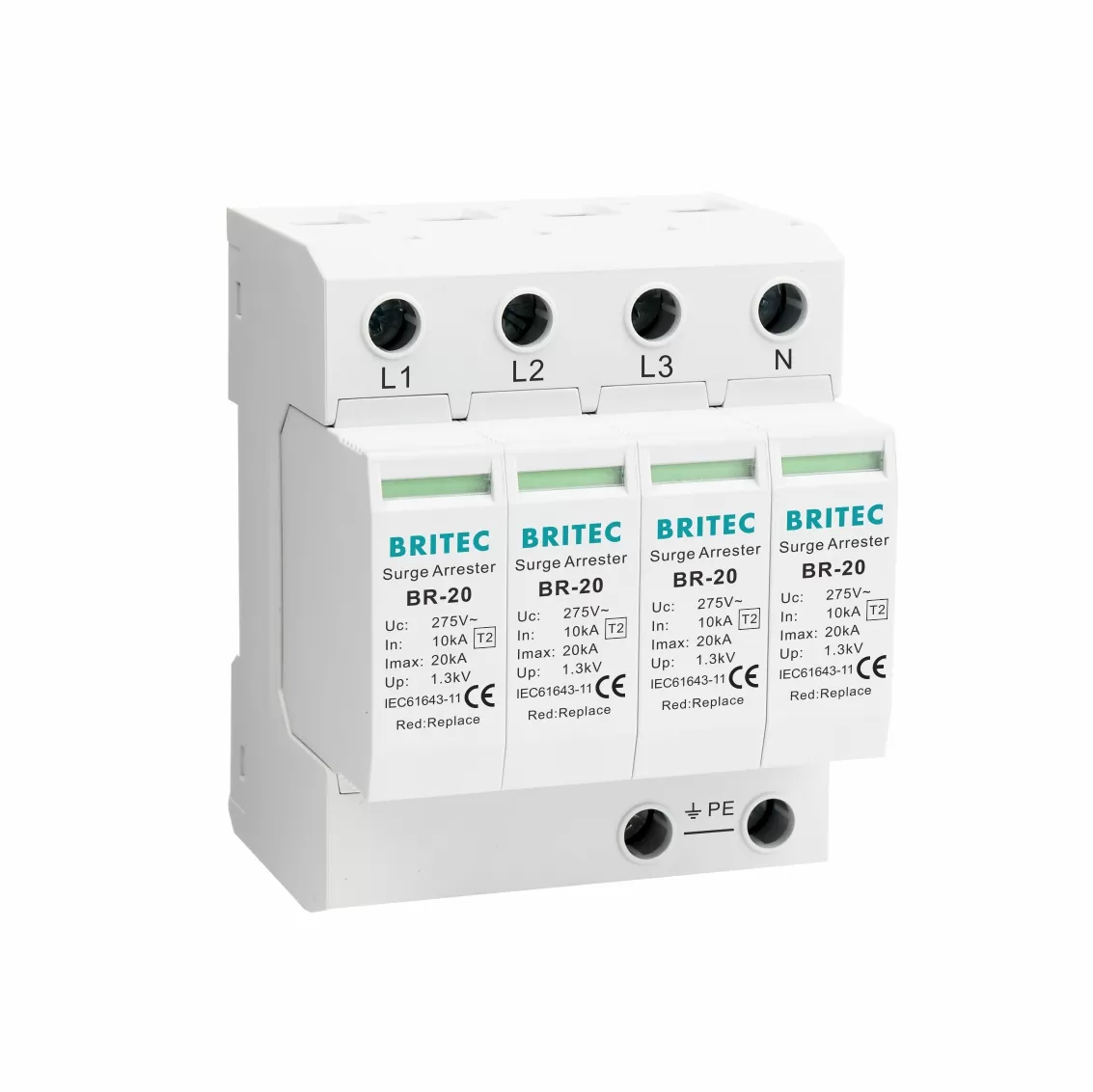

Two devices on a wholesaler’s shelf both say 20kA. One has a nominal discharge current of 20kA and will survive that level repeatedly; the other survives 20kA exactly once, and its repeatable rating is half that. Same number on the box, very different device in the board.
If you fit surge protection into consumer units, sub-boards and small commercial panels, this guide covers what you need to specify a 20kA surge protection device correctly in 2026 — how to read the rating, where the device belongs, the specifications that matter as much as the kA figure, and the point at which 20kA stops being enough for the job in front of you.
Type 2 devices carry two current ratings, both tested on the 8/20 µs waveform — a short impulse that represents induced and switching surges rather than direct lightning current.
Nominal discharge current (In) is the level the device withstands repeatedly, typically fifteen to twenty times, without degrading. Maximum discharge current (Imax) is a single-shot survival figure; after an event at that level the device may still function but has consumed a significant share of its life. On a well-specified 20kA Type 2 SPD you would expect In of 20kA with Imax around 40kA. A product quoting 20kA as Imax is roughly half the device, so check which figure the headline number refers to before you compare prices.
A 20kA device is a downstream product. Its natural position is a sub-distribution board or final circuit board that already has upstream protection at the origin of the installation, where the incoming device has absorbed the bulk of any high-energy event and the 20kA unit handles what passes through.
This is also where a 20kA surge protector for distribution board use earns its place economically: fitting a higher rating at every sub-board adds cost without adding protection, because the energy reaching those boards has already been limited by the device upstream.
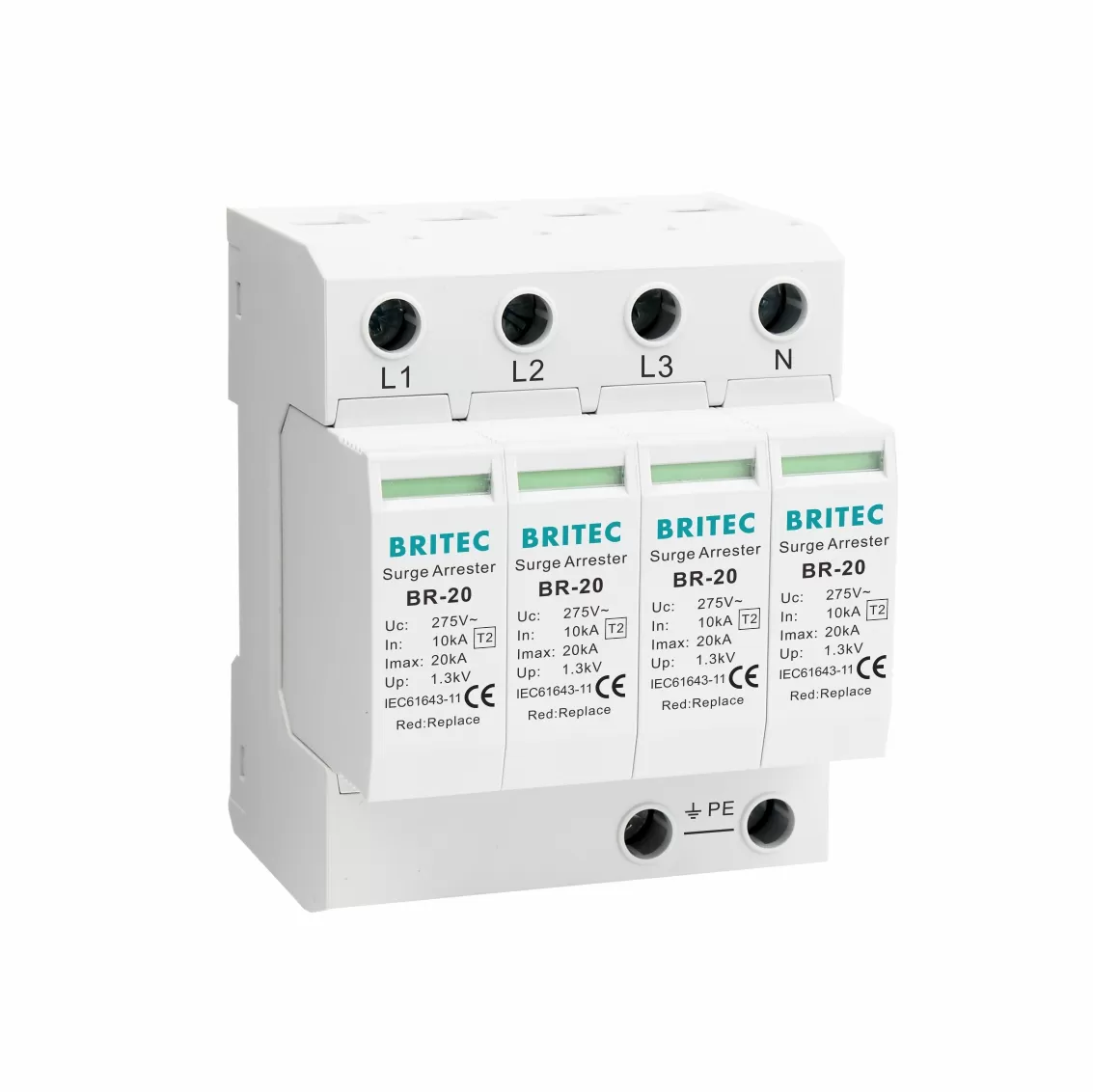
A 20kA Type 2 SPD on DIN rail — check the label to confirm whether the 20kA figure is In or Imax before specifying.
On domestic installations with an underground supply, no external lightning protection system and low ground flash density, a 20kA Type 2 device at the consumer unit is a sound specification. The realistic threat is induced and switching transients from the local network and from appliances in the property, and 20kA covers that comfortably.
Where the property has an overhead service drop, sits in an exposed position, or is in a region with frequent thunderstorm activity, move up the range — the exposure profile has changed even though the load has not.
Light commercial premises usually present a single main board feeding a modest electronic load: tills and payment terminals, a small server or network cabinet, lighting control, and increasingly a heat pump or a single EV charge point.
A 20kA device at the main board suits this profile where the supply is underground and the building has no LPS. If the site runs critical IT or holds card payment infrastructure, add a Type 3 device close to that equipment rather than raising the main board rating — the residual voltage at the sensitive load, not the kA figure at the origin, is what protects it.
The kA rating is the number everyone quotes and rarely the one that determines whether the installation is protected. Four other parameters do more of the work, and the table below sets out what each means alongside the values you would expect on a 20kA device for a 230/400V supply.
| Parametro | What It Means | Typical Value on a 20kA Device |
| Uc | Maximum continuous operating voltage the SPD tolerates without conducting | 275V AC (for a 230V nominal supply) |
| Su | Voltage protection level — what actually reaches downstream equipment | 1.2–1.5 kV |
| In | Nominal discharge current, withstood repeatedly on 8/20 µs | 20 kA |
| Imax | Maximum discharge current, single-shot survival on 8/20 µs | 40 kA |
| Tempo di risposta | Time for the varistor to begin conducting | ≤ 25 ns |
| Backup protection | Fuse or breaker isolating the SPD if it fails short at end of life | gG fuse per manufacturer datasheet, commonly 32–63 A |
| Module width | DIN rail space required, per pole | 1 module (18 mm) per pole |
Two of these deserve a second look on site. Uc must exceed your highest expected supply voltage — specifying 275V on a supply prone to overvoltage invites premature ageing. And Up must sit below the impulse withstand of the equipment it protects; a device with a high Up passes through more than sensitive electronics can tolerate, regardless of how large the kA rating is.
Three rules turn a correctly specified device into a correctly protected installation.
Keep connecting leads short. The total conductor length on the live and earth sides combined should stay within about 0.5 metres, because inductive voltage drop across longer leads adds directly to the protection level your equipment sees. A V-connection, where the supply conductors land on the SPD terminals in series, removes the problem entirely where the board layout allows it.
Coordinate with upstream devices. A 20kA Type 2 unit needs adequate cable length — commonly around ten metres — or a decoupling element between it and any upstream SPD, so the two stages share energy in the intended sequence rather than the downstream device taking more than its share.
Match the configuration to the earthing system: 1P or 1P+N on single-phase supplies, 3P for TN-C, 4P or 3P+N for TN-S, and 3P+N incorporating an N-PE spark gap for TT. Confirm the arrangement on site before ordering, since a mismatch leaves a conductor unprotected or creates an unwanted current path.
Five situations should move you up the range, and two of them are appearing far more often in 2026 than they did five years ago.
An external lightning protection system on the building changes the requirement entirely — you need a Type 1 device at the origin, tested on the 10/350 µs waveform, because partial lightning current is a different problem from the induced transients a Type 2 handles. An overhead supply, an isolated or elevated site, or a region with high ground flash density all point the same way.
The two newer triggers are load-side. EV charge points and heat pumps are now routine additions to domestic and light commercial boards, and both concentrate expensive power electronics on circuits that previously carried nothing more sensitive than a socket outlet. A property with a 7kW charger and an air-source heat pump has considerably more to lose than the same property did before, which justifies a higher rating at the main board and often a dedicated device at the charger.
Finally, a history of SPD failures on site is evidence rather than coincidence. If a device has operated more than once in a few years, the exposure is higher than the original specification assumed.
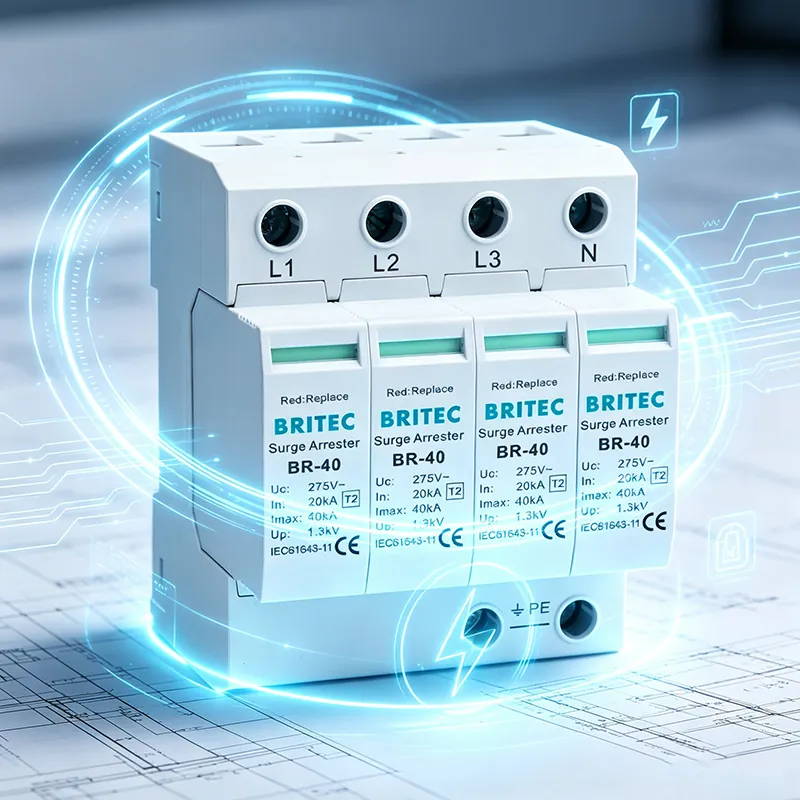
Where exposure or load value rules out a 20kA specification, a higher-rated Type 2 device is the straightforward upgrade path.
Run through these seven points before the board goes live. They take a few minutes and cover the errors that account for most field failures.
Confirm the earthing arrangement on site rather than from the drawing, and select the pole configuration accordingly. Verify what protection sits upstream, and check that cable length or decoupling between stages is adequate. Check Uc against the actual supply voltage, including any known overvoltage tendency on the network. Confirm the backup fuse or breaker matches the manufacturer’s stated rating — not a convenient nearby size. Plan lead routing so total conductor length stays under 0.5 metres before you start terminating. Check DIN rail space, allowing one module per pole. And confirm the status indication arrangement: a visual window is sufficient for a board someone inspects, while an unattended installation needs a remote signalling contact wired to something that will report it.
Britec Electric Wenzhou has manufactured surge protective devices since 2003, with ISO 9001 and ISO 14001 certification and products tested in-house to IEC 61643-11 and UL 1449 — which means production batches are verified on the 8/20 µs waveform, not only design samples at certification.
The Type 2 range covers 20kA and higher ratings in 1P, 1P+N, 2P, 3P, 3P+N and 4P configurations for TN-C, TN-S and TT systems, with replaceable modules, visual status indication and optional remote signalling contacts. Type 1, Type 1+2 and Type 3 devices are available from the same range where a project needs coordinated stages, and cross-reference support is provided for the major European brands if you are replacing an existing installation.
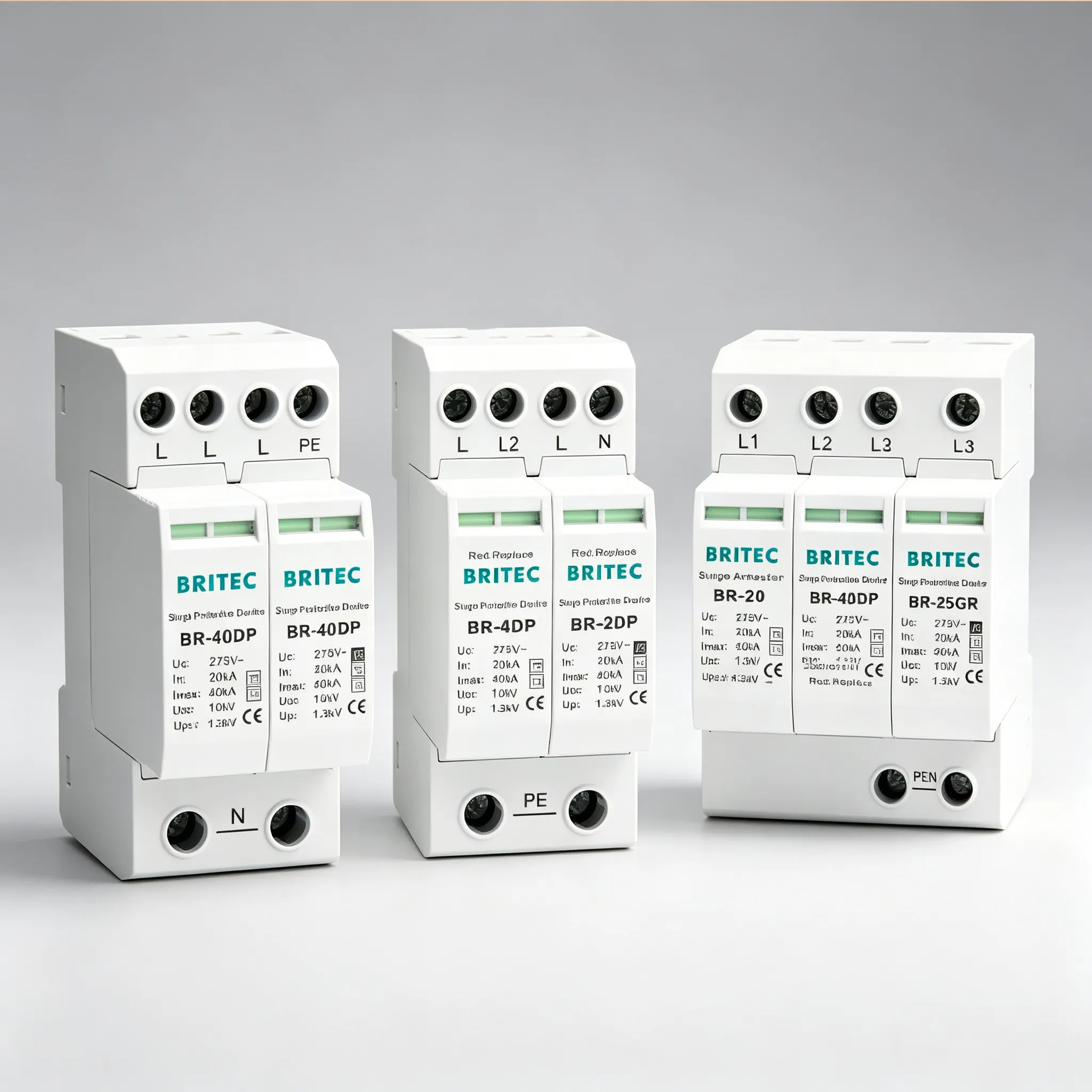
Britec surge protective devices on DIN rail, with the status window that tells you whether protection is still active.
For most homes, yes — provided the supply is underground, the property has no external lightning protection system, and it is not in a high-exposure location. Where the service is overhead, the site is exposed, or the property has an EV charger, heat pump or solar installation, specify a higher rating or add a Type 1 device at the origin.
In is the current the device withstands repeatedly without degrading; Imax is what it survives once. A device with In 20kA is substantially more capable than one with Imax 20kA, even though both may be advertised as 20kA. Always check which figure the datasheet headline refers to.
It can where the installation has no external lightning protection system and the supply is underground in a low-exposure area — a Type 2 device at the origin is a recognised arrangement in that case. Where an LPS exists or direct strike exposure is identified by risk assessment, a Type 1 device is required instead.
Use the fuse or breaker type and rating stated on the datasheet, commonly a gG fuse in the 32–63 A range for Type 2 devices. If the upstream overcurrent device already meets that specification, a separate backup is not needed. Undersizing causes nuisance disconnection; oversizing leaves the SPD unprotected in the failure mode the backup exists to cover.
No. Beyond the level your exposure justifies, extra kA adds cost rather than protection, and it does nothing about the parameter that actually protects sensitive equipment — the voltage protection level. A 20kA device with a low Up, correctly coordinated and installed with short leads, outperforms a higher-rated device fitted with long connecting conductors.
Specifying a 20kA surge protection device correctly comes down to a handful of checks that take minutes on site — establish whether the headline figure is In or Imax before comparing products, position the device downstream of origin protection where its rating makes economic sense, match Uc to the real supply voltage and Up to the withstand of the equipment behind it, keep total lead length under 0.5 metres, and confirm the pole configuration against the earthing arrangement rather than the drawing; then apply the upgrade test honestly, because an external lightning protection system, an overhead supply, or the EV charger and heat pump that arrived on the board last year all move the job beyond what a 20kA device was chosen to do. If you are specifying surge protection for 2026 projects, contact Britec Electric at [email protected] or +86 0577-6260 5321 for datasheets, certificates and a quotation on the ratings and configurations your installations require — our technical team responds to all enquiries within 24 hours.