
If you buy surge protection devices for resale, panel assembly, or project specification, your supplier decision outlives every individual purchase order. The devices you sell for the next five years will carry that supplier’s tolerances, materials, and quality control — and if a batch fails in the field, your customer calls you, not the factory in Zhejiang.
Yet most sourcing decisions still come down to a price comparison across three quotations. That approach works for commodity fasteners. It does not work for a component whose entire purpose is to survive a rare, high-energy event that nobody witnesses until the equipment behind it is already destroyed.
The ten criteria below give you a repeatable framework for evaluating any surge protector supplier, whether you are qualifying a new manufacturer in China or auditing one you have used for years. Work through them in order, and the shortlist tends to narrow itself.
Start here, because everything downstream depends on it. Your supplier should hold ISO 9001 for quality management, and their products should be tested to IEC 61643-11 for AC surge protective devices, IEC 61643-31 for photovoltaic applications, or UL 1449 if you sell into North America.
Ask for the certificates and read them properly. Check that the certificate number, the issuing body, and the product model on the document actually match what you are buying. A certificate covering one SKU does not cover the whole catalogue, and this is where weaker suppliers rely on buyers not looking closely.
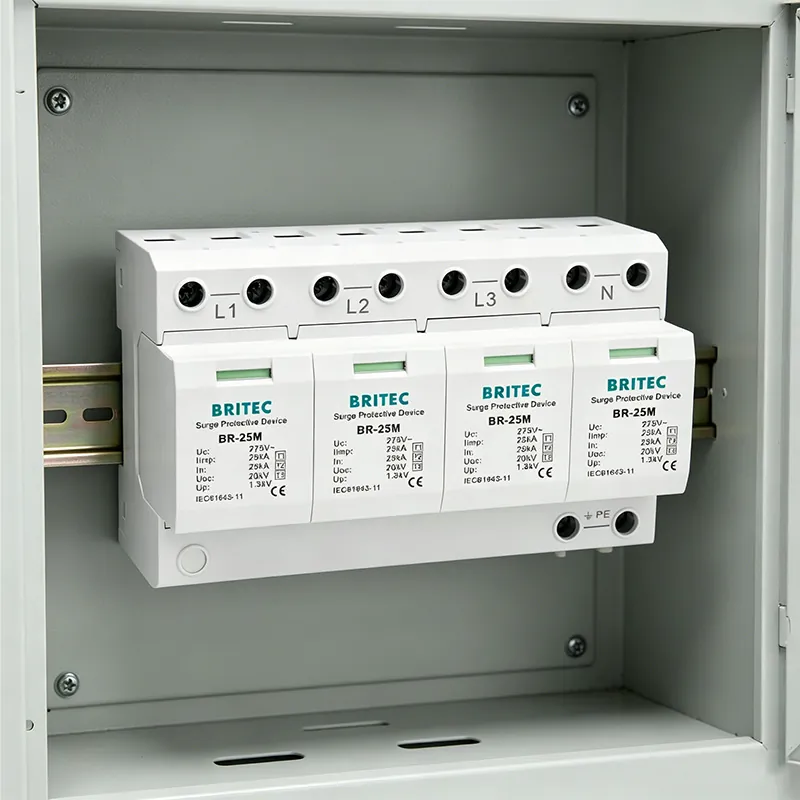
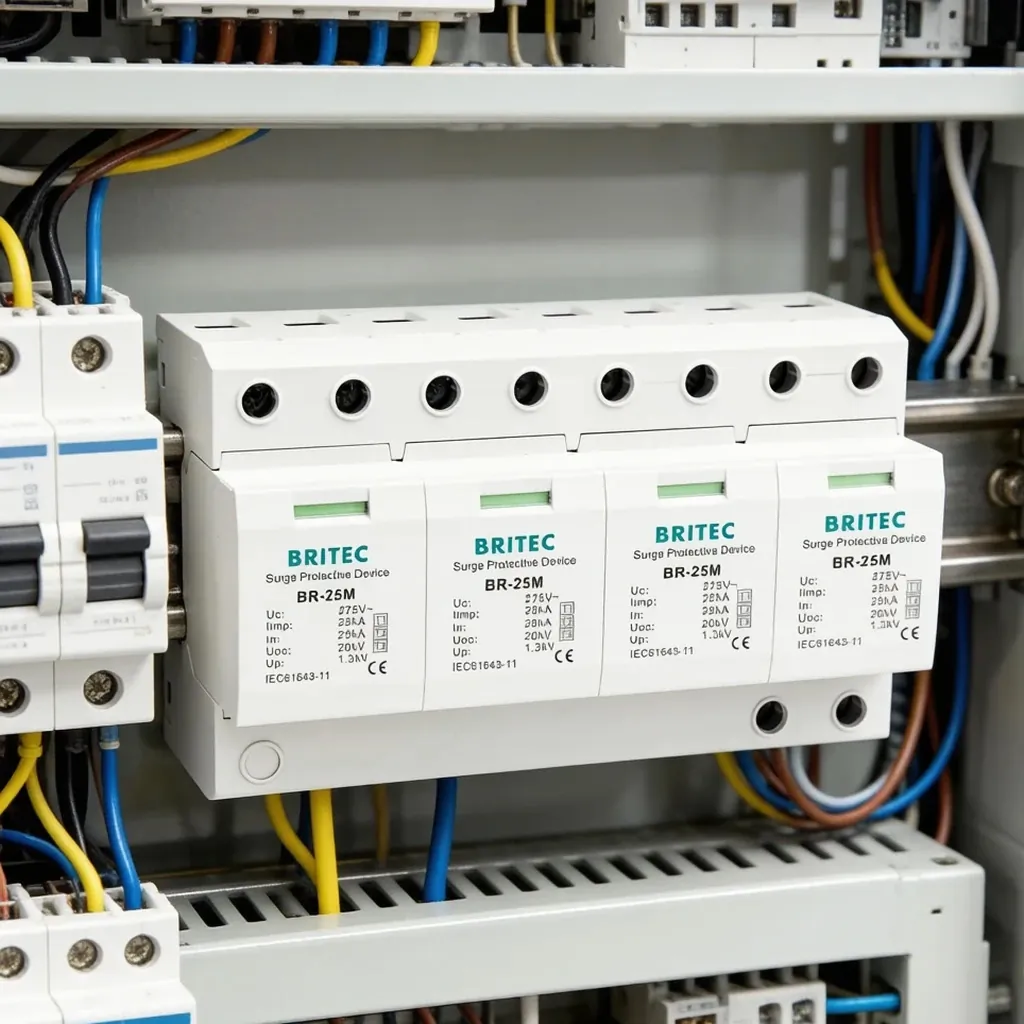
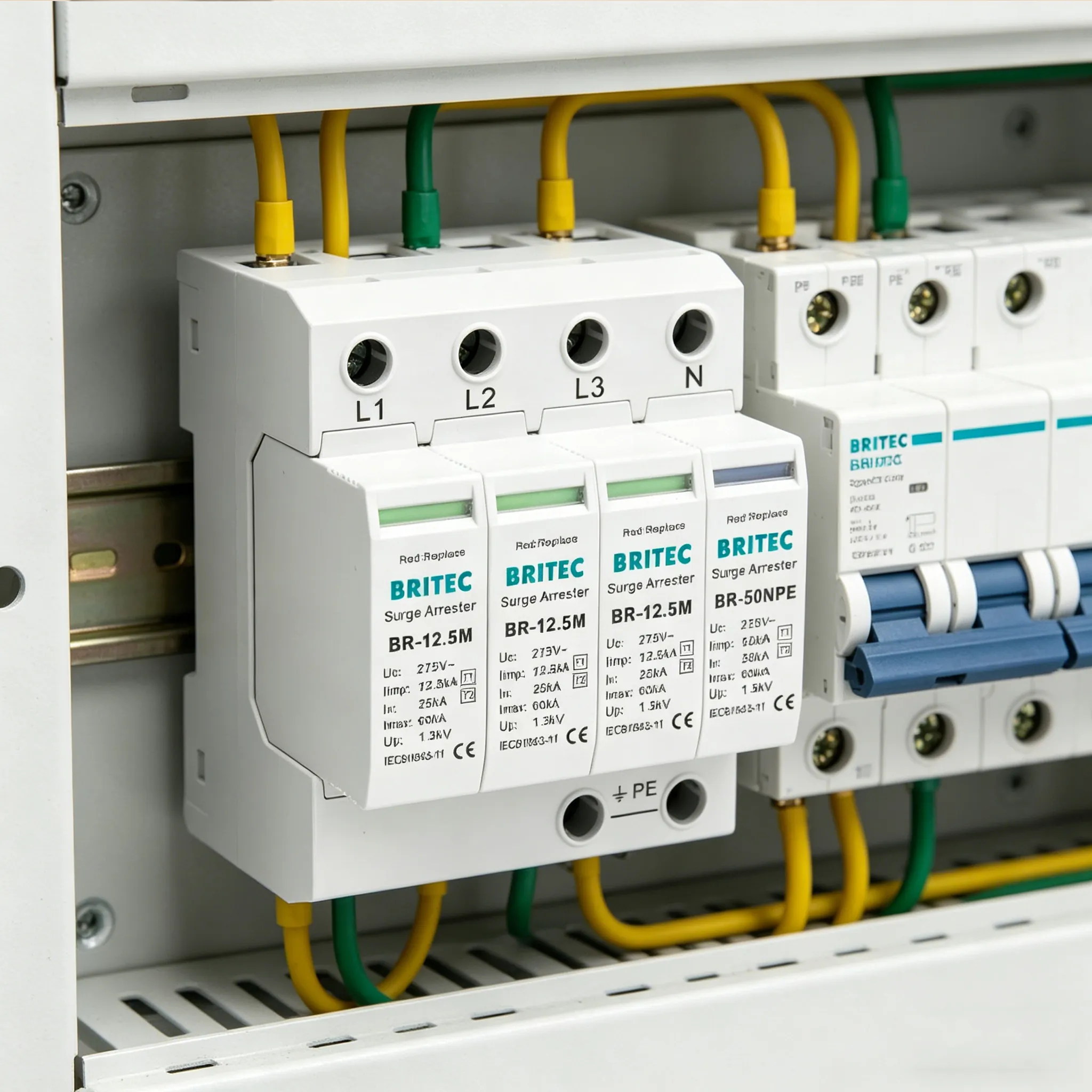
A Britec BR-25M Type 1 SPD, with Uc, Iimp, In, Imax and Up ratings and the IEC 61643-11 reference printed directly on the module face.
A manufacturer that owns its impulse generator can test every design iteration and audit production batches whenever it chooses. One that outsources testing can only afford to test at certification milestones — which means the units shipping to you in month eighteen may never have been verified at all.
Ask directly whether the factory has an impulse current generator on site, what waveforms it produces (8/20 μs and 10/350 μs), and whether they can run a witness test while you visit. The answer separates real manufacturers from assemblers who buy modules and print their own label on the housing.
Years in business matter less than years making this specific product. A supplier that has produced surge protection devices for two decades has seen field failures you have not, and has already engineered around them.
Ask which markets they have supplied longest, which certifications they have held continuously, and whether they can name reference projects. A manufacturer like Britec, established in 2003 and focused on SPDs throughout, has accumulated failure data that a newer entrant simply cannot have.
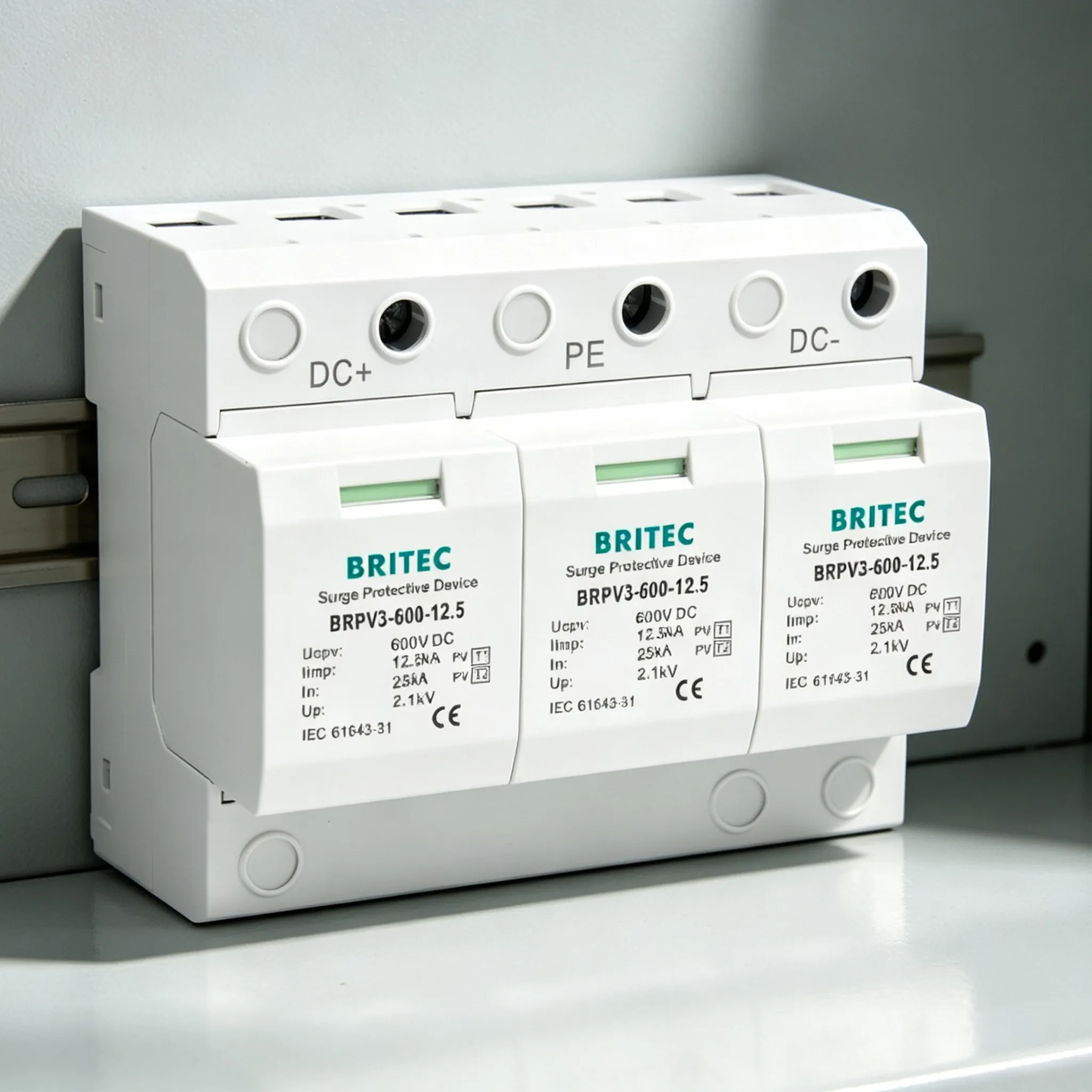
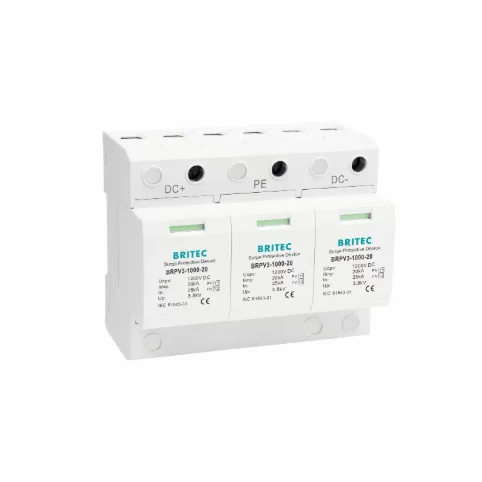
Range depth protects you from a specific commercial problem: the project that needs one item you cannot source. If your supplier covers Type 1, Type 1+2, Type 2 and Type 3 AC devices, plus DC and PV protectors, LED protectors and signal-line SPDs, you can serve a whole installation from one purchase order.
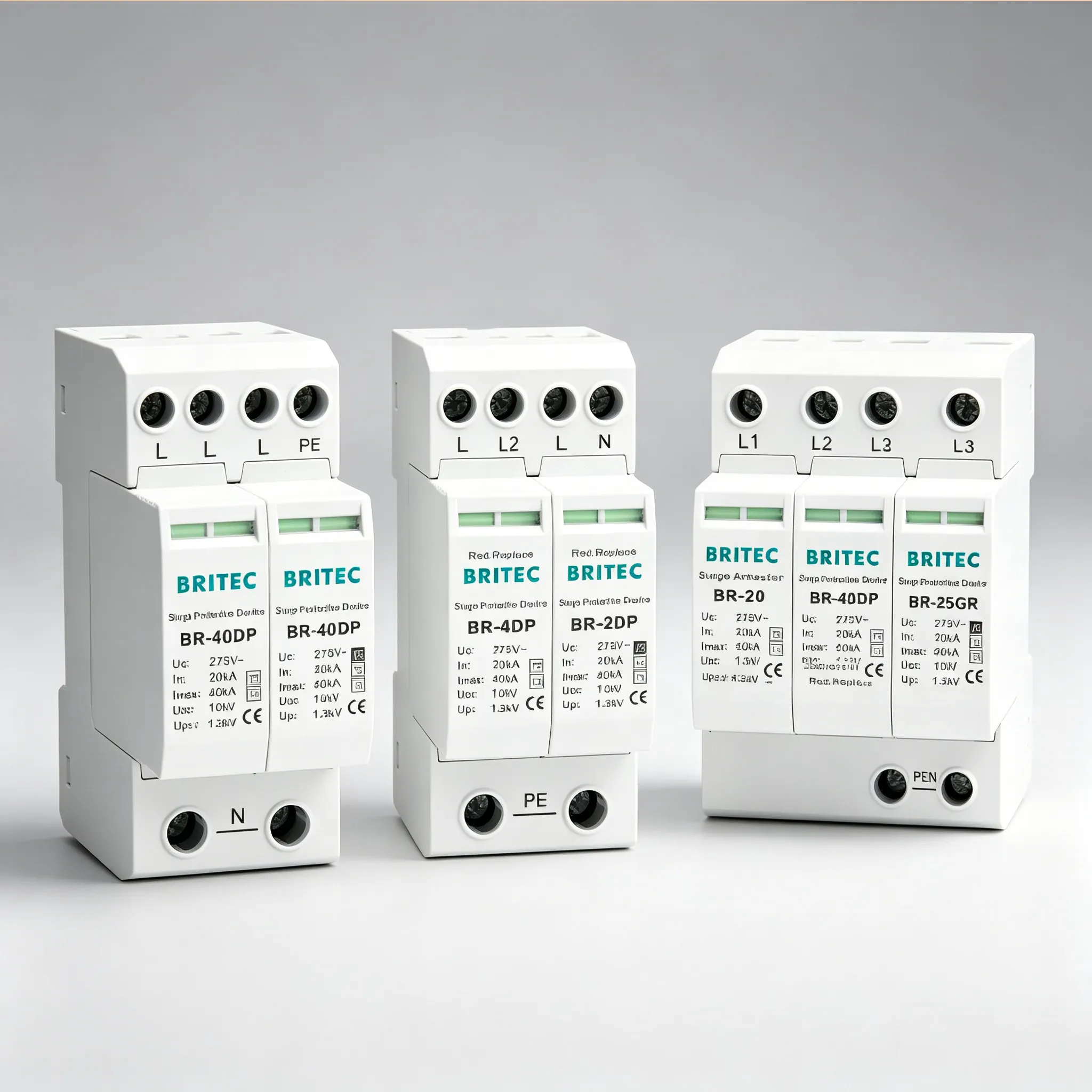
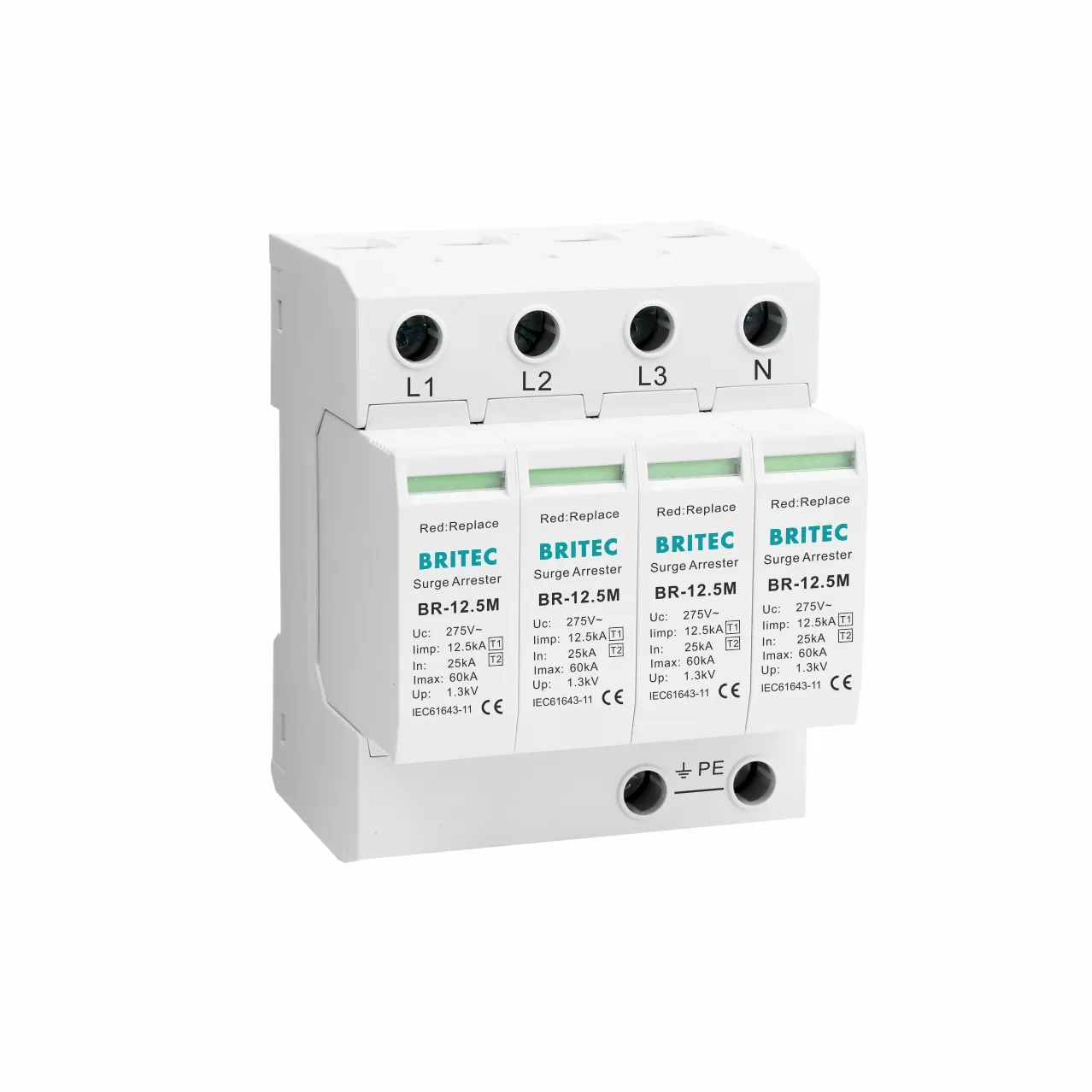
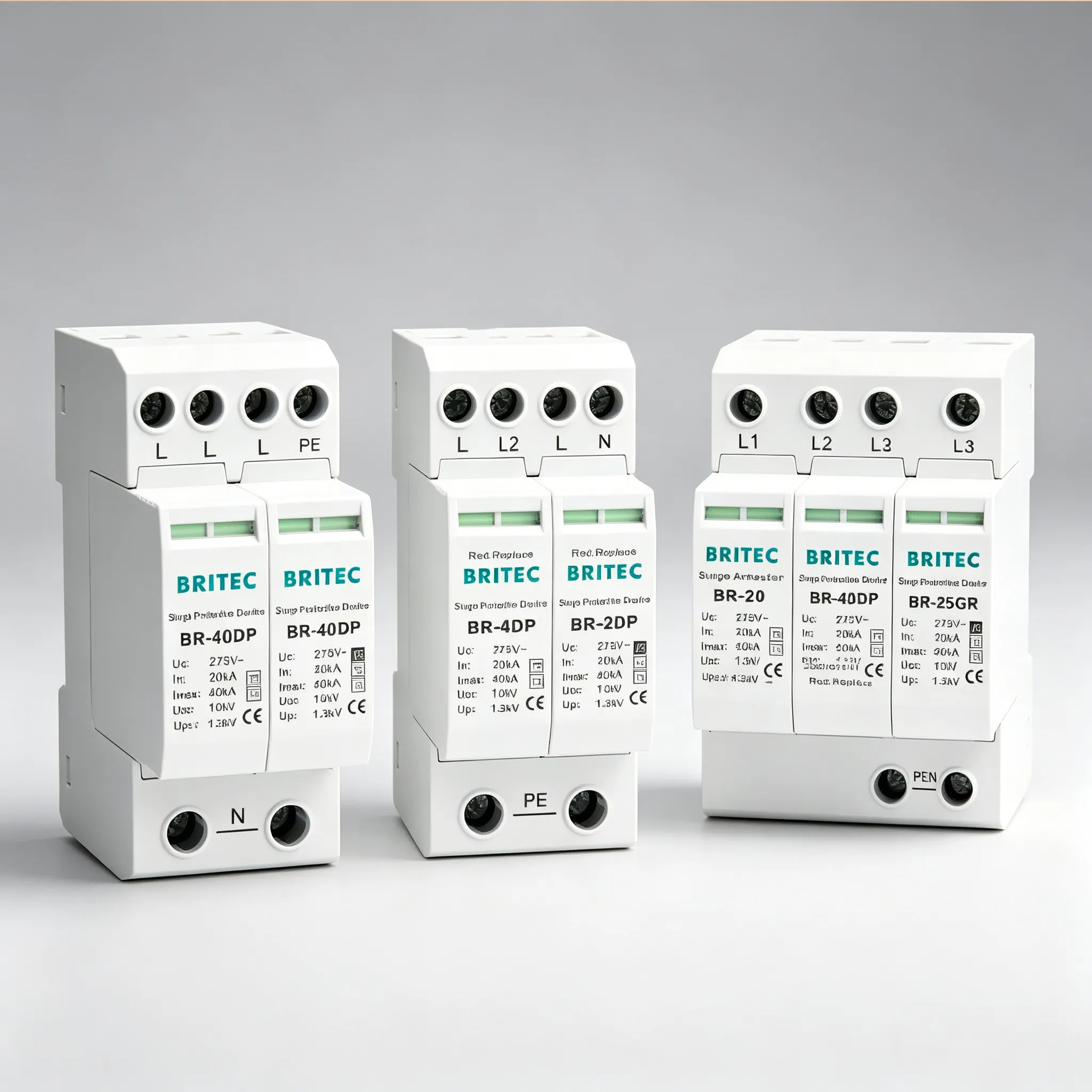
A Type 1+2 combined unit in 3P+N configuration — one example of the range spanning Type 1 through Type 3, DC, PV and signal-line devices.
Fragmenting across three suppliers means three quality standards, three lead times, and three sets of documentation to reconcile when a project engineer asks for compliance evidence. Depth is not a luxury — it is what lets you quote complete solutions instead of parts.
If you sell under your own brand, ask two concrete questions: what tooling is required for a custom housing, and how long does it take. A capable manufacturer will quote a realistic figure — Britec, for instance, works to roughly 45 days for new tooling — while a vague answer usually means the work is being subcontracted.
Also confirm what customization is available short of new tooling. Custom labelling, packaging, technical parameters within an existing housing, and private-label documentation can often be delivered at low volume, which matters when you are testing a new market.
Most of your customers are already using DEHN, Phoenix Contact, OBO or CITEL. Switching them requires showing that your device matches on Uc, Iimp or In, Up, and pole configuration.
A supplier that maintains cross-reference tables has done that work for you. Without it, you are matching datasheets manually for every enquiry, and any mistake becomes your liability. When you evaluate a supplier, ask them to cross-reference three specific competitor part numbers and see how quickly and precisely they respond.
The question that reveals most is simple: if a customer returns a failed unit next year, can you trace which production batch it came from, which MOV supplier fed that batch, and what the test results were?
Suppliers with genuine traceability answer immediately. Those without it change the subject to warranty replacement. The difference matters because traceability lets a manufacturer isolate a problem to one batch rather than recalling everything — and it tells you whether they control their component sourcing or buy varistors on the spot market.
Capacity cuts both ways. Too little, and your large order gets delayed behind someone else’s. Too much rigidity, and your small trial order is refused or quoted at punitive prices.
Ask for monthly capacity by product family, current utilisation, and the minimum order quantity for both stock items and custom work. The most useful suppliers accept small batches while retaining capacity for volume — which is what lets you test a market before committing to container quantities.
Read the warranty terms rather than the headline number. A five-year warranty that excludes any device that has experienced a surge event is worth almost nothing, since operating in surge conditions is the entire job.
Then test the technical support before you order. Send a genuine application question — an unusual earthing arrangement, a coordination query between Type 1 and Type 2 devices — and judge the response. If a pre-sales question takes a week, a post-sales problem will take longer.
The final criterion is the one that stops shipments at customs. Your supplier needs to produce correct commercial invoices, packing lists, certificates of origin, and any market-specific documentation without prompting.
Ask which countries they currently export to and whether they have shipped to yours. A manufacturer already supplying Europe, the Middle East, or South America has resolved the documentation problems you would otherwise discover at the port.
The table below summarises all ten criteria, what to request from each supplier, and the warning sign that should prompt a closer look.
| Criterion | What to Ask For | Red Flag |
|---|---|---|
| 1. Certifications | ISO 9001 certificate plus IEC 61643-11 or UL 1449 test reports naming your exact model | Certificates cover different SKUs than quoted |
| 2. In-house testing | On-site impulse generator producing 8/20 μs and 10/350 μs waveforms; witness test on request | Testing outsourced or capability described vaguely |
| 3. Experience | Years making SPDs specifically; reference projects and long-held certifications | Long company history but recent entry into SPDs |
| 4. Range depth | Type 1, 1+2, 2, 3 plus DC, PV, LED and signal-line devices | Gaps that force you to split orders across suppliers |
| 5. OEM/ODM | Tooling lead time in days; what customization needs no new tooling | No firm tooling timeline; work subcontracted |
| 6. Cross-reference | Live cross-reference of three competitor part numbers | Slow or imprecise matching on Uc, Iimp, Up |
| 7. Traceability | Batch-level records linking finished units to MOV supplier and test data | Cannot trace a returned unit to its batch |
| 8. Capacity | Monthly capacity by product family, utilization, and MOQ for stock and custom | Small trial orders refused or heavily surcharged |
| 9. Warranty | Written terms covering surge-operated devices; module replacement policy | Warranty excludes devices that operated during a surge |
| 10. Export | Countries currently supplied; sample invoice, packing list, certificate of origin | No shipping history to your market |
Documents establish a shortlist; verification decides it.
Start with samples, and pay for them — free samples are sometimes hand-built. Test what you can: confirm the markings match the datasheet, check housing quality and terminal torque, and if you have access to a lab, verify Up and leakage current independently.
Next, validate the test reports. Reports from recognised bodies carry report numbers you can check with the issuing laboratory. It takes one email, and it occasionally produces a surprising answer.
Finally, audit the factory, either in person or through a third party such as SGS or TÜV. What you are looking for is not a tidy showroom but the impulse generator running, incoming material inspection records, and finished-goods testing logs with real data in them.
Some signals should end the conversation early.
Be wary if certificates cannot be produced quickly, or if the model numbers on them do not match the products quoted. Treat vagueness about in-house testing as a negative answer. Watch for prices far below the market — surge protection cost is dominated by MOV mass and housing material, so a large discount usually means less of one or both.
Other warnings are behavioural: reluctance to allow a factory visit, technical answers that dodge specifics like Up or Iimp, no traceability system, and a warranty written to exclude the failure modes that actually occur. Any one of these merits a direct question. Two or more, and you should be looking elsewhere.
Britec Electric Wenzhou has manufactured surge protective devices since 2003, holding ISO 9001 and ISO 14001 certification with products tested to IEC 61643 and UL 1449. Testing is performed in-house, and the supply chain is traceable end to end.
The range spans Type 1, Type 1+2, Type 2 and Type 3 AC devices, DC and PV protectors, LED protectors, and signal-line SPDs across TN-S, TN-C and TT configurations — enough to specify a complete installation from a single source. OEM and ODM programmes are supported with roughly 45-day tooling, cross-reference tables cover the major European brands, and order volumes remain flexible for both trial batches and container quantities.
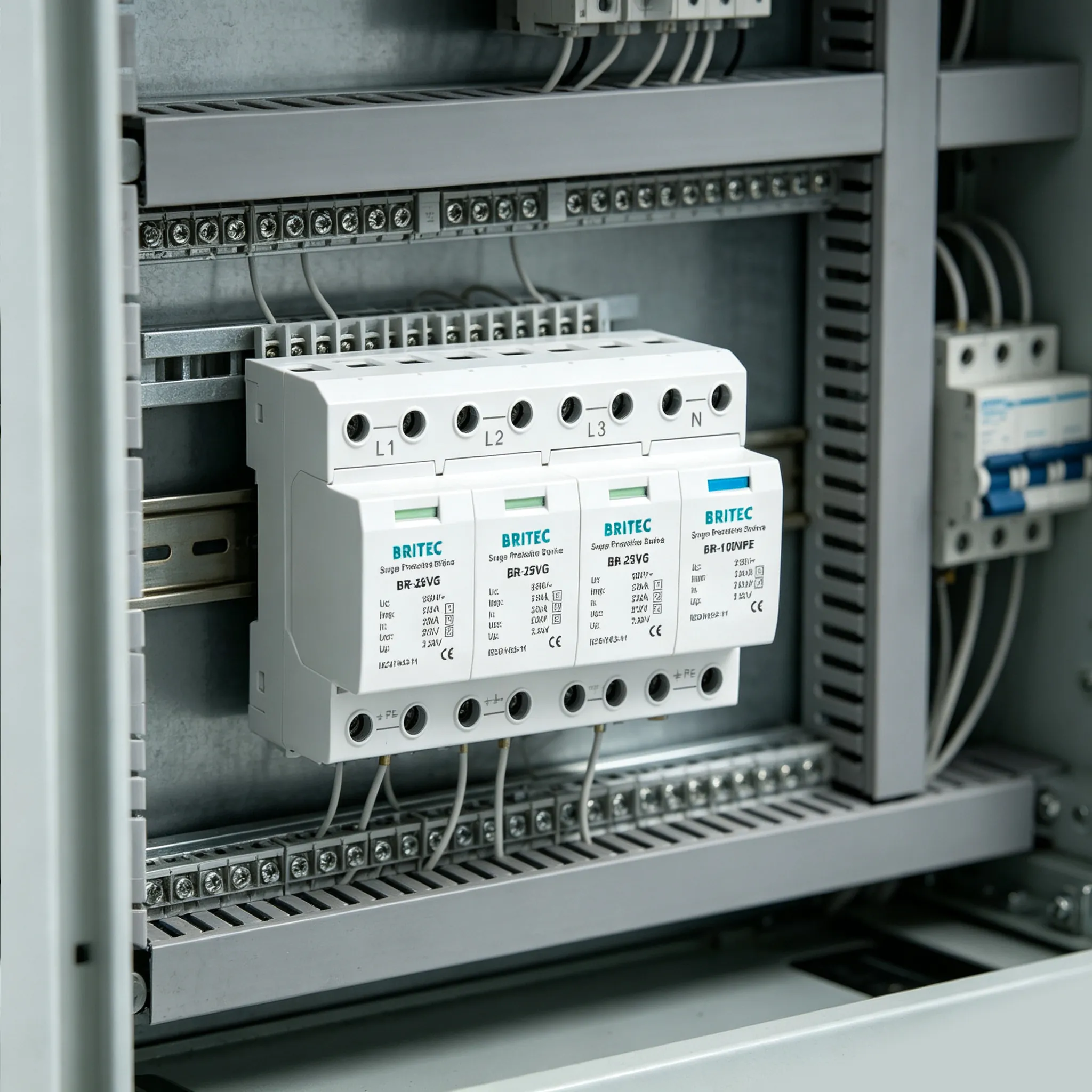
Britec surge protective devices installed in a distribution enclosure, showing the status indicator window used for routine inspection.
T1 : What certifications should a surge protector supplier have?
A1: Look for ISO 9001 quality management and product testing to IEC 61643-11 for AC devices, IEC 61643-31 for PV, and UL 1449 for North America. ISO 14001 indicates environmental management. Always check that certificate numbers and model references match the products you are quoting.
Q2: How do I know which surge protector type fits my application?
A2: Type 1 goes at the service entrance where lightning current is expected, Type 2 at distribution boards, and Type 3 close to sensitive equipment. Your supplier should recommend a configuration based on your earthing system, exposure level, and equipment withstand voltage rather than simply quoting the highest rating.
Q3: What warranty should I expect from a surge protector supplier?
A3: One to five years is typical. What matters more than duration is what the warranty covers: check whether devices that have operated during a surge event are excluded, how replacement modules are handled, and who pays shipping on a claim.
Q4: What’s the difference between Type 1, Type 2, and Type 3 surge protectors?
A4: Type 1 devices are tested with impulse current (Iimp) on a 10/350 μs waveform and handle partial lightning current. Type 2 devices are tested with nominal discharge current (In) on 8/20 μs and manage residual and switching surges. Type 3 devices provide final protection at the equipment and must be installed downstream of a Type 2.
Q5: Is a factory audit necessary before choosing a surge protector manufacturer?
A5: For any significant or recurring order, yes. An audit confirms that testing equipment exists and is used, that traceability records are real, and that capacity claims are accurate. If travel is impractical, a third-party audit from SGS or TÜV provides most of the same assurance.
Choosing a surge protector supplier is a decision you make once and live with across hundreds of orders, so it deserves more scrutiny than a price comparison — work through certifications and testing capability first, since they gate everything else, then assess manufacturing depth, customization, cross-reference support, traceability, capacity, warranty and export documentation before verifying your shortlist with paid samples, validated test reports and a factory audit; the ten criteria above turn what is often an instinctive judgement into a checklist you can hand to a colleague and apply consistently, and the suppliers that answer all ten questions without hesitation are, almost without exception, the ones still worth calling in five years. If you would like to put these criteria to a supplier directly, contact Britec Electric at [email protected] ou +86 0577-6260 5321 for certificates, test reports and a quotation on your required configurations — our technical team responds to all enquiries within 24 hours.