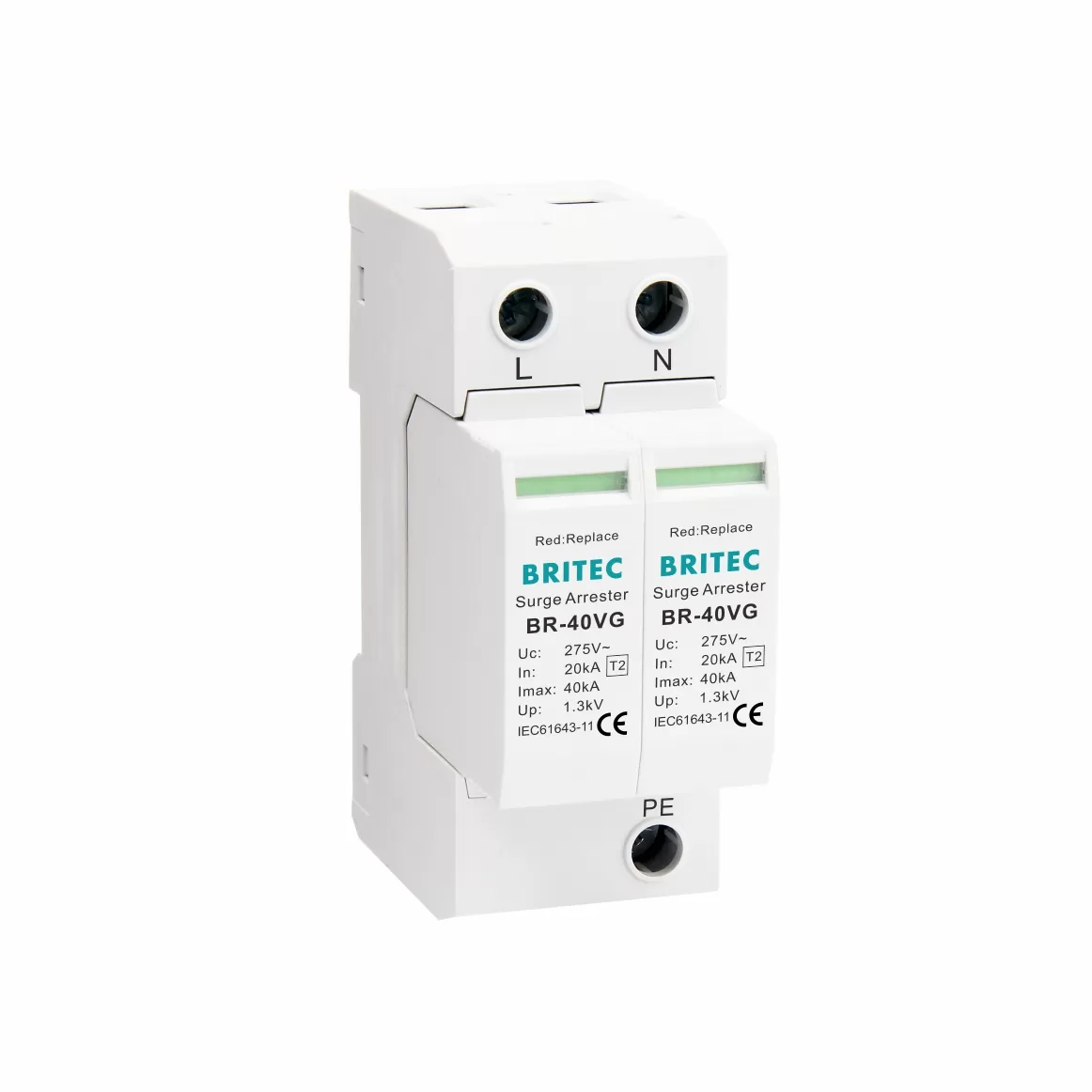

By the Britec Electric engineering team. Britec Electric, based in Wenzhou, Zhejiang, China, has manufactured surge protective devices (SPDs) since 2003, operates an ISO 9001 quality system, and certifies its products to TÜV, CE, and Intertek SEMKO. Written from a manufacturer’s perspective, this guide explains why solar DC SPDs overheat or fail prematurely on PV sites — and how B2B buyers and installers can specify one that does not.
A photovoltaic DC circuit is a tougher environment for a surge protector than the AC side. String voltages climb to 1000–1500 V DC, fault current is low, there is no natural AC zero-crossing to help extinguish an arc, and most DC SPDs live inside sealed combiner boxes, inverter DC cabinets, or string monitoring units with limited ventilation. Heat inside a DC SPD comes from three repeatable sources: continuous leakage current through the metal-oxide varistor (MOV), energy absorbed during every surge event, and I²R losses at the terminals. When any one of those sources is allowed to run above the design envelope, the device ages fast — or fails in the field.
The most common root cause of a hot DC SPD is simply specifying the wrong voltage class. A 600 V-class PV SPD placed on a 1000 V or 1500 V string sits permanently close to its clamp threshold, so the MOV carries elevated leakage current around the clock. That leakage is converted directly into heat, and the device never cools back to its design baseline. The practical rule is to match the maximum continuous operating voltage Ucpv to the real open-circuit string voltage — for a 1000 V system use a unit rated Ucpv 1200 V, and for a 1500 V system use a 1500 V-class device. Sizing the SPD below the system voltage is the fastest way to guarantee premature thermal aging.
De Britec DC surge protector range is split by voltage class for exactly this reason, so the Ucpv is matched to the array before it ever ships.
A DC SPD is a consumable. Its nominal discharge current In (8/20 µs) and maximum discharge current Imax describe how much energy it can absorb before its internal resistance climbs. In a lightning-prone region, a unit sized too small absorbs surge after surge, each event nudging the MOV’s leakage current upward. Higher leakage means more standing heat, which accelerates aging, which raises leakage again — a thermal runaway loop that ends in a failed module. Choosing In/Imax to the site’s actual lightning exposure, and coordinating with an upstream Type 1 or 1+2 device, breaks that loop before it starts.
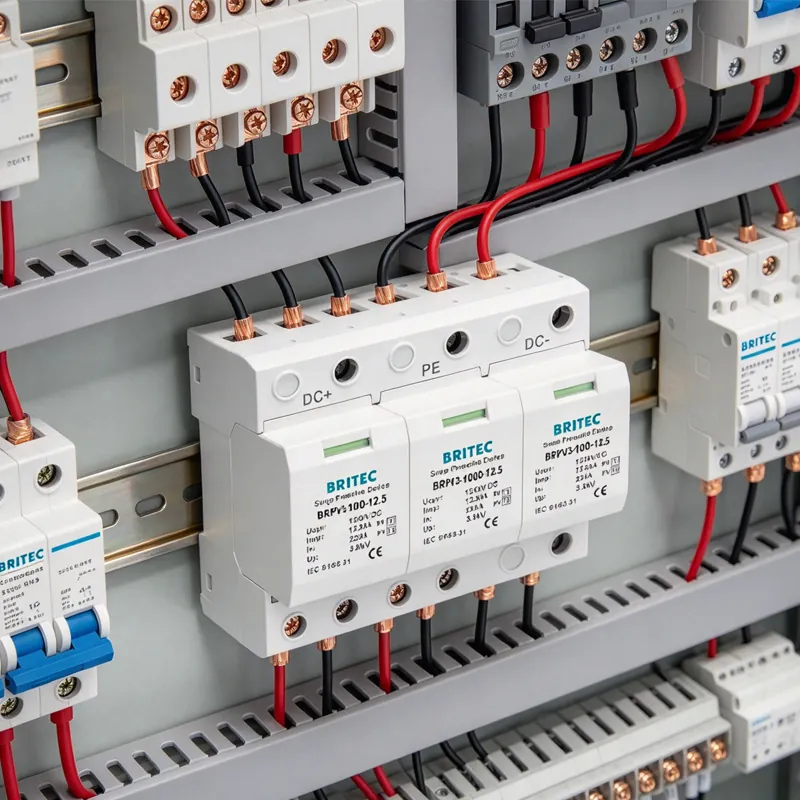
Even a correctly rated DC SPD will overheat if its installation ignores the thermal budget. PV combiner boxes in desert or rooftop sites routinely exceed 60–70 °C ambient, and a DIN rail packed with modules leaves no air gap for convection. The device may be rated for −40 °C to +80 °C with a UL94 V-0 housing, but if it is mounted inside a sealed enclosure without derating, the internal junction temperature can exceed the safe limit. Leave clearance above and below the SPD, avoid stacking heat-generating devices directly beside it, and confirm the enclosure ventilation matches the climate.
DC at 1000 V and above is unforgiving of resistance. A loose terminal, an under-sized conductor, or a poor ferrule creates a high-resistance point that dissipates power as heat (P = I²R). That local heating burns the terminal block, discolours the housing, and can cascade into a full module failure. Britec PV units accept 4–35 mm² conductors on a 35 mm DIN rail; torquing to specification with properly crimped ferrules is the single cheapest insurance against this failure mode. Field data shows loose DC terminations are one of the top causes of premature SPD replacement.
A DC SPD that is asked to absorb every surge the site sees — with no Type 1 or 1+2 device upstream to share the energy — will age far faster than its rating suggests. Proper surge protection coordination lets the larger upstream arrester take the bulk of the energy while the downstream DC SPD handles the residue. Without that cascade, the PV SPD is effectively doing the job of two devices, and its service life collapses. The principles are the same as on the AC side; see our guide on DC Type 2 SPD coordination with DC circuit breakers for a worked example.
Even with no surges, an MOV slowly degrades. Its leakage current creeps upward over years of continuous DC bias, and a device without a proper thermal disconnect can drift into thermal runaway instead of failing safely. This is why the protection inside the SPD matters as much as the rating on the label. A high-Ucpv DC design with a genuine thermal disconnect will fail open and stop the leak; a cheap one keeps heating until something gives.
Diagnosing A Failing PV SPD On Your Site?
Send Britec your string voltage, site lightning level, and enclosure layout. Our application engineers will flag overheating risks and recommend the correct Ucpv, In, and coordination before you buy.
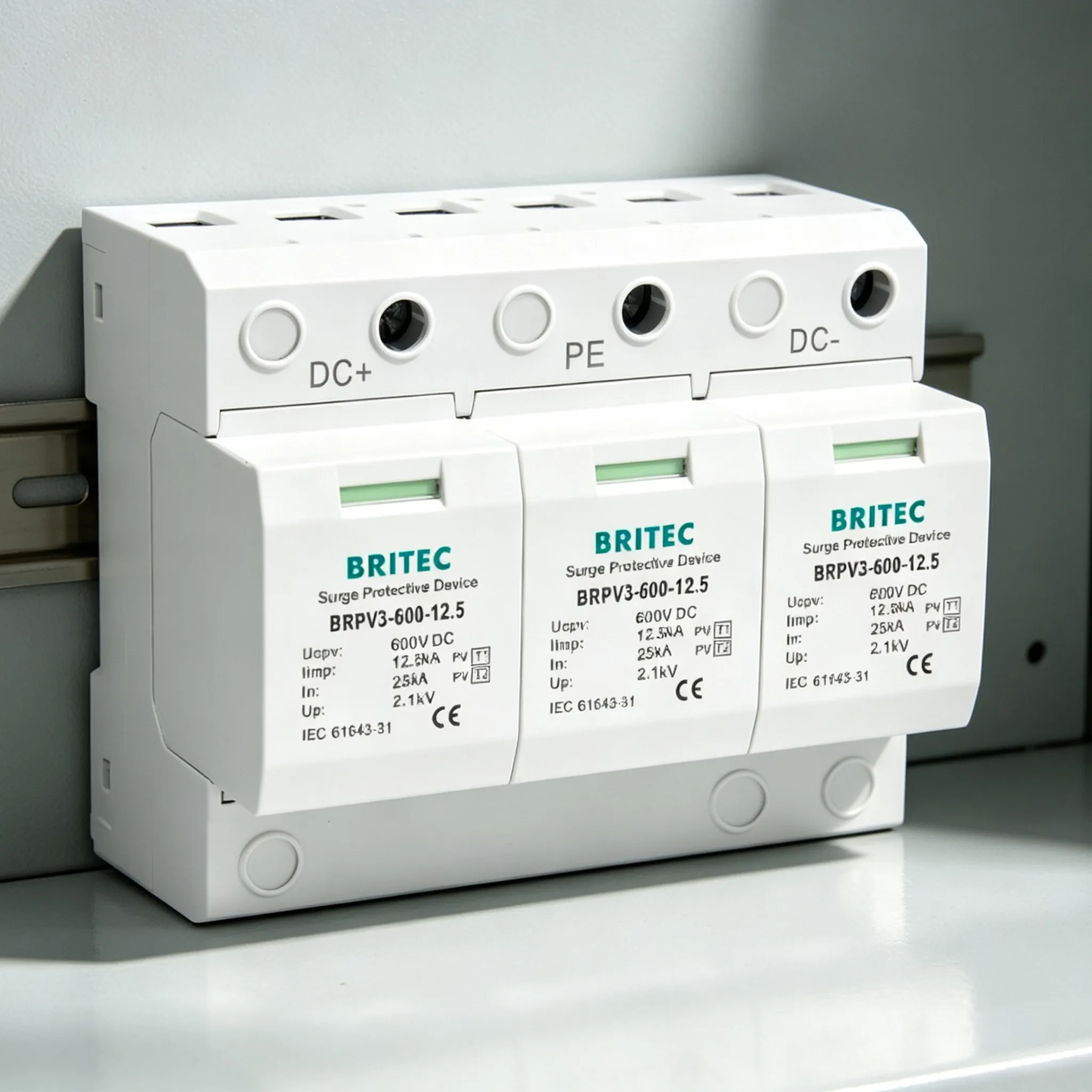
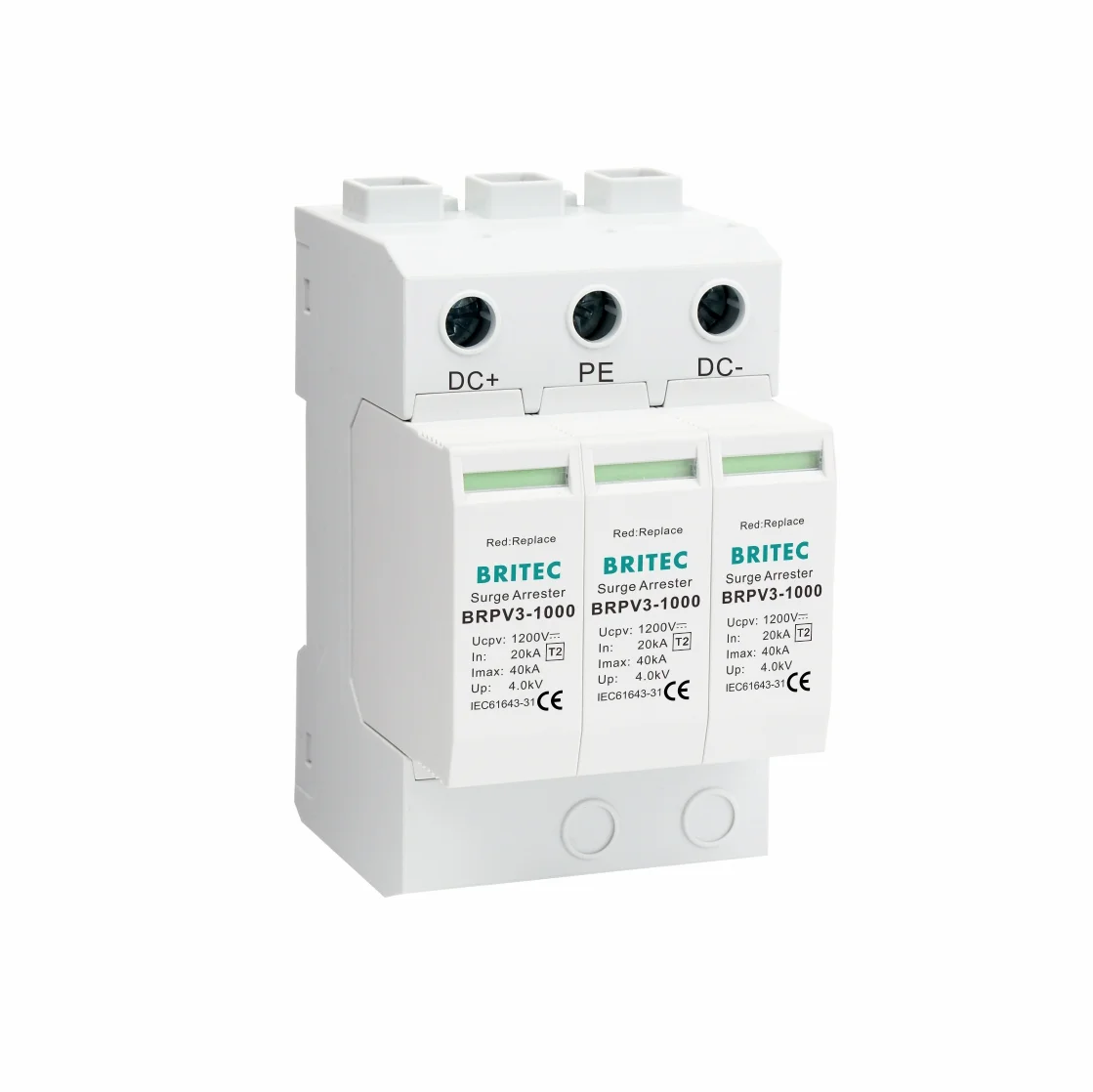
Because Britec builds these devices, the failure causes above are designed against at the component level. The BRPV3 family is built with over-current and over-heat, temperature-control open-circuit technology: when a module begins to fail thermally, it is disconnected from the DC network safely rather than left to heat the enclosure. Modules are plug-in, so a failed cartridge is swapped in seconds without rewiring the string. A green/red status window — with an optional remote signal — tells you at a glance whether the device is healthy. The housing is thermoplastic UL94 V-0, rated IP20, and approved for −40 °C to +80 °C operation on a 35 mm DIN rail.
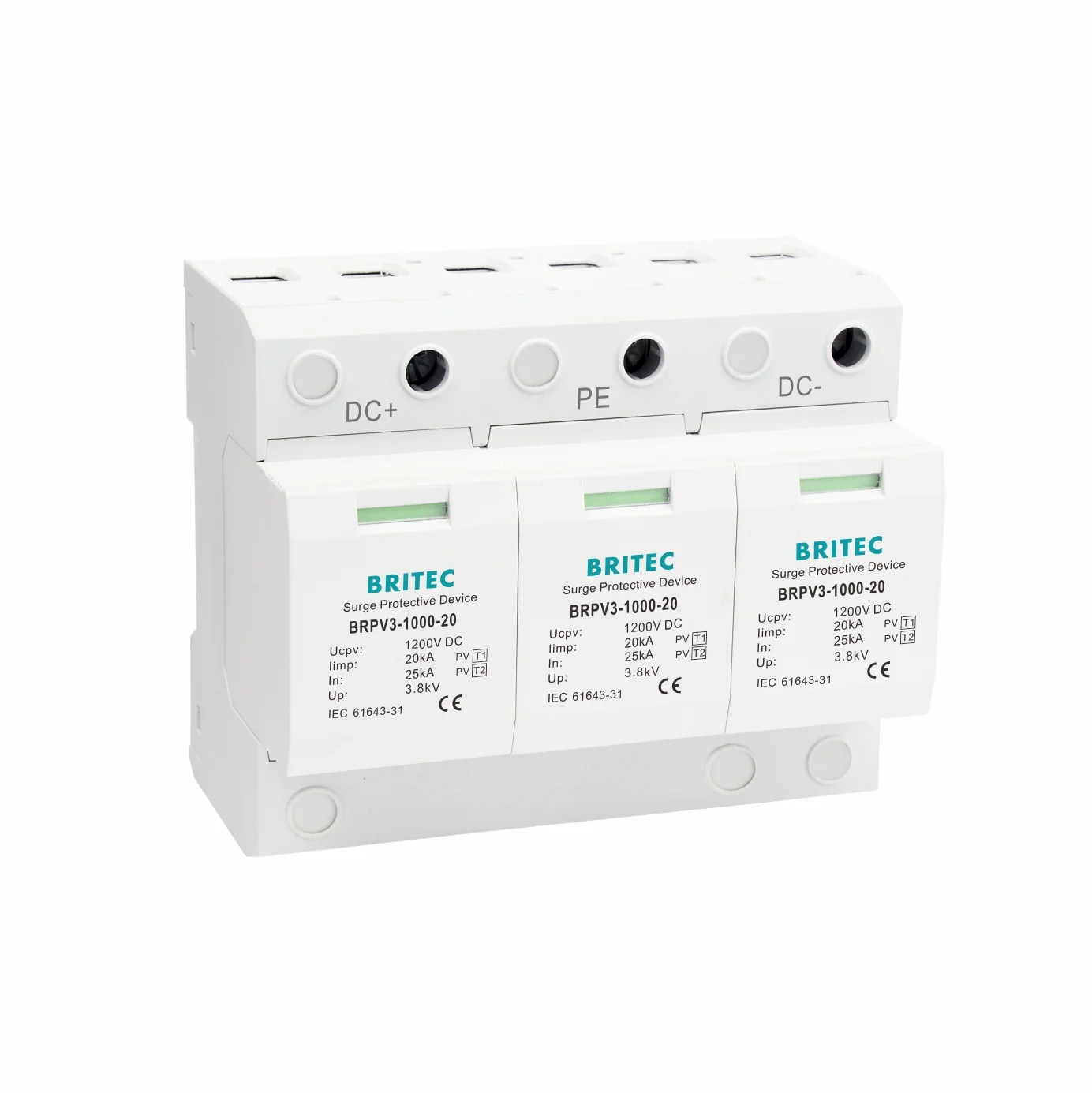
Representative BRPV3 specifications: the BRPV3-1000 Type 2 offers Ucpv 1200 V, In 20 kA (8/20 µs), Imax 40 kA, Up ≤4.0 kV, and response time tA ≤25 ns for 1000 V PV strings. The BRPV3-1500-12.5 Type 1+2 covers 1500 V systems, and the BRPV3-1000-20 Type 1+2 adds 20 kA nominal capacity for harsher lightning zones.
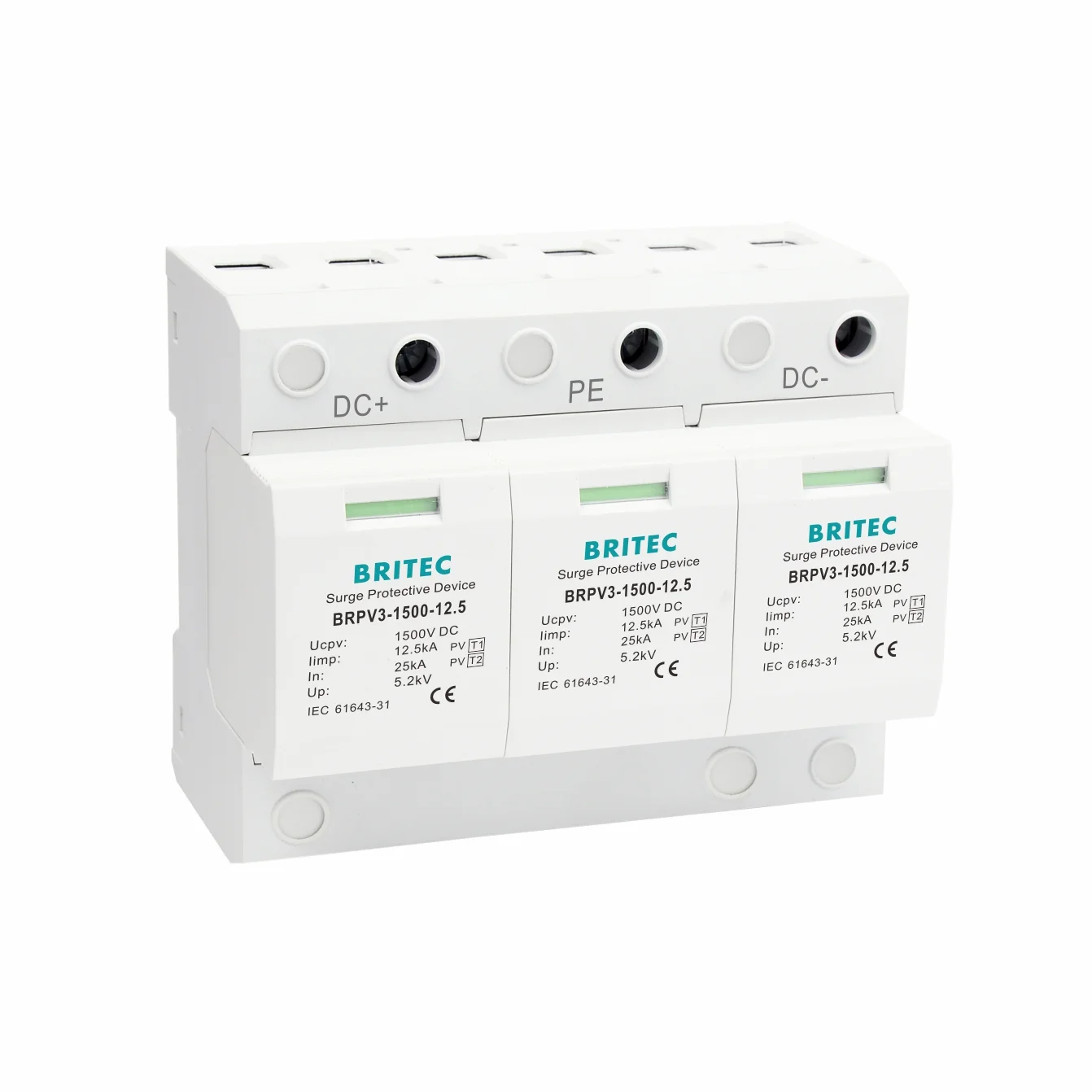
● Match Ucpv to the system — 1200 V-class for 1000 V strings, 1500 V-class for 1500 V strings.
● Size In and Imax to the site’s lightning level, not just the nominal rating.
● Confirm the operating temperature range and derate for sealed, hot enclosures.
● Use the correct conductor cross-section (4–35 mm²) and torque terminals to spec.
● Require a real thermal disconnect / temperature-control open-circuit protection.
● Choose plug-in modules for fast, safe field replacement.
● Verify certifications (TÜV / CE / Intertek) and visible status indication.
Specifying A Solar DC SPD For Your Project?
Get a PV surge protection quote matched to your string voltage, enclosure, and standards — with coordination and remote signaling built in.
What temperature is normal for a solar DC SPD?
Slightly warm to the touch is normal because the MOV carries a small standing leakage current. A device that is too hot to hold, discoloured, or smells of burning is not normal and should be isolated. Well-designed units stay within their −40 °C to +80 °C rating even in a hot combiner box when derated correctly.
Can a 600 V DC SPD be used on a 1000 V system?
No. A 600 V-class device lacks the Ucpv headroom for a 1000 V string and will run hot from continuous leakage. Always specify Ucpv at or above the maximum system operating voltage — 1200 V-class for 1000 V systems and 1500 V-class for 1500 V systems.
How do I know if my PV SPD is overheating?
Watch the status window: a red indicator, loss of the green window, or a remote-signal alarm all point to a degraded or failed module. Physical signs — a hot housing, melt marks, or discolouration — mean the device should be taken out of service immediately.
Do DC SPDs wear out even without surges?
Yes. Continuous DC bias slowly increases MOV leakage over time, so every PV SPD has a finite service life. Units with a genuine thermal disconnect fail safely open; units without one can drift into thermal runaway, which is why the internal protection matters.
Should solar DC SPDs have a thermal disconnect?
Absolutely. A thermal disconnect — or, better, temperature-control open-circuit technology — is what stops a degrading module from heating the enclosure or starting a fire. It is a non-negotiable safety feature for DC SPDs in sealed PV enclosures.
Type 2 or Type 1+2 — which prevents DC SPD failure better?
Type 1+2 (e.g. the BRPV3-1500-12.5 or BRPV3-1000-20) absorbs both direct lightning and switch surges, sharing energy with upstream protection and reducing the load on the downstream DC SPD. On exposed sites this coordination dramatically slows premature aging of the whole protection chain.
How often should PV SPDs be inspected or replaced?
Inspect at least annually and after any major storm. Replace any module showing a red status, a remote alarm, or physical heat damage. With plug-in modules, replacement is a quick on-rail swap that does not require rewiring the string.
Need A Solar DC SPD Spec That Will Not Fail In The Field?
Britec’s application engineers help B2B buyers specify Type 2 and Type 1+2 PV surge arresters matched to your voltage, climate, and standards — with coordination and remote signaling built in.
● Electrical SPD for Solar PV Systems: Do You Really Need It?
● DC Surge Protective Device — What It Is And Where It Goes
● DC Type 2 SPD Coordination With DC Circuit Breakers
● Type 1 vs 1+2 vs 2 vs 3 DC SPD: Which To Choose