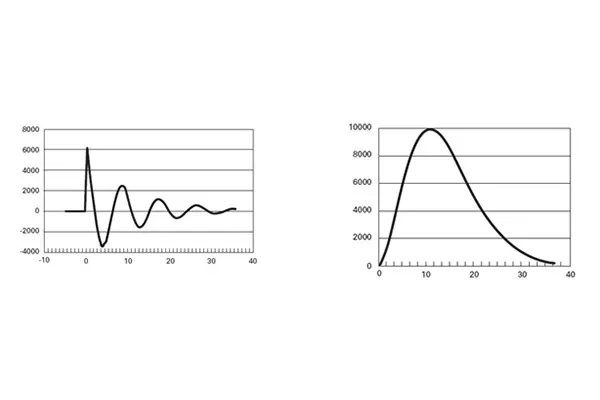

Type 1 surge protection devices generate more datasheet confusion than any other product in the SPD range. The ratings look similar to Type 2 devices until you notice the waveform is different, the installation rules are stricter, and the question of whether you legally need one has no universal answer. If you specify, quote or install at the service entrance, the ten questions below cover what actually comes up in practice — from what the device protects you against to how you know when it has stopped doing so.
A Type 1 device protects against partial lightning current — the portion of a direct strike that is conducted into your electrical installation rather than dissipated through the lightning protection system. When a strike hits a building’s air terminals or a nearby overhead line, a share of that energy travels along the incoming conductors, and a Type 1 SPD is the component designed to divert it safely to earth before it enters the installation.
This is a different job from suppressing the induced and switching transients Type 2 devices handle. Type 1 protection is about surviving a high-charge event; Type 2 is about managing the more frequent, lower-energy surges that follow.
The difference is defined by the test class each device must pass. A Type 1 SPD is tested with impulse current (Iimp) on a 10/350 µs waveform, which simulates the long, high-charge profile of a lightning discharge. A Type 2 device is tested with nominal discharge current (In) on an 8/20 µs waveform — much shorter, carrying a fraction of the energy at the same peak current. A Type 3 device provides final protection at the equipment and must always sit downstream of a Type 2.
Location follows from test class: Type 1 at the origin of the installation, Type 2 at distribution boards, Type 3 at or near the load.
A Type 1 device becomes necessary when your building has an external lightning protection system, or where a risk assessment to IEC 62305 identifies direct strike exposure — overhead supply lines, isolated or tall structures, and high ground flash density all push the assessment that way. Where no LPS exists and the supply is underground in a low-exposure area, Type 2 protection at the origin is often sufficient. Since national wiring rules differ, treat the risk assessment as the deciding document.
Iimp is the impulse current rating: the peak lightning current, in kA, that the device can discharge without failing, tested on the 10/350 µs waveform. The two numbers describe the shape of the test pulse — roughly 10 microseconds to rise to peak, and 350 microseconds to decay to half of it.
That long tail is what matters. A 25kA 10/350 µs pulse carries far more charge than a 25kA 8/20 µs pulse, which is why a Type 1 SPD 12.5kA Iimp rating cannot be compared directly with a Type 2 device quoting a much larger figure on the shorter waveform. When you compare products, always check which waveform the number refers to.
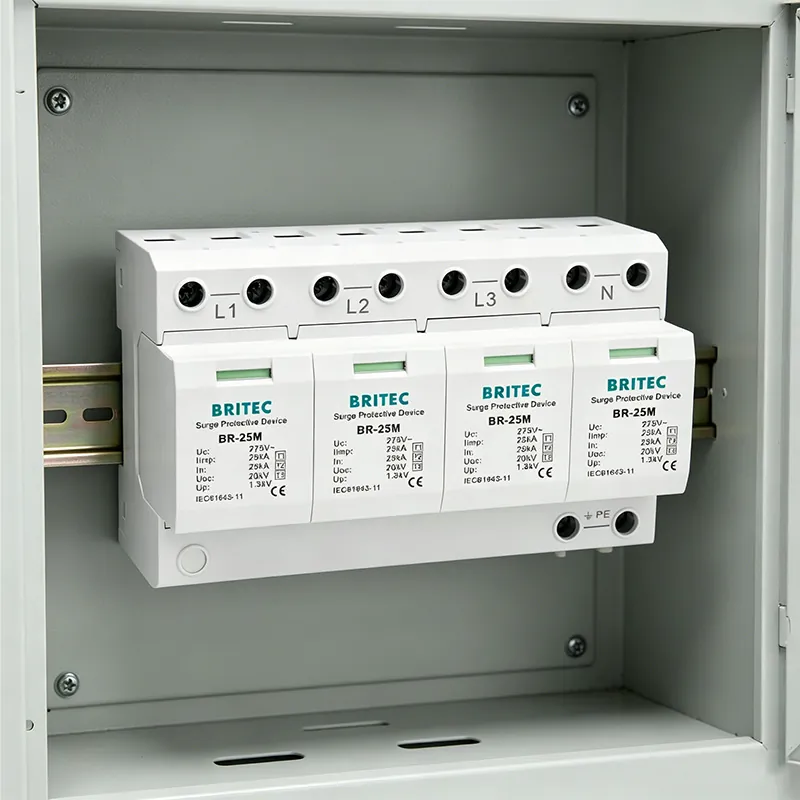
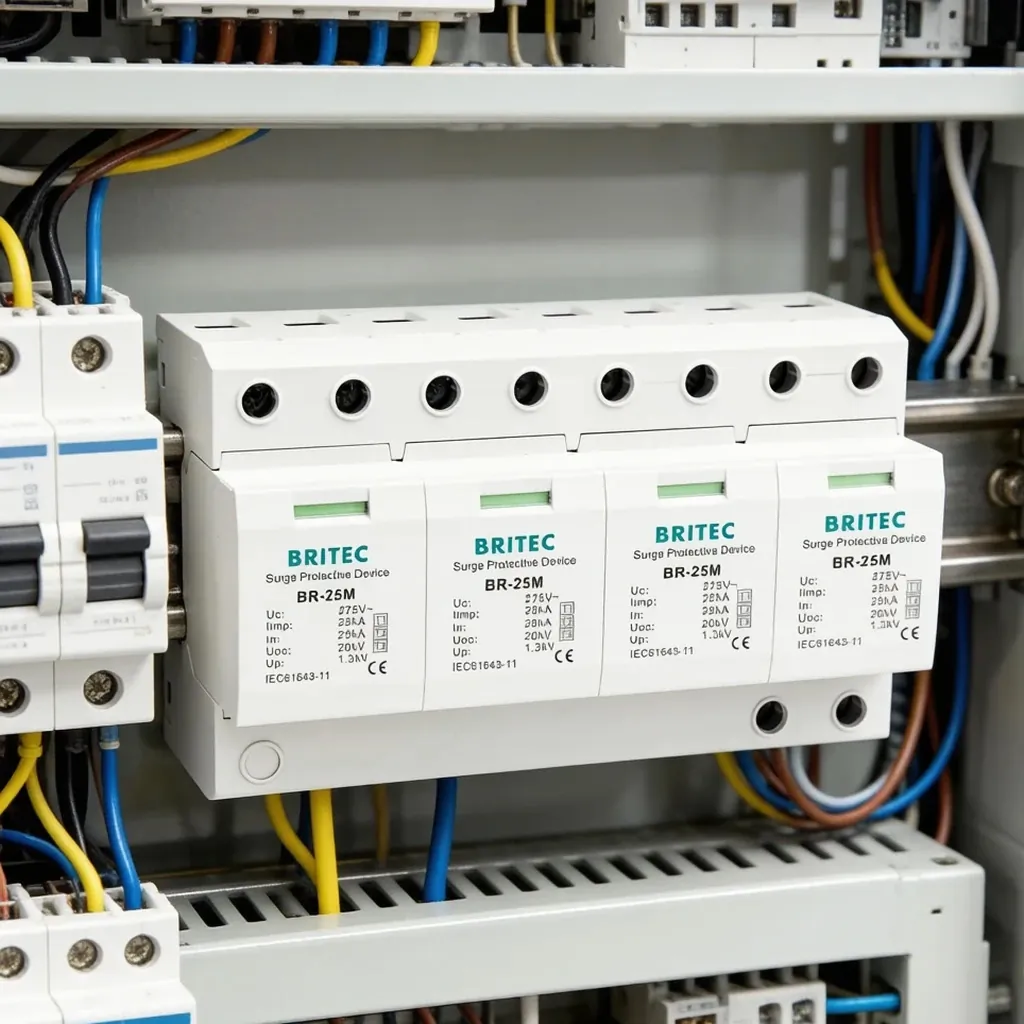
A Type 1 SPD with Uc, Iimp, In, Imax and Up printed on the module face — note that Iimp is quoted on the 10/350 µs waveform, not 8/20 µs.
Install it at the origin of the installation — the main board or service entrance panel where power first enters the building — so surge energy is intercepted at the boundary before it propagates through the wiring.
Two rules govern the installation. Keep total connecting conductor length, live plus earth side, within about 0.5 metres, since every extra centimetre adds inductive voltage that raises the protection level your equipment actually sees. And keep the earthing connection short, direct and low-impedance; a Type 1 device is only as good as the path it discharges into.
Yes, unless the upstream overcurrent device already meets the manufacturer’s specified rating. Backup protection disconnects the SPD if it fails to a short circuit at end of life, preventing a fire risk or a trip of the whole installation. Use the fuse or breaker type stated in the documentation, not an assumption — undersizing causes nuisance disconnection during ordinary surge activity, while oversizing leaves the device unprotected in the very failure mode it should cover.
There is no fixed service life, because a Type 1 SPD wears out by absorbing energy rather than by running hours. In moderate exposure, five to fifteen years is realistic — but a single severe strike can end that life immediately. Treat the status indicator, not the calendar, as the authority; on a device over ten years old with no maintenance history, planned replacement is cheaper than discovering its condition during the next storm.
Four signals are worth checking: a status window turned from green to red, a tripped backup fuse or breaker on the SPD circuit (usually meaning the device failed short), visible discolouration or burn marks indicating thermal damage, and on monitored installations a remote signalling contact reporting to your control system. Make the check routine after any significant storm — a device that sacrificed itself protecting you looks unchanged until you read the indicator.
Rarely. A Type 1 device survives enormous energy, but its voltage protection level (Up) is typically higher than sensitive electronics tolerate — it reduces a catastrophic surge to a survivable one, not a harmless one. For installations with drives, controllers or IT equipment, coordinate a Type 2 device downstream with adequate cable length or a decoupling element between stages. A combined Type 1+2 unit achieves both duties in one housing where panel space is limited.
Configuration follows the earthing arrangement. TN-C uses a 3P device on three-phase supply; TN-S uses 4P or 3P+N; TT generally requires 3P+N with a spark gap between neutral and earth, so no continuous leakage path exists to the local electrode. On single-phase supplies the same logic gives 1P for TN-C and 1P+N or 2P for TN-S and TT. Confirm the earthing system on site before ordering — a mismatch either leaves a conductor unprotected or creates an unwanted current path.
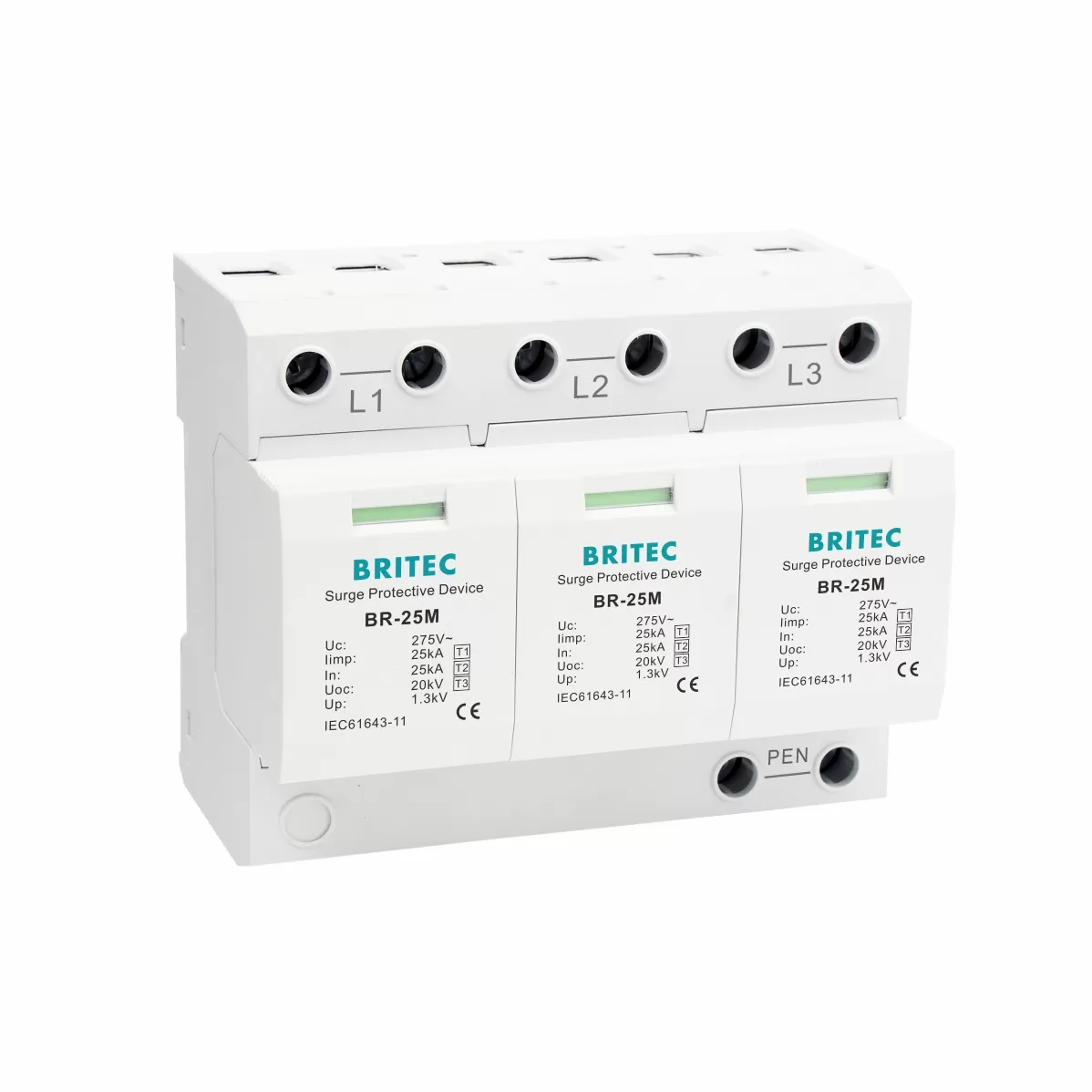
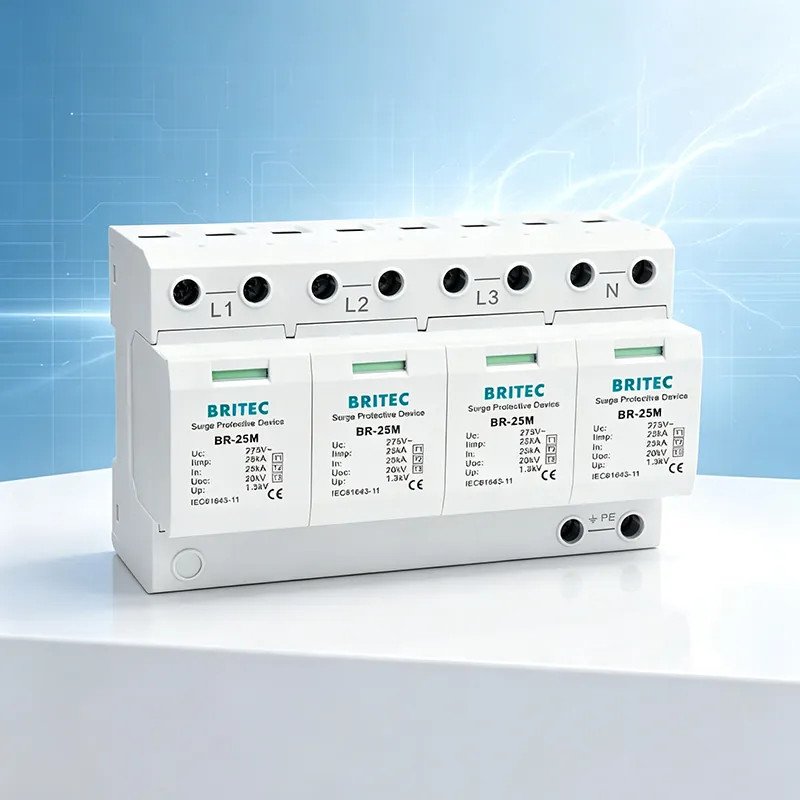
The same Type 1 platform in a 3P configuration for TN-C systems — pole count and internal arrangement follow the earthing system on site.
The table below condenses all ten answers into a single reference you can keep alongside a datasheet.
| Question | Short Answer |
| What does it protect against? | Partial lightning current conducted into the installation from a direct or nearby strike |
| How does it differ from Type 2 and 3? | Tested with Iimp on 10/350 µs; Type 2 uses In on 8/20 µs; Type 3 protects at the load |
| Is it mandatory? | Generally where an external LPS exists or an IEC 62305 risk assessment identifies direct strike exposure |
| What are Iimp and 10/350 µs? | Peak lightning current the device can discharge, tested on a long, high-charge waveform |
| Where is it installed? | At the origin of the installation, with connecting leads under about 0.5 m |
| Does it need backup protection? | Yes — a fuse or breaker of the type and rating stated by the manufacturer |
| How long does it last? | Typically 5–15 years, but a single severe strike can end its life immediately |
| How do I know it has failed? | Red status indicator, tripped backup device, visible damage, or a remote contact alarm |
| Can it work alone? | Rarely — its Up is too high for sensitive equipment; coordinate a Type 2 downstream |
| Which configuration do I need? | 3P for TN-C, 4P or 3P+N for TN-S, 3P+N with N-PE spark gap for TT |
Four subjects sit just beyond these answers and reward further reading. Coordination between stages determines how energy is shared between Type 1 and Type 2 devices, and depends on cable length or decoupling inductors. The lightning protection zone concept in IEC 62305 explains why device selection changes at each boundary. Risk assessment methodology gives you a defensible basis for deciding whether a Type 1 device is required at all. And conductor routing influences real-world performance more than most specification decisions.
Britec Electric Wenzhou has manufactured surge protective devices since 2003, with ISO 9001 and ISO 14001 certification and products tested to IEC 61643-11 and UL 1449. Impulse testing is performed in-house, so designs and production batches alike can be verified against the 10/350 µs waveform rather than only at certification milestones.
The Type 1 range covers 1P, 2P, 3P and 4P configurations for TN-C, TN-S and TT systems, with Iimp ratings from 12.5kA to 50kA per pole, replaceable modules, visual status indication and optional remote signalling contacts. Type 1+2 combined units are available where a single device must cover both duties, and cross-reference support is provided for the major European brands if you are replacing an existing installation.
Only inside a suitably rated enclosure. The modules are designed for DIN rail mounting in a protected environment, so outdoor use requires an IP-rated cabinet keeping out moisture, dust and direct sun. Confirm the ambient temperature range too, as heat accelerates ageing of the internal components.
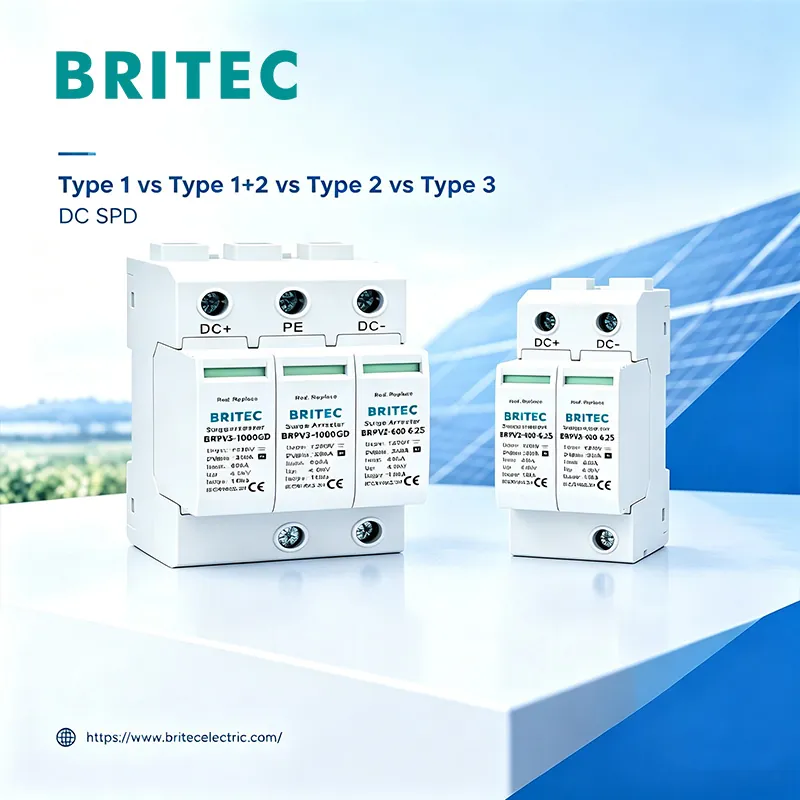
Not the AC versions. DC systems have no natural zero crossing to extinguish an arc, so they need purpose-built DC or PV devices with the correct DC voltage rating and arc-extinction design. Britec supplies PV Type 1+2 and PV Type 2 protectors for exactly this application.
Price depends mainly on Iimp rating, pole count and technology, so a 1P 12.5kA unit sits well below a 4P 50kA device. Because the device protects an entire installation, compare on Iimp, Up and certification rather than on unit price alone — for a current quotation on specific configurations, contact the manufacturer directly.
Installation at the origin of the installation is work for a qualified electrician. It involves the incoming supply, backup protection coordination and earthing arrangements, and in most jurisdictions it must be certified. Owners can safely handle inspection — reading the status window — but not installation or replacement.
No, but the two are closely linked. An external LPS is the usual trigger for requiring a Type 1 device, since it creates a defined path for partial lightning current to enter the installation. Type 1 devices are also specified without an LPS where overhead supply lines or high exposure justify it through risk assessment.
Most of the confusion around Type 1 surge protection devices resolves once you hold on to a single distinction — the 10/350 µs waveform behind the Iimp rating is what separates a lightning current arrester from every other SPD, and it explains the installation position at the origin, the mandatory backup protection, the strict 0.5 metre lead length, the need for coordinated Type 2 protection downstream, and why the kA figure cannot be compared with a Type 2 datasheet; get the earthing configuration right for your TN-C, TN-S or TT system, check the status indicator after every storm, and the device will do its job quietly for years. If you are specifying Type 1 protection for a project, contact Britec Electric at [email protected] or +86 0577-6260 5321 for datasheets, certificates and a quotation on the configuration and Iimp rating your installation requires — our technical team responds to all enquiries within 24 hours.