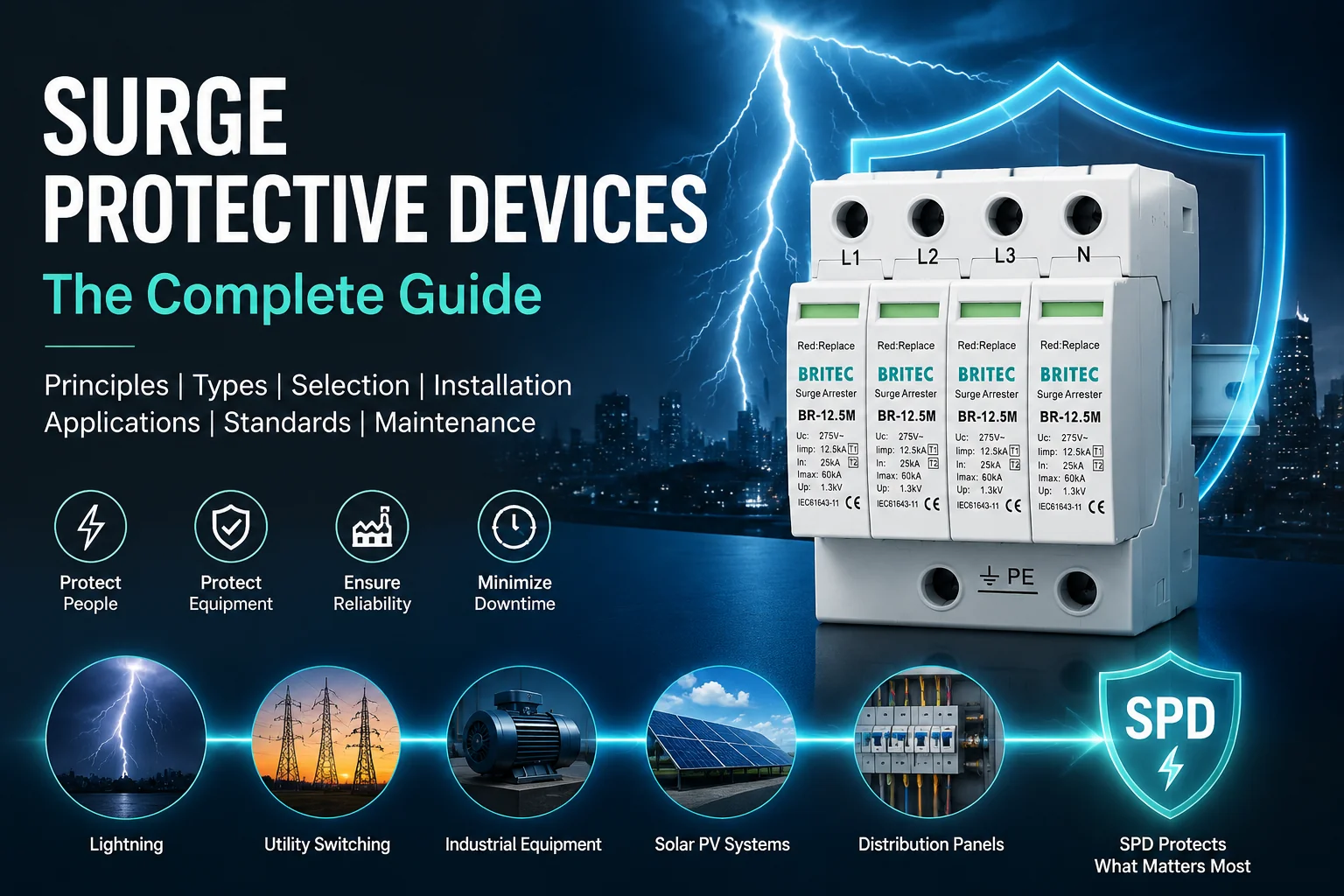
Surge Protective Devices: The Complete Guide to Protecting Electrical and Electronic Systems
Ensuring Integrity and Compliance: Secure Lock Solutions for Pharmaceutical Projects
TOVÁBBI MEGTEKINTÉSE

Surge Protective Devices (SPD): Complete Guide to Selection, Installation & Protection | BRITEC
Learn everything about Surge Protective Devices (SPD), including how they work, different SPD types, installation methods, selection tips, international standards, and industry applications. Protect your electrical systems from lightning and transient overvoltages with this comprehensive guide.
Modern electrical systems power almost every aspect of our daily lives. From industrial manufacturing plants and commercial buildings to hospitals, solar power stations, telecommunications networks, and smart homes, electronic equipment has become increasingly sensitive to voltage fluctuations. While these systems offer greater efficiency and intelligence, they are also more vulnerable to one invisible threat—transient overvoltage, commonly known as a power surge.
A surge lasting only a few microseconds can permanently damage expensive equipment, interrupt business operations, corrupt critical data, and even create fire hazards. These electrical transients may originate from lightning strikes, utility switching operations, motor start-ups, or faults within the electrical network.
This is where Surge Protective Devices (SPDs) play a vital role.
Designed to divert excess surge energy safely to ground, SPDs act as the first line of defense against destructive voltage spikes. Whether protecting a residential distribution board or a large industrial automation system, the right SPD significantly improves equipment reliability and extends service life.
In this comprehensive guide, you’ll learn:
Whether you’re an electrical engineer, system integrator, distributor, or facility manager, this guide will help you understand how surge protection contributes to a safer and more reliable electrical infrastructure.
What Is a Surge Protective Device (SPD)?
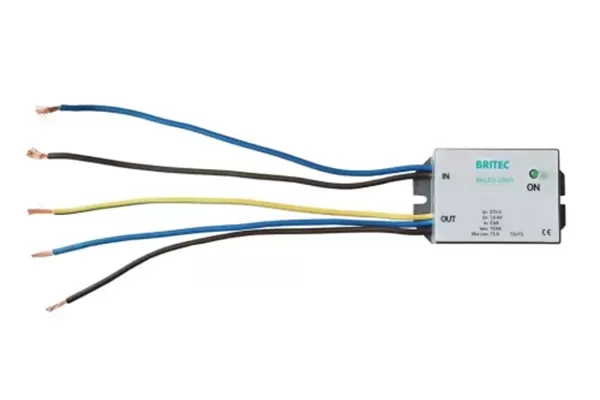
A Surge Protective Device (SPD) is an electrical protection device designed to limit transient overvoltages by diverting surge current away from sensitive electrical equipment. Once the surge has passed, the SPD automatically returns to its normal operating condition without interrupting the power supply.
Unlike circuit breakers or fuses, which respond to overloads and short circuits, an SPD reacts within nanoseconds to high-energy transient events. This extremely fast response allows it to clamp dangerous voltage levels before they reach connected equipment.
Typical sources of transient surges include:
| Source | Typical Cause |
| Lightning | Direct or nearby lightning strikes |
| Utility Switching | Power grid switching operations |
| Large Motors | Starting or stopping heavy machinery |
| Variable Frequency Drives | High-frequency switching |
| Transformer Operations | Load transfer and energization |
| Internal Equipment | Switching of inductive loads |
Even when lightning does not strike a building directly, electromagnetic coupling from nearby strikes can induce thousands of volts into electrical cables.
Without surge protection, these voltage spikes may damage:
Why Surge Protection Matters
Many people assume surge protection is only necessary in regions with frequent thunderstorms. In reality, studies have shown that most transient surges originate from within the electrical installation itself rather than from direct lightning strikes.
Every day, electrical systems experience numerous small transient events caused by switching operations. Although these surges may not cause immediate failure, they gradually weaken electronic components, reducing their lifespan and increasing maintenance costs.
The consequences of inadequate surge protection include:
For industries such as manufacturing, healthcare, telecommunications, renewable energy, and data centers, even a few minutes of downtime can result in significant financial losses. Installing properly selected SPDs is therefore not only a technical requirement but also a cost-effective investment in operational reliability.
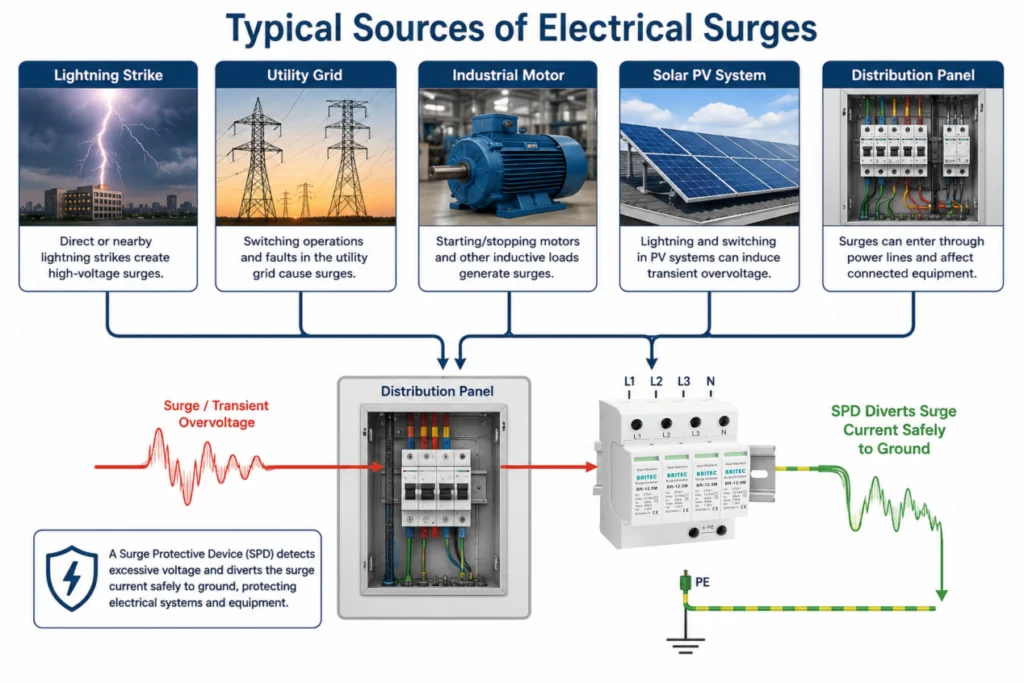
How Does a Surge Protective Device Work?
To understand the value of a Surge Protective Device (SPD), it is important to know what happens during a transient overvoltage event.
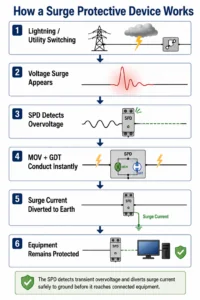
Under normal operating conditions, the voltage in an electrical system remains within a safe range (for example, 230 V AC or 400 V AC). During this time, an SPD stays in a high-impedance state, allowing electricity to flow normally without affecting the connected equipment.
When a sudden voltage spike occurs—whether caused by lightning, utility switching, or internal electrical operations—the voltage rises sharply within microseconds. As soon as this voltage exceeds the SPD’s protection threshold, the device reacts almost instantly.
Instead of allowing the excessive voltage to reach sensitive equipment, the SPD creates a low-impedance path that safely diverts the surge current to the grounding system. Once the transient disappears, the SPD automatically returns to its standby condition and continues monitoring the electrical network.
This entire process typically takes place in less than one microsecond, making SPDs one of the fastest protection devices used in modern electrical systems.
The Four Stages of Surge Protection
The operation of an SPD can be divided into four simple stages:
During normal operation, the SPD continuously monitors the voltage level of the power system.
Because it remains electrically inactive under standard conditions, it consumes virtually no power and has no impact on system performance.
When a transient overvoltage occurs, the internal protection components detect the sudden increase in voltage almost immediately.
Typical surge durations range from 1 μs to 100 μs, meaning protection must occur extremely quickly to prevent equipment damage.
Once activated, the SPD redirects the surge current through its internal protective components and safely discharges the excess energy into the earth grounding system.
This prevents dangerous voltages from reaching connected electrical equipment.
Instead of absorbing all of the surge energy, the SPD acts as a controlled bypass, ensuring that only safe voltage levels remain on the protected circuit.
After the transient has passed, the SPD automatically returns to its original high-resistance state.
Unlike fuses, which often require replacement after operation, quality SPDs are designed to withstand numerous surge events throughout their service life, provided the surge energy remains within their rated capacity.
Main Components Inside a Surge Protective Device
Although different SPD designs exist, most modern devices combine several protective technologies to achieve fast response times and high surge current capability.
Metal Oxide Varistor (MOV)
The Metal Oxide Varistor (MOV) is the most widely used component in AC surge protective devices.
Under normal voltage conditions, the MOV behaves like an insulator with extremely high resistance.
When the voltage exceeds its operating threshold, its resistance drops dramatically within nanoseconds, allowing the surge current to pass safely to ground.
Advantages of MOV Technology:
Limitations:
Because MOVs absorb surge energy repeatedly, their performance gradually degrades over time. High-quality SPDs therefore include thermal disconnect mechanisms and status indicators to ensure safe operation throughout the product’s life.
Gas Discharge Tube (GDT)
A Gas Discharge Tube (GDT) uses an enclosed chamber filled with inert gas.
When the voltage reaches a predefined level, the gas ionizes and creates a conductive path capable of carrying extremely high surge currents.
Unlike MOVs, GDTs are especially suitable for handling lightning currents.
Előnyök:
Typical Applications:
Many premium surge protective devices combine MOV and GDT technologies to achieve both fast response and high surge current capacity.
Thermal Disconnect Device
As MOVs age through repeated surge exposure, they may eventually overheat.
A thermal disconnect device continuously monitors the temperature of the MOV.
If abnormal heating occurs, the disconnect mechanism safely isolates the damaged component from the electrical circuit, preventing overheating or fire hazards.
This safety feature is required in many international standards and is considered essential for reliable SPD performance.
Status Indicator
Modern SPDs often include a visual status indicator that allows maintenance personnel to quickly determine whether the device is still operational.
Typical indicators include:
| Indicator Color | Meaning |
| Green | SPD operating normally |
| Red | Protection has reached end of life |
| No Display | Device requires inspection or replacement |
For critical installations such as data centers, hospitals, or industrial plants, many SPDs also provide remote signaling contacts that can be connected to building management systems (BMS) or alarm panels for real-time monitoring.
Why Response Time Matters
Electrical surges occur incredibly quickly.
A lightning-induced transient can rise to several thousand volts in less than one microsecond.
If protection is delayed, sensitive semiconductor components inside modern electronic equipment may fail before traditional protective devices such as circuit breakers or fuses have time to react.
This is why response time is one of the most important performance characteristics of a Surge Protective Device.
A high-quality SPD typically responds within nanoseconds, significantly reducing the voltage that reaches downstream equipment.
However, response time alone does not determine protection quality. Engineers should also evaluate:
Selecting the right combination of these parameters ensures reliable protection under real-world operating conditions.
Types of Surge Protective Devices (Type 1, Type 2, Type 3, and Combined Type 1+2)
Not all surge protective devices are designed for the same purpose. The performance requirements, installation locations, and surge current capabilities vary depending on the level of protection required.
International standards such as IEC 61643-11 classify SPDs into different categories based on the type of surge they are designed to withstand. Understanding these classifications is essential for selecting the right protection strategy.
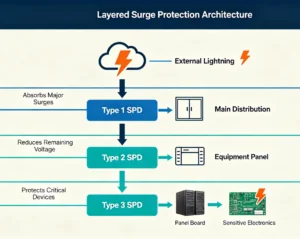
In most electrical installations, a coordinated surge protection system uses multiple SPDs installed at different points throughout the electrical network. This layered approach ensures that surge energy is gradually reduced before it reaches sensitive equipment.
Type 1 Surge Protective Devices
Type 1 SPDs are installed at the main service entrance of a building, where the electrical supply first enters the installation.
Their primary purpose is to protect against high-energy lightning currents, including direct lightning strikes where a lightning protection system (LPS) is installed.
These devices are tested using the 10/350 μs impulse waveform, which simulates the enormous energy associated with direct lightning discharge.
Typical Installation Location:
Main Features:
Typical Applications:
Type 2 Surge Protective Devices
Type 2 SPDs are the most commonly installed surge protection devices worldwide.
Instead of protecting against direct lightning currents, they are designed to protect against indirect lightning effects and switching overvoltages generated within the electrical network.
These devices are tested using the 8/20 μs impulse waveform, which represents the majority of transient surges found in everyday electrical systems.
Typical Installation Location:
Main Features:
Typical Applications:
For many commercial and residential installations without an external lightning protection system, a properly selected Type 2 SPD provides an effective balance between performance and cost.
Type 3 Surge Protective Devices
Type 3 SPDs provide the final stage of surge protection for particularly sensitive electronic equipment.
These devices are installed close to the equipment they protect, ensuring that any residual voltage remaining after upstream protection is further reduced.
Type 3 SPDs typically have lower discharge capacities but offer very low voltage protection levels.
Typical Installation Location:
Typical Protected Equipment:
Combined Type 1+2 Surge Protective Devices
Many modern installations use combined Type 1+2 SPDs, which integrate the capabilities of both Type 1 and Type 2 protection into a single device.
These hybrid SPDs can withstand high lightning currents while also providing excellent protection against switching surges.
Combined SPDs simplify installation, reduce panel space, and improve overall system coordination.
They are especially suitable for:
As renewable energy installations continue to expand globally, Type 1+2 SPDs have become one of the fastest-growing product categories in the surge protection market.
Comparison of SPD Types
| Funkció | 1. típus | 2. típus | 3. típus | 1+2 típus |
| Main Purpose | Lightning current protection | Túlfeszültség elleni védelem | Berendezésvédelem | Combined protection |
| Test Waveform | 10/350 μs | 8/20 μs | Combination Wave | 10/350 μs + 8/20 μs |
| Telepítés | Service entrance | Distribution board | Near equipment | Service entrance or distribution board |
| Surge Capacity | Very High | Magas | Alacsony | Very High |
| Voltage Protection Level | Közepes | Alacsony | Very Low | Alacsony |
| Typical Technology | GDT | MOV | MOV / TVS | Hibrid |
Coordinated Surge Protection
One SPD alone cannot provide complete protection for every installation.
Professional electrical designs follow the principle of coordinated surge protection, in which multiple SPDs work together to gradually reduce surge energy.
A typical protection scheme looks like this:
Utility Grid
│
▼
Main Distribution Board
│
1. típusú SPD
│
▼
Sub Distribution Board
│
2. típusú SPD
│
▼
Equipment Cabinet
│
3. típusú SPD
│
▼
Sensitive Electronic Equipment
Each stage absorbs part of the surge energy, allowing the next stage to handle a lower remaining voltage. This coordinated approach minimizes stress on individual SPDs and significantly enhances overall protection.
Choosing the Right SPD Type
Selecting the appropriate surge protective device depends on several factors rather than simply choosing the highest surge current rating.
Consider the following questions:
A comprehensive risk assessment helps determine the most effective combination of SPD types for long-term reliability.
How to Choose the Right Surge Protective Device
Choosing the right Surge Protective Device (SPD) is more than selecting the model with the highest surge current rating. A properly chosen SPD should match the characteristics of the electrical installation, the environmental conditions, and the sensitivity of the equipment being protected.
An oversized SPD may increase costs unnecessarily, while an undersized SPD may fail prematurely or provide insufficient protection during a severe surge event.
The following factors should always be considered before selecting an SPD.
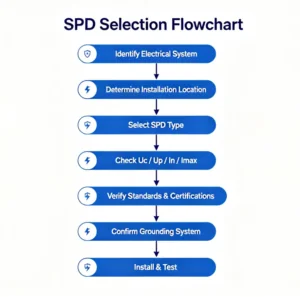
The first step is to identify the type of electrical system in which the SPD will be installed.
Different systems require different SPD configurations.
Typical power systems include:
The wiring configuration determines the number of poles required and the appropriate grounding arrangement.
For example, a three-phase TN-S system generally requires a four-pole SPD, while a TT system may require a different protection configuration to ensure proper coordination with residual current devices (RCDs).
The installation point has a significant influence on SPD selection.
Ask yourself:
General recommendations include:
| Telepítési hely | Recommended SPD |
| Building service entrance | Type 1 or Type 1+2 |
| Sub-distribution board | 2. típus |
| Equipment cabinet | 3. típus |
| Solar PV DC side | DC SPD |
| Ethernet network | Data line SPD |
3.Check the Maximum Continuous Operating Voltage (Uc)
One of the most overlooked parameters is the Maximum Continuous Operating Voltage (Uc).
Uc is the highest RMS voltage that the SPD can withstand continuously without operating.
If the Uc value is too low, the SPD may activate unnecessarily, reducing its lifespan.
If the Uc value is too high, the protection level may become inadequate.
For this reason, always select a Uc value appropriate for your system voltage.
Several current ratings are commonly specified for SPDs.
Nominal Discharge Current (In):
The Nominal Discharge Current (In) indicates the surge current that the SPD can repeatedly withstand under standardized testing conditions.
A higher In value generally means better long-term durability.
Maximum Discharge Current (Imax):
The Maximum Discharge Current (Imax) represents the highest surge current the SPD can survive during a single 8/20 μs impulse.
This parameter is especially important in areas with frequent thunderstorms.
Lightning Impulse Current (Iimp):
For Type 1 SPDs, Iimp specifies the maximum 10/350 μs lightning current that the device can safely discharge.
Buildings equipped with external lightning protection systems should always consider the Iimp rating during SPD selection.
Many buyers focus only on surge current ratings, but Voltage Protection Level (Up) is equally important.
Up represents the maximum voltage that may appear at the protected equipment while the SPD is operating.
A lower Up value means better protection.
However, the selected Up should also be compatible with the impulse withstand voltage of the connected equipment.
The objective is to ensure that the SPD limits transient voltages to a level safely below the insulation capability of downstream devices.
Choosing an SPD certified to recognized international standards provides greater confidence in its safety and performance.
Common standards include:
Depending on the project, additional certifications such as CE, TUV, CB, or RoHS may also be required.
The operating environment has a direct impact on SPD reliability.
Factors to evaluate include:
For outdoor installations, select SPDs with appropriate weather-resistant enclosures and ensure that all grounding connections are protected against corrosion.
In critical facilities, maintenance personnel may not inspect every distribution panel regularly.
For this reason, many modern SPDs include remote signaling contacts that can be connected to:
These features allow maintenance teams to identify failed SPDs quickly, reducing downtime and improving preventive maintenance.
Common Mistakes When Selecting an SPD
Even experienced engineers occasionally make mistakes during SPD selection.
Some of the most common errors include:
Selecting Only by Imax
A very high Imax rating does not necessarily provide better protection if the Voltage Protection Level (Up) is too high.
Ignoring Grounding Quality
An SPD can only perform effectively when connected to a properly designed grounding system.
Poor grounding may significantly reduce protection performance, regardless of the SPD’s specifications.
Using Only One Protection Stage
Installing a single SPD at the service entrance cannot protect every sensitive device throughout a large building.
Layered protection remains the preferred solution.
Ignoring Signal and Data Lines
Many surge events enter through communication cables rather than power cables.
Comprehensive protection should also consider:
Delaying Replacement
SPDs gradually age after repeated surge events.
Even if no visible damage is present, periodic inspection and timely replacement help maintain reliable protection.
Quick SPD Selection Checklist
Before purchasing a surge protective device, verify the following:
✅ Electrical system type identified
✅ Installation location confirmed
✅ Correct SPD type selected
✅ Uc matches system voltage
✅ Up suitable for connected equipment
✅ In and Imax meet project requirements
✅ Grounding system verified
✅ Certified to IEC or UL standards
✅ Remote monitoring required?
✅ Environmental conditions considered
Completing this checklist helps ensure that the selected SPD provides effective and long-lasting protection for the intended application.
Applications of Surge Protective Devices
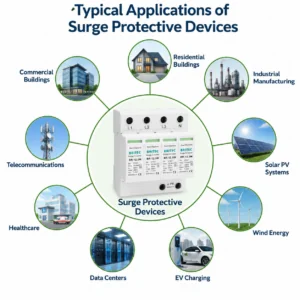
Electrical surges can occur in virtually any environment where electricity is generated, distributed, or consumed. As modern facilities become increasingly dependent on sensitive electronic equipment, surge protection has evolved from an optional safeguard into an essential part of electrical system design.
Different industries face different surge risks. Selecting the right surge protection solution requires understanding both the operating environment and the critical equipment involved.
The following sections explore some of the most common applications of Surge Protective Devices (SPDs).
Residential Buildings
Today’s homes contain far more electronic devices than ever before. Smart TVs, home automation systems, Wi-Fi routers, security cameras, heat pumps, induction cooktops, and EV chargers all rely on sensitive semiconductor components.
Although homeowners often associate power surges with lightning, most residential surges are caused by internal switching events, such as air conditioners, refrigerators, or large household appliances cycling on and off.
Installing a Type 2 SPD at the main distribution board helps reduce the risk of damage to expensive household electronics. In regions with high lightning density or homes equipped with external lightning protection systems, a coordinated Type 1 + Type 2 solution provides even greater protection.
Typical residential applications include:
Kereskedelmi épületek
Office buildings, shopping malls, hotels, schools, and hospitals rely on continuous operation of electrical and electronic systems.
Unexpected downtime can disrupt business operations, affect customer service, and increase maintenance costs.
Commercial facilities typically install SPDs at multiple levels of the electrical distribution system, including the main switchboard, floor distribution panels, and equipment cabinets.
Typical protected systems include:
Layered surge protection helps ensure uninterrupted operation and extends the service life of expensive building infrastructure.
Industrial Manufacturing
Manufacturing facilities often operate around the clock, making electrical reliability a top priority.
Industrial equipment such as PLCs, robotic production lines, variable frequency drives (VFDs), CNC machines, and automated packaging systems are particularly vulnerable to transient overvoltages.
In addition to external lightning activity, industrial environments generate numerous switching surges due to the frequent operation of motors, transformers, and heavy electrical loads.
Common industrial applications include:
Properly coordinated SPDs help reduce unexpected downtime, improve production efficiency, and lower maintenance costs.
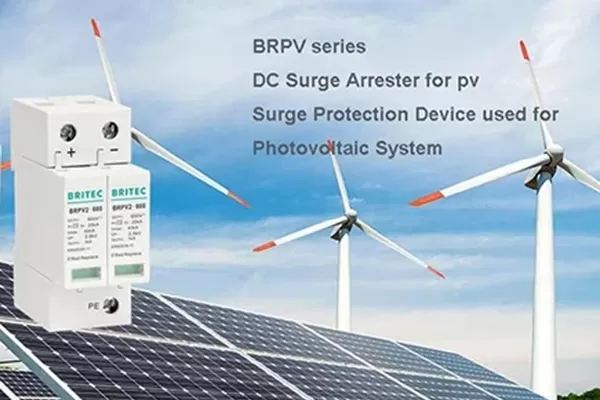
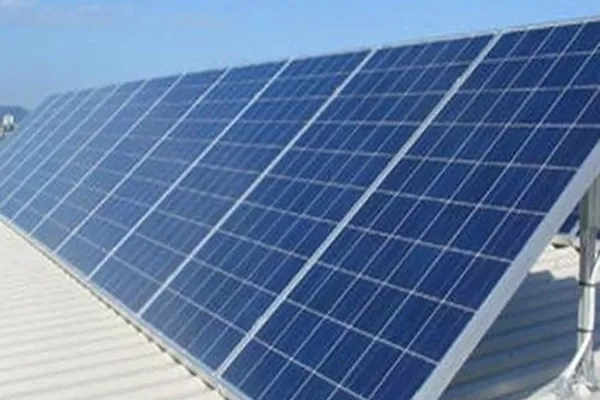
Solar Photovoltaic (PV) Systems
Solar power systems are especially exposed to surge events because of their outdoor installation and long cable runs.
Both the DC side and the AC side of a photovoltaic installation require appropriate surge protection.
Typical protection points include:
Because photovoltaic arrays are frequently installed on rooftops or in open fields, they are more susceptible to lightning-induced surges than many conventional electrical installations.
Selecting SPDs specifically designed for photovoltaic systems helps improve system reliability and reduces inverter failures.
Wind Energy Systems
Wind turbines operate in some of the most challenging electrical environments.
Their significant height, exposed location, and extensive cabling increase the likelihood of lightning-related surge events.
Critical protection areas include:
Reliable surge protection reduces maintenance visits and improves turbine availability, especially in remote wind farms.
Electric Vehicle (EV) Charging Infrastructure
The rapid expansion of electric vehicle charging networks has created new challenges for electrical protection.
EV chargers contain sophisticated power electronics that are highly sensitive to transient overvoltages.
Surge protection is commonly installed in:
For outdoor charging stations, coordinated AC power protection and communication line protection are equally important.
Adatközpontok
Data centers require one of the highest levels of electrical reliability.
Even a brief power disturbance can result in data corruption, service interruption, or significant financial losses.
Surge protection is typically integrated throughout the entire electrical infrastructure, including:
In addition to power line protection, Ethernet, fiber interface equipment, and communication systems should also be protected where appropriate.
Telecommunications Networks
Communication equipment often operates continuously and is frequently installed outdoors or on elevated structures.
Typical protected equipment includes:
Both power supply lines and signal lines should be considered when designing surge protection for telecommunications infrastructure.
Egészségügyi létesítmények
Hospitals depend on uninterrupted operation of critical medical equipment.
Devices such as MRI scanners, CT systems, patient monitoring equipment, and laboratory analyzers contain highly sensitive electronic components.
Unexpected equipment failure may affect patient care and increase operating costs.
Medical facilities typically use coordinated surge protection together with high-quality grounding systems to improve electrical safety and equipment reliability.
Typical SPD Applications by Industry
| Ipar | Typical Protected Equipment | Recommended SPD |
| Lakó | Distribution board, appliances | 2. típus |
| Kereskedelmi | Building electrical system | Type 2 / Type 1+2 |
| Solar PV | Combiner box, inverter | DC SPD + AC SPD |
| Wind Energy | Generator, converter | 1+2 típus |
| EV Charging | AC/DC charger | Type 2 / Type 1+2 |
| Telecommunications | Base station, network equipment | Power + Data Line SPD |
Why Every Industry Needs Surge Protection?
Although the source of surges may vary, the consequences are often the same:
By selecting the appropriate Surge Protective Device for each application, organizations can significantly improve system reliability, reduce unexpected failures, and protect valuable electrical assets.
Installation Best Practices for Surge Protective Devices
Selecting the correct Surge Protective Device is only the first step. Even the highest-quality SPD cannot provide effective protection if it is installed incorrectly.
Poor wiring practices, inadequate grounding, or improper coordination can significantly reduce the performance of an SPD, leaving sensitive equipment exposed to damaging transient overvoltages.
Following recognized installation best practices helps maximize protection while ensuring compliance with international electrical standards.
Install the SPD as Close as Possible to the Protected Equipment
One of the most important principles of surge protection is minimizing the distance between the SPD and the equipment or distribution point it protects.
Long conductor lengths increase inductive voltage drop during a surge event. Even a high-performance SPD may not be able to fully protect downstream equipment if the connecting cables are excessively long.
As a general recommendation:
Every additional centimeter of conductor can slightly increase the residual voltage seen by the protected equipment.
Ensure a High-Quality Grounding System
An SPD does not eliminate surge energy—it redirects it safely to earth. For this reason, the effectiveness of any surge protection system depends heavily on the quality of the grounding system.
A grounding system should provide a low-impedance path for transient currents.
Key recommendations include:
Without proper grounding, even a correctly selected SPD cannot perform as intended.
Minimize Wiring Length
The total length of the conductors connecting the SPD to the power supply and grounding system has a direct impact on protection performance.
International installation guides commonly recommend keeping the combined conductor length as short as practical—often less than 0.5 meters where feasible.
Shorter conductors reduce inductive effects and improve the SPD’s ability to clamp transient voltages effectively.
Select Appropriate Backup Protection
Many SPDs require coordination with upstream protective devices such as:
The recommended ratings should always follow the SPD manufacturer’s technical documentation.
Using oversized or undersized backup protection may affect both safety and performance.
Protect Both Power and Data Lines
Many modern facilities focus only on protecting the AC power supply while overlooking communication circuits.
However, transient overvoltages can also enter through:
A complete surge protection strategy considers all conductive paths entering sensitive equipment.
Inspect SPDs Regularly
Although modern SPDs are designed for long service life, they are not maintenance-free.
Routine inspections should include:
Preventive maintenance helps ensure continuous protection throughout the life of the electrical installation.
Common Installation Mistakes
Even experienced installers sometimes overlook important details.
The following mistakes can significantly reduce surge protection effectiveness.
Long Connection Leads:
Excessive cable length increases inductive voltage during surge events.
Always keep conductors as short as possible.
Poor Grounding:
Loose grounding terminals, corroded connections, or high earth resistance can severely reduce SPD performance.
Installing the Wrong SPD Type:
Using a Type 2 SPD where a Type 1 SPD is required may result in premature failure during a direct lightning event.
Always select the SPD type based on the installation environment and applicable standards.
Ignoring Data Line Protection:
Communication equipment often fails because only the power supply is protected.
Signal lines should receive appropriate surge protection whenever they enter or leave a building.
Incorrect Wiring Configuration:
Improper conductor routing, reversed connections, or failure to follow the manufacturer’s installation instructions may compromise the effectiveness of the entire surge protection system.
Installation Checklist
Before energizing the system, verify the following:
✅ Correct SPD type installed
✅ Appropriate operating voltage selected
✅ Proper grounding completed
✅ Connection leads kept as short as possible
✅ Backup fuse or circuit breaker correctly rated
✅ Status indicator shows normal operation
✅ Remote monitoring tested (if equipped)
✅ All power and signal lines evaluated for surge protection
Completing this checklist helps ensure that the surge protection system operates as intended and provides reliable long-term performance.
Expert Tip
A surge protective device should never be viewed as a standalone component. Its effectiveness depends on the quality of the overall electrical protection system, including grounding, bonding, cable routing, and coordination with upstream and downstream protective devices. Investing in proper installation often delivers greater long-term benefits than simply choosing a device with the highest surge current rating.
International Standards and Certifications for Surge Protective Devices
When selecting a Surge Protective Device (SPD), technical performance is only one part of the evaluation. Compliance with internationally recognized standards ensures that an SPD has been tested under defined conditions and meets established requirements for safety, performance, and reliability.
Whether you are designing a residential installation, an industrial facility, or a renewable energy project, choosing certified SPDs helps reduce risks and simplifies project approval.
Below are the most important standards and certifications commonly associated with surge protective devices.
IEC 61643-11
IEC 61643-11 is one of the most widely recognized international standards for low-voltage surge protective devices.
Published by the International Electrotechnical Commission (IEC), it specifies the performance requirements, testing procedures, classifications, and marking requirements for SPDs used in AC power systems.
The standard defines important technical parameters such as:
IEC 61643-11 also establishes standardized laboratory test methods, allowing engineers to compare products from different manufacturers under consistent conditions.
For many international projects, compliance with IEC 61643-11 is considered a basic requirement.
UL 1449
For the North American market, UL 1449 is the primary safety standard for surge protective devices.
Developed by Underwriters Laboratories (UL), this standard includes additional safety requirements related to:
UL 1449 introduces the concept of Voltage Protection Rating (VPR), which indicates the maximum voltage that may appear at the protected equipment during standardized testing.
Products intended for the United States and Canada are commonly certified according to UL 1449.
IEC vs. UL: Understanding the Difference
Although IEC 61643-11 and UL 1449 both address surge protection, they are designed for different markets and use different testing methods.
| Funkció | IEC 61643-11 | UL 1449 |
| Primary Market | Europe, Asia, Middle East, Africa | United States, Canada |
| Test Philosophy | Performance-based | Safety-focused |
| SPD Classification | Type 1, Type 2, Type 3 | Type 1, Type 2, Type 3, Type 4, Type 5 |
| Main Voltage Rating | Fel | VPR |
| Tipikus alkalmazások | International projects | North American installations |
For manufacturers serving global customers, offering products that comply with both IEC and UL requirements can significantly expand market opportunities.
CE Marking
For products sold within the European Economic Area (EEA), CE marking demonstrates that the product complies with applicable European legislation.
Although CE is not a performance certification by itself, it indicates conformity with relevant directives concerning:
Customers often expect CE-marked SPDs for projects in Europe.
CB Scheme
The IECEE CB Scheme simplifies international product certification by allowing test reports to be recognized across participating countries.
A CB Test Certificate can reduce the need for repeated testing when entering multiple international markets, making it valuable for manufacturers with global distribution networks.
TÜV Certification
Independent testing organizations such as TÜV are widely respected for evaluating electrical products.
A TÜV-certified SPD demonstrates that it has been independently tested for compliance with relevant technical standards.
Many engineering consultants and project owners view third-party certification as an additional indicator of product quality and reliability.
RoHS Compliance
Environmental regulations are becoming increasingly important worldwide.
The Restriction of Hazardous Substances (RoHS) Directive limits the use of certain hazardous materials in electrical and electronic equipment.
RoHS-compliant SPDs help manufacturers meet environmental requirements while supporting sustainable product design.
Why Certifications Matter?
Choosing a certified SPD provides several advantages:
For distributors and contractors, certified products also simplify procurement because many tenders and technical specifications explicitly require compliance with recognized international standards.
Understanding Key SPD Technical Parameters
In addition to certifications, engineers should understand the meaning of several important technical ratings found on an SPD datasheet.
Maximum Continuous Operating Voltage (Uc):
The highest RMS voltage that the SPD can withstand continuously without operating.
Feszültségvédelmi szint (fel):
The maximum voltage that remains after the SPD limits a surge.
Lower Up values generally provide better protection for sensitive equipment.
Nominal Discharge Current (In):
The surge current that the SPD can withstand repeatedly under standardized test conditions.
Maximum Discharge Current (Imax):
The highest single 8/20 μs surge current that the SPD can safely discharge.
Lightning Impulse Current (Iimp):
Used primarily for Type 1 SPDs, this rating represents the device’s capability to discharge high-energy lightning currents with a 10/350 μs waveform.
Temporary Overvoltage (TOV):
TOV performance indicates how well the SPD can withstand temporary increases in system voltage caused by faults or switching events without failing.
How to Read an SPD Datasheet?
When comparing different SPDs, avoid focusing on a single specification such as Imax.
Instead, evaluate the product as a whole by considering:
A balanced evaluation ensures the selected SPD meets both technical and operational requirements.
Expert Insight
An SPD should never be selected based on one specification alone. A product with an extremely high Imax rating but an unsuitable Uc or a high Up value may not provide the best protection for a specific application. Evaluating the complete set of technical parameters—together with compliance to recognized international standards—ensures a more reliable and effective surge protection solution.
At BRITEC, all surge protective devices are designed and manufactured in accordance with internationally recognized standards. Our product portfolio includes AC SPDs, DC SPDs, photovoltaic surge protection devices, signal line protectors, and customized surge protection solutions for industrial, commercial, and renewable energy applications. Every product undergoes rigorous quality control and performance testing to ensure reliable operation in demanding environments.
Maintenance and Service Life of Surge Protective Devices
Many users assume that once a Surge Protective Device (SPD) has been installed, it will continue protecting electrical equipment indefinitely. In reality, SPDs are designed to withstand a finite amount of surge energy throughout their operational life.
Each surge event—whether caused by lightning, switching operations, or transient faults—places a small amount of stress on the internal protective components. While a single minor surge may have little impact, repeated exposure gradually reduces the SPD’s protection capability.
Understanding how SPDs age and implementing a proper maintenance program are essential for ensuring long-term electrical protection.
Do Surge Protective Devices Wear Out?
Yes. Unlike circuit breakers, which primarily respond to overloads or short circuits, SPDs absorb or divert transient energy. Over time, repeated surge events gradually degrade components such as Metal Oxide Varistors (MOVs).
The aging process depends on several factors, including:
An SPD installed in a lightning-prone industrial facility may reach the end of its service life much sooner than one installed in a low-risk indoor office environment.
Signs That an SPD Should Be Replaced
Modern surge protective devices are designed with visual or remote indicators that simplify maintenance.
Typical signs include:
Red Status Indicator
Most SPDs use a simple color indicator.
If the indicator is red, the electrical circuit may still operate normally, but the surge protection function has been lost.
Remote Alarm Signal
Many industrial SPDs include a floating changeover contact for remote monitoring.
When the protection module reaches end-of-life, the contact changes state and sends an alarm to:
This allows facility managers to schedule replacement before the next major surge event occurs.
Physical Damage
An SPD should be inspected immediately if any of the following are observed:
Physical damage may indicate that the device has experienced a severe surge or has been exposed to unsuitable environmental conditions.
Recommended Inspection Schedule
Although inspection intervals vary by application, the following guidelines are commonly adopted.
| Installation Environment | Recommended Inspection |
| Residential Buildings | Every 12 months |
| Kereskedelmi épületek | Every 6–12 months |
| Ipari létesítmények | Every 6 months |
| Napelemes PV rendszerek | Every 6 months and after major storms |
| Wind Turbines | During scheduled maintenance visits |
| Adatközpontok | Quarterly inspection |
| Critical Infrastructure | Continuous remote monitoring |
Facilities located in regions with frequent lightning activity should perform additional inspections after severe thunderstorms.
Maintenance Best Practices
A preventive maintenance program should include:
Proper documentation also helps identify patterns, such as unusually frequent SPD replacements, which may indicate grounding issues or excessive surge exposure.
Can an SPD Be Repaired?
In most cases, the answer is no.
The internal protective elements of an SPD are factory-engineered and tested as an integrated safety device. Once these components have reached the end of their service life, attempting to repair or modify the unit may compromise both safety and performance.
Some modular SPDs are designed with replaceable plug-in protection modules. In these systems, only the protection module is replaced while the base remains installed, reducing maintenance time and minimizing system downtime.
Factors That Influence SPD Service Life
The lifespan of an SPD varies depending on several operating conditions.
Lightning Activity
Regions with frequent thunderstorms expose SPDs to more surge events, accelerating component aging.
Switching Operations
Industrial facilities with large motors, transformers, and variable frequency drives often experience numerous internally generated transient surges.
Grounding Quality
A well-designed grounding system reduces electrical stress on the SPD and improves its overall effectiveness.
Environmental Conditions
High temperatures, humidity, dust, vibration, and corrosive atmospheres can shorten the service life of electrical protection devices.
Selecting an SPD with an appropriate enclosure rating and environmental specifications helps improve long-term reliability.
Extending the Life of Your SPD
Although surge events cannot be prevented, several measures can maximize SPD service life.
Use Coordinated Protection
A properly coordinated Type 1, Type 2, and Type 3 protection strategy distributes surge energy across multiple devices instead of overloading a single SPD.
Ensure Proper Installation
Short connection leads, low-impedance grounding, and correct conductor routing all contribute to improved protection performance.
Select the Correct Ratings
Choosing an SPD with appropriate Uc, In, Imax, and Iimp values prevents unnecessary electrical stress during normal operation.
Perform Regular Maintenance
Routine inspections allow aging SPDs to be identified before protection is lost.
Preventive maintenance is significantly less expensive than replacing damaged electrical equipment after a surge event.
Life Cycle Cost of Surge Protection
Some project owners hesitate to invest in high-quality surge protection because of the initial purchase cost.
However, the lifetime cost of an SPD is typically insignificant compared with the potential losses caused by equipment damage, production downtime, or business interruption.
For example, replacing a failed PLC, industrial inverter, or server often costs many times more than installing a properly selected SPD.
Viewed from a lifecycle perspective, surge protection is not simply an electrical accessory—it is an investment in system reliability, operational continuity, and asset protection.
Common Surge Protection Mistakes to Avoid
Even the most advanced Surge Protective Device cannot provide effective protection if it is incorrectly selected, improperly installed, or poorly maintained.
Over years of electrical system design and field experience, several common mistakes continue to appear in residential, commercial, and industrial installations. Understanding these issues helps improve the overall effectiveness of any surge protection strategy.
Mistake 1: Installing the Wrong Type of SPD
One of the most common errors is selecting an SPD based solely on price or surge current rating rather than the actual application.
For example, installing a Type 2 SPD at the service entrance of a building equipped with an external lightning protection system may expose the device to lightning currents beyond its design capability. Conversely, installing only a Type 1 SPD without downstream protection may leave sensitive electronic equipment vulnerable to residual overvoltages.
Bevált gyakorlat:
Always determine the installation location and the expected surge environment before selecting the SPD type. In many commercial and industrial facilities, a coordinated combination of Type 1, Type 2, and Type 3 SPDs provides the most effective protection.
Mistake 2: Ignoring the Importance of Grounding
An SPD can only divert surge energy if there is a low-impedance path to earth.
Poor grounding is one of the leading causes of ineffective surge protection. High earth resistance, loose terminals, corroded connections, or inadequate bonding can all reduce the ability of an SPD to safely discharge transient energy.
Bevált gyakorlat:
Inspect the grounding system regularly, verify bonding connections, and ensure compliance with local electrical standards. A high-quality grounding system is just as important as the SPD itself.
Mistake 3: Using Long Connection Leads
Every centimeter of additional conductor introduces inductance. During a high-speed surge event, this inductance increases the voltage appearing across the protected equipment.
Installations with unnecessarily long or coiled connection leads may significantly reduce the effectiveness of even the highest-rated SPD.
Bevált gyakorlat:
Keep all conductors between the SPD, the power supply, and the grounding terminal as short and straight as possible.
Mistake 4: Protecting Only the Power Supply
Many electrical failures occur because transient surges enter through communication or signal cables rather than the AC power line.
Modern buildings often contain Ethernet networks, CCTV systems, RS485 communication buses, telephone lines, and monitoring cables that connect equipment located both inside and outside the building.
Bevált gyakorlat:
A complete surge protection strategy should include both power-line SPDs and data-line protection devices where required.
Mistake 5: Choosing the Highest Imax Instead of the Right SPD
A common misconception is that the SPD with the highest maximum discharge current is always the best choice.
In reality, selecting an SPD requires balancing multiple parameters, including:
An SPD with a very high Imax but an unsuitable Up value may provide less effective protection for sensitive electronic equipment.
Bevált gyakorlat:
Evaluate the complete technical specification rather than focusing on a single performance parameter.
Mistake 6: Forgetting Regular Inspection
Many SPDs continue to supply power even after the protection module has reached the end of its service life.
Without periodic inspection, facility managers may incorrectly assume that surge protection is still active.
Bevált gyakorlat:
Include SPD inspection in routine maintenance schedules and replace modules immediately when status indicators or remote alarms indicate end-of-life.
Mistake 7: Assuming One SPD Protects Everything
A single SPD installed at the main distribution board cannot fully protect equipment located throughout a large facility.
As surge energy travels through the electrical system, additional protection stages are often required closer to sensitive equipment.
Bevált gyakorlat:
Implement a coordinated, multi-stage protection concept that combines Type 1, Type 2, and Type 3 SPDs where appropriate.
Quick Checklist: Avoid These Common Mistakes
Before completing an installation, ask the following questions:
Answering “Yes” to each of these questions greatly improves the long-term effectiveness of the surge protection system.
Real-World Applications and Case Studies
Understanding the theory behind surge protection is important, but seeing how SPDs are applied in real-world situations provides even greater insight. The following examples illustrate how surge protection strategies can be adapted to different industries and operating environments.
Case Study 1: Industrial Manufacturing Plant
Challenge:
A metal processing factory experienced repeated failures of PLC controllers and variable frequency drives during thunderstorms. Although no direct lightning strikes occurred, nearby lightning activity and switching operations caused frequent transient overvoltages.
Each unexpected shutdown resulted in production delays, equipment diagnostics, and increased maintenance costs.
Solution:
A coordinated surge protection system was implemented, including:
Result:
Following installation, the facility reported a significant reduction in surge-related equipment failures. Maintenance interruptions decreased, and production continuity improved during storm seasons.
Case Study 2: Solar Photovoltaic Installation
Challenge:
A commercial rooftop PV system experienced repeated inverter failures after severe thunderstorms. Investigation showed that both the DC array cables and AC output circuits were exposed to lightning-induced surges.
Solution:
The protection strategy included:
Result:
The upgraded system operated through subsequent storm seasons without additional surge-related inverter damage, reducing maintenance costs and improving system availability.
Case Study 3: Data Center
Challenge:
A regional data center required uninterrupted operation of servers, network switches, and UPS systems. Even short-duration power disturbances posed a risk to customer services and business continuity.
Solution:
A layered surge protection approach was implemented:
Result:
The coordinated protection strategy enhanced electrical reliability and supported continuous operation of critical IT infrastructure.
Case Study 4: Hospital
Challenge:
A hospital planned to upgrade its electrical infrastructure to improve the protection of diagnostic imaging equipment, operating theatres, and intensive care units.
Medical equipment such as MRI scanners, patient monitoring systems, and laboratory analyzers required stable power with minimal risk of transient overvoltage.
Solution:
Engineers implemented:
Result:
The new surge protection strategy contributed to improved equipment reliability and reduced the likelihood of unplanned service interruptions.
Case Study 5: EV Charging Station
Challenge:
A public EV charging station located near a coastal highway experienced repeated communication faults following thunderstorms.
Solution:
The protection system included:
Result:
After implementing the upgraded protection system, charging availability improved and communication interruptions were significantly reduced.
Lessons Learned from These Applications
Although every installation is different, these examples highlight several common principles:
By applying these best practices, organizations across residential, commercial, industrial, and renewable energy sectors can reduce equipment damage, minimize downtime, and improve the overall resilience of their electrical systems.
Frequently Asked Questions (FAQ)
A Surge Protective Device (SPD) is an electrical protection device designed to protect electrical systems and connected equipment from transient overvoltages. It works by detecting excessive voltage and safely diverting surge current to the grounding system before it reaches sensitive electronics.
SPDs are commonly installed in residential buildings, commercial facilities, industrial plants, renewable energy systems, telecommunications networks, and data centers.
Power surges can originate from both external and internal sources.
Common external sources include:
Internal sources include:
In many buildings, internal switching events occur far more frequently than lightning-related surges.
Although the terms are often used interchangeably, “surge protector” usually refers to consumer products such as power strips, while “Surge Protective Device (SPD)” refers to professional equipment installed within electrical distribution systems.
Industrial SPDs are designed to withstand significantly higher surge currents and comply with international standards such as IEC 61643-11 or UL 1449.
The correct SPD depends on the installation location and the level of protection required.
Many installations use a coordinated combination of all three types.
There is no fixed service life.
The lifespan of an SPD depends on:
Some SPDs remain in service for many years, while others installed in high-risk environments may require earlier replacement.
Regular inspection is recommended.
No. An SPD does not stop or attract lightning.
Instead, it limits the electrical overvoltage caused by lightning and safely diverts surge current to the grounding system.
Direct lightning protection requires a complete Lightning Protection System (LPS), including air terminals, down conductors, and grounding electrodes.
SPDs work together with the LPS to provide comprehensive protection.
Modern buildings rely heavily on sensitive electronics, making surge protection beneficial in most applications.
Surge protection is particularly important for:
In most cases, no.
Large electrical installations benefit from coordinated surge protection using multiple SPDs installed at different points throughout the electrical distribution system.
This layered approach reduces surge energy progressively and provides better protection for sensitive equipment.
AC SPDs protect alternating current electrical systems commonly found in buildings and industrial facilities.
DC SPDs are specifically designed for direct current applications such as:
Because AC and DC systems have different electrical characteristics, dedicated SPDs should always be used for each application.
Yes. Although SPDs cannot prevent every type of electrical fault, they significantly reduce damage caused by transient overvoltages.
Reducing repeated electrical stress helps extend the service life of sensitive electronic components and lowers maintenance costs.
Inspection frequency depends on the application.
A general guideline is:
Additional inspections should always be performed after severe lightning events.
Yes. An SPD may reach the end of its protective life while the electrical circuit continues operating normally.
This is why visual status indicators and remote signaling contacts are important. They allow maintenance personnel to identify and replace a failed SPD before the next surge event occurs.
Absolutely. An SPD diverts surge current to earth. Without a properly designed and maintained grounding system, the SPD cannot effectively limit transient overvoltages.
Grounding quality is one of the most important factors affecting surge protection performance.
Requirements vary by country and project type.
Many national electrical codes now recommend or require SPDs in applications such as:
Always consult the applicable local regulations and project specifications.
Selecting the correct SPD requires consideration of several factors, including:
A professional risk assessment is recommended for complex or high-value installations.
Következtetés
Electrical systems have become increasingly sophisticated, and with that sophistication comes greater sensitivity to transient overvoltages. Whether caused by lightning strikes, utility switching, or internal electrical operations, surges pose a constant threat to valuable equipment and uninterrupted operations.
A well-designed surge protection strategy is not simply about installing a single device. It involves selecting the appropriate SPD type, ensuring proper installation, maintaining an effective grounding system, and coordinating protection at multiple levels throughout the electrical network.
By understanding how Surge Protective Devices work, recognizing the differences between Type 1, Type 2, and Type 3 SPDs, following best installation practices, and performing regular maintenance, engineers and facility managers can significantly reduce equipment failures, minimize downtime, and extend the lifespan of critical electrical systems.
As industries continue to embrace digitalization, automation, renewable energy, and smart infrastructure, the importance of reliable surge protection will only continue to grow.
Investing in high-quality Surge Protective Devices today helps safeguard the performance, safety, and reliability of electrical systems for years to come.